

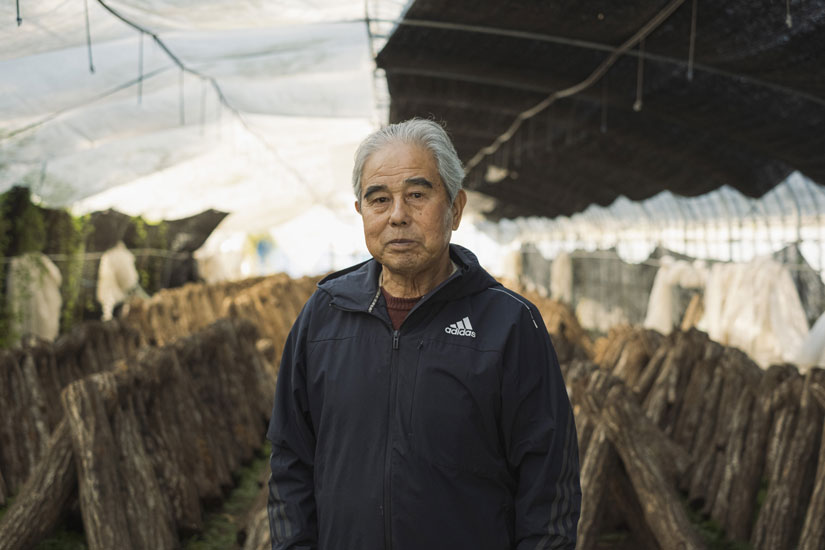
Yamada Town is located roughly in the center of Iwate Prefecture’s coastline. Because it faces the Pacific Ocean, it is strongly associated with fishing, but the town is also known for its log-grown shiitake mushrooms, and almost every year, farmers from the town have won the Minister of Agriculture, Forestry and Fisheries Award at national competitions. Eizo Haga, one of only a handful of renowned experts in this field nationwide, is considered a pioneer in the cultivation of log-grown shiitake mushrooms in Yamada Town.
A cool climate and lush mountains nurture log-grown shiitake mushrooms
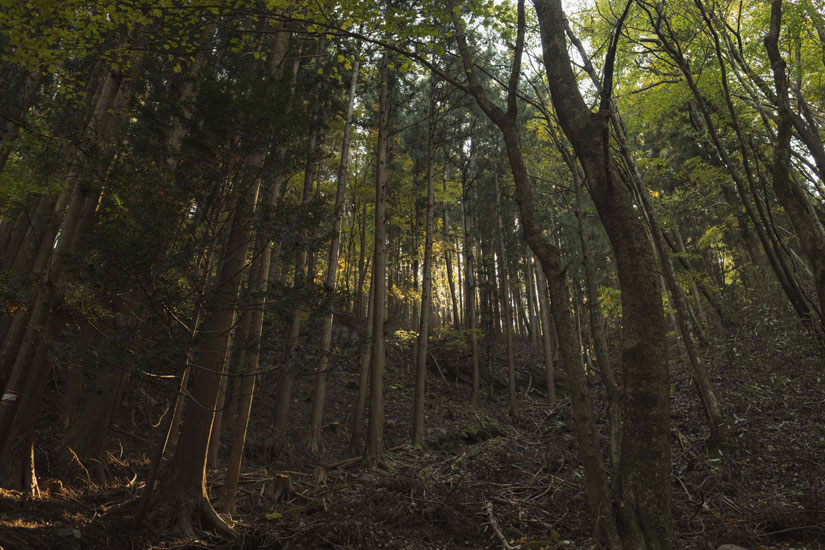
Yamada Town, located in Shimohei District, Iwate Prefecture, is a town embraced by nature, with the Pacific Ocean to the east and the Kitakami Mountains stretching to the west. Because the mountains are rich in broadleaf trees such as beech, oak, and red pine, the area is ideal for growing shiitake mushrooms on logs, and shiitake cultivation is thriving here. Since log-grown shiitake mushrooms prefer locations that are sheltered from direct sunlight, well-ventilated, and have moderate humidity, the mountainous forest environment—where vegetation provides shade, the cool climate at higher elevations, and the moisture released by trees’ respiration help maintain optimal conditions—is ideal.
Incidentally, shiitake mushrooms are classified as “log-grown shiitake” or “substrate-grown shiitake” depending on the cultivation method, and most fresh shiitake mushrooms sold in supermarkets are substrate-grown. The reason for this is that substrate-grown shiitake are cultivated by artificially adding nutrients to blocks of compressed sawdust, allowing them to be harvested in 3 to 6 months—a growth rate nearly four times faster than that of log-grown shiitake. Furthermore, as long as the necessary facilities are in place, they can be grown anywhere and are not affected by the climate, resulting in stable production volumes.
On the other hand, log-grown shiitake mushrooms are cultivated by inoculating natural logs with spawn, so they rely solely on the nutrients from the wood and take time to grow. While it is possible to cultivate them indoors as long as you have the logs for inoculation, log-grown shiitake mushrooms that have been carefully cultivated in a natural environment with optimal conditions are said to have a particularly rich flavor and thicker caps.
In Yamada Town, these log-grown shiitake mushrooms are often dried and processed into dried shiitake mushrooms (hoshishitake). Among dried shiitake mushrooms, those with large, well-shaped caps are highly prized as gifts and high-end ingredients.
Dried shiitake mushrooms from Yamada Town—a premium ingredient
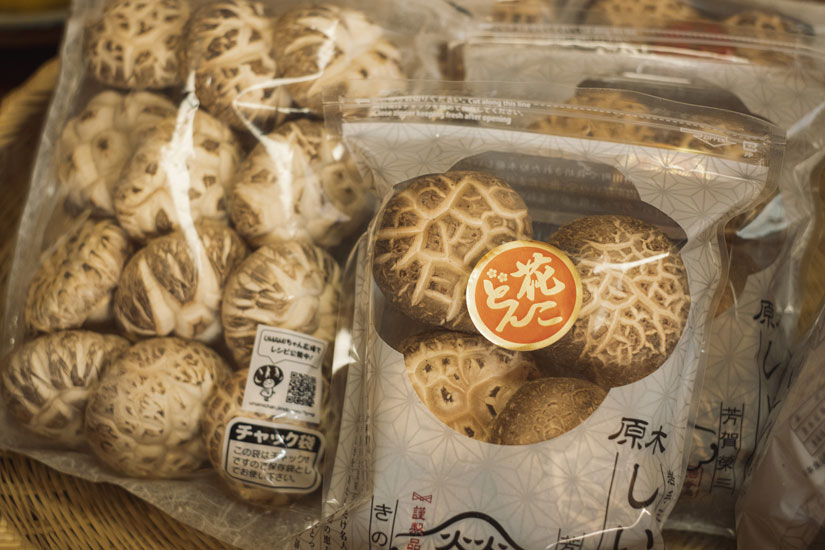
Dried shiitake mushrooms have several names. “Hana-donko” refers to mushrooms with white, flower-like cracks on the surface of the cap; due to their beautiful appearance, they are often used as gifts. “Kōshin” refers to mushrooms with caps that are more open than those of standard donko and have gills; because they produce a rich broth, they are highly valued in simmered dishes and the like. The Zen-Noh Dried Shiitake Mushroom Competition features categories such as “Kōshin (medium-leaf, thick-fleshed),” “Hana-donko,” and “Donko,” with entries judged based on color, shape, and size.
Dried shiitake mushrooms that win awards at these competitions are used as premium ingredients in hotels and traditional Japanese restaurants. Yamada Town’s dried shiitake mushrooms, prized for both their appearance and flavor, are in high demand among chefs and sushi masters.
As a master of log-grown shiitake mushrooms
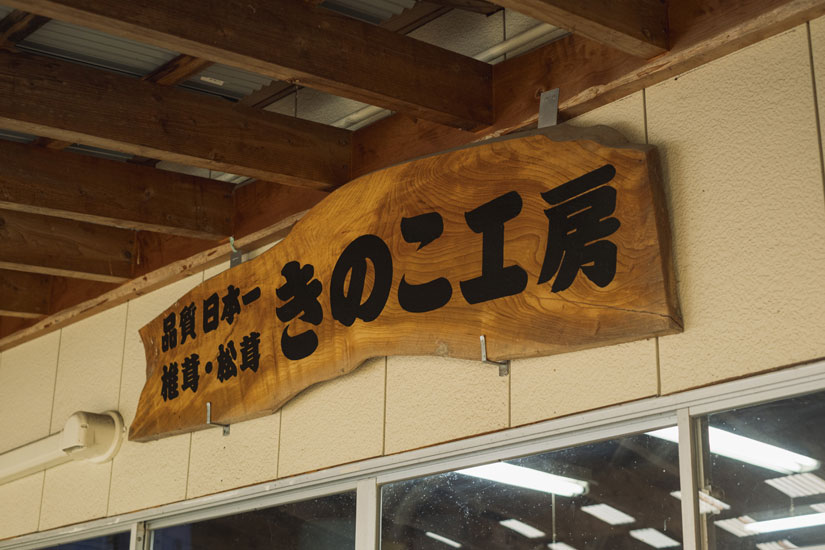
Eizo Haga, a master of log-grown shiitake mushrooms, has established a mushroom workshop in the Toyamane district—located inland within Yamada Town—where he cultivates log-grown shiitake mushrooms. In the fall, he heads into the mountains to forage for matsutake mushrooms as well. The matsutake mushrooms gathered by Mr. Haga, who knows the mountains well, are renowned for their high quality, and he is known among locals as the “Mushroom Master.”
Mr. Haga began cultivating log-grown shiitake mushrooms in 1983, when he was about 38 years old. He won his first Minister of Agriculture, Forestry and Fisheries Award at a national competition when he was 49. Since then, he has won the Minister of Agriculture, Forestry and Fisheries Award five times in the “Hanadonko” category. Having become a regular recipient of the highest honors, Mr. Haga was awarded the title of “Master.” Since then, he has continued to enter competitions in various categories and has accumulated numerous awards.
Cultivating log-grown shiitake mushrooms using the abundant oak trees in Yamada Town
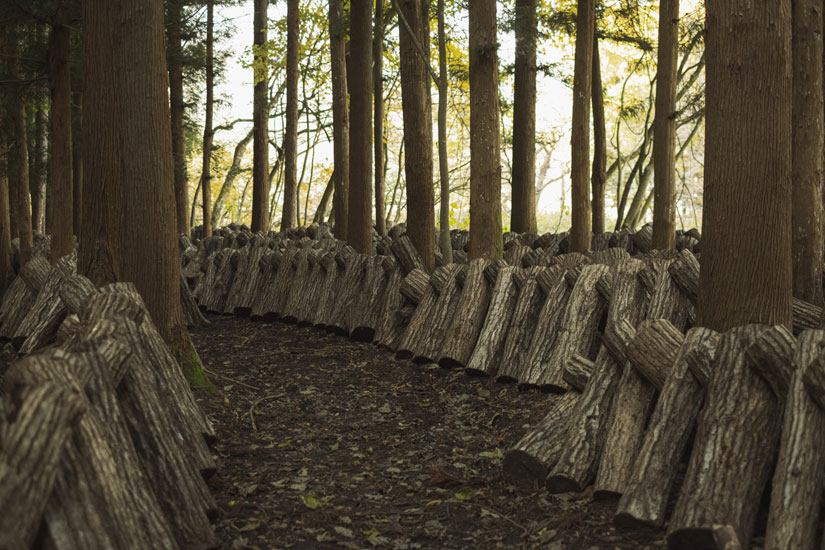
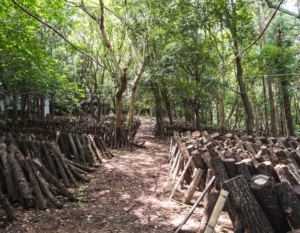
Mr. Haga’s log-grown shiitake mushrooms are cultivated both outdoors and in greenhouses. The logs used to inoculate the shiitake spores are made from Japanese oak. Broadleaf trees, not conifers, are best suited for these logs. While oak is commonly used in other prefectures, there are no oak trees growing in the forests of Yamada Town; however, since Japanese oak is abundant there, that is the wood used. Japanese oak also has a characteristic bark with cracks, making it easier to inoculate with shiitake spawn. Mr. Haga says, “Some places cultivate shiitake using other broadleaf trees, but even after trying them, shiitake grown on Japanese oak still tastes the best.” Since shiitake mushrooms grow best in cool, moderately humid environments, it is preferable for the logs to be shielded from direct sunlight. Therefore, even though it is called “open-field cultivation,” the mushrooms are actually grown in mountain forests shaded by tall trees. The size of the shiitake mushrooms is said to be proportional to the size of the logs. In other words, the thicker and sturdier the log, the larger the shiitake mushrooms will grow.
A Leading Force in Log Cultivation in Yamada Town
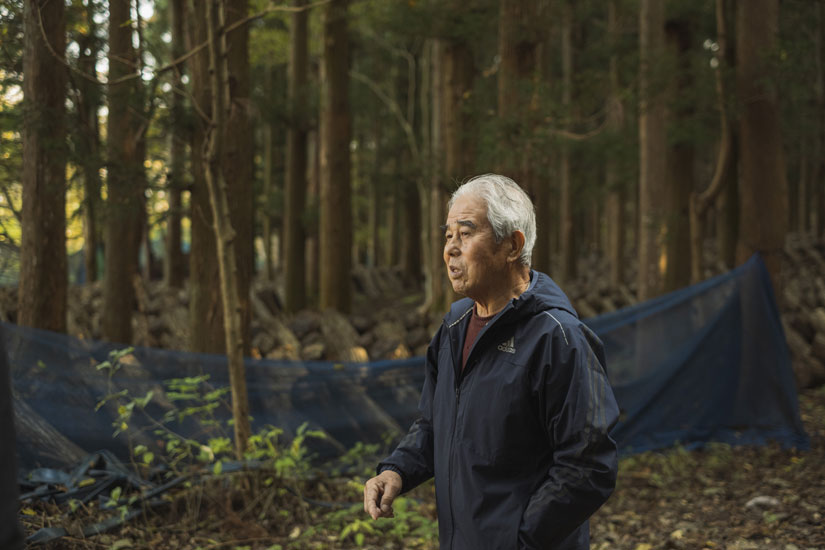
The year 1983, when Mr. Haga began cultivating log-grown shiitake mushrooms, coincided with the time when Yamada Town was just beginning to focus its efforts on shiitake cultivation. Many others also began growing log-grown shiitake mushrooms around the same time. However, once the Heisei era began, inexpensive Chinese shiitake mushrooms flooded the market, causing market prices to plummet. There was a period when Yamada Town’s log-grown shiitake industry also faced difficult times. It is said that some growers even went out of business during that period. Even amid these challenges, Mr. Haga continued to actively enter his mushrooms in competitions across the country.
Reflecting on the Future of Log-Grown Shiitake Mushrooms
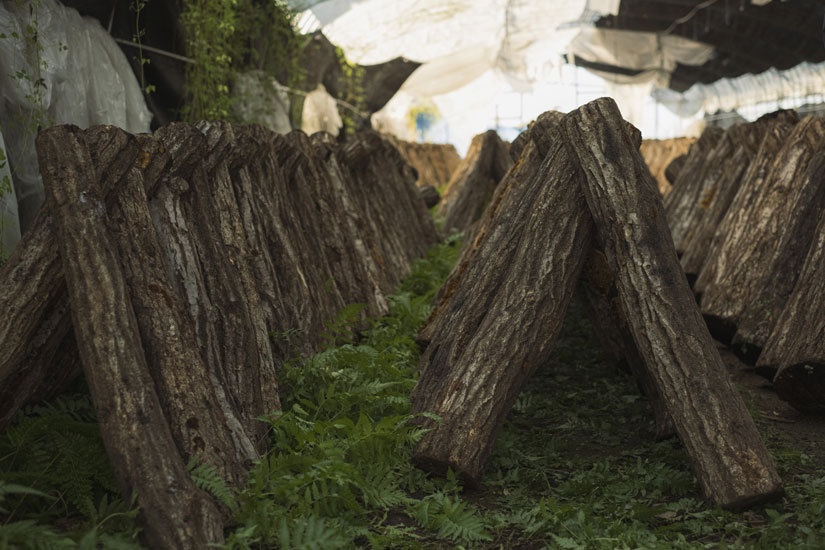
Even at over 80 years old, Mr. Haga continues to energetically cultivate log-grown shiitake mushrooms. “Log-grown shiitake mushrooms have a better texture and more umami than those grown on sawdust beds,” he says, explaining his commitment to log-grown shiitake.
He explains that to win awards at competitions, he enters shiitake mushrooms with caps that are as uniform as possible in size, color, and shape. To grow a large number of mushrooms of the same size, the logs must also be uniform in size. The logs have a diameter of about 18 cm. Because they are quite heavy, managing them is hard work for the elderly Mr. Haga.
“If you keep them inside the greenhouse for too long, they’ll suffer from heat stress. By July, it gets hot inside the greenhouse. When that happens, we move the logs back to the mountains. Rather than spraying them with pesticides, returning them to the mountains provides better ventilation and is better for them,” said Mr. Haga. November. Although no shiitake mushrooms had yet sprouted on the logs in the greenhouse, he said they would be ready for harvest around April. Because they are cultivated using logs that have not been treated with pesticides, log-grown shiitake mushrooms are safe and reliable.
I will continue to grow shiitake mushrooms on logs for as long as I live.
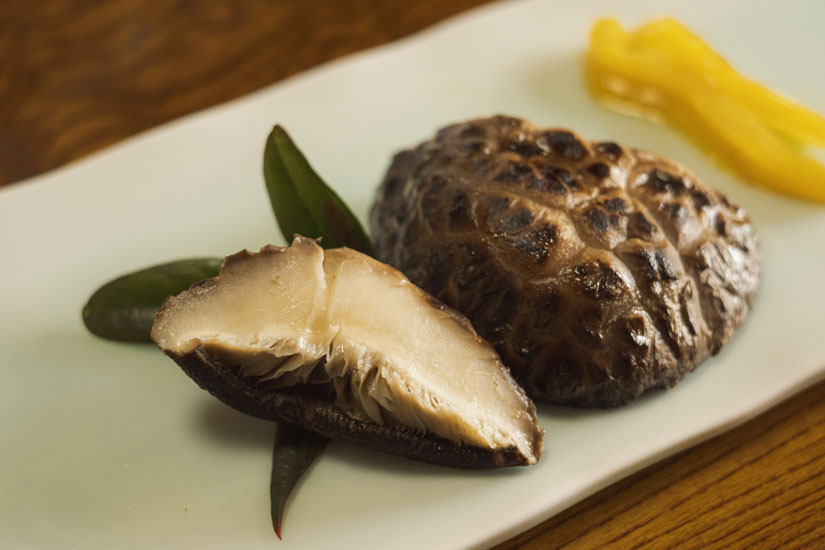
Mr. Haga has been at the forefront of shiitake cultivation on logs in Yamada Town ever since it first took off. Even as other producers his age have stopped farming, he continues to lead the way in shiitake cultivation. “My biggest challenge is my own physical stamina,” he says. “I work every year thinking this might be my last batch of shiitake.” Yet even under these circumstances, Mr. Haga continues to achieve outstanding results at competitions. “I suppose it’s the result of many years of experience. If you visit the farm every day, the weather tells you what to do. When the humidity rises, the caps split open, revealing distinct white cracks, and the shiitake mushrooms turn out beautifully. When the humidity is too low, I water them. I have to say, I’m doing a pretty good job. I also need to train the next generation. I want to keep doing my best as long as I live,” says Mr. Haga. His expression radiated the pride of a master craftsman.