

Kochi Prefecture is said to be the birthplace of “fruit tomatoes”—tomatoes with a high sugar content—and high-value-added, high-sugar-content tomatoes are produced and sold throughout the prefecture. In Konan City, which boasts the third-highest production volume in the prefecture, Majima Farm has successfully established a brand of “fruit tomatoes” called “Ushi no Megumi.” Mashima Farm is located near National Route 55, which runs through the eastern part of Kochi Prefecture, about 10 minutes from Kochi Ryoma Airport. It is a family-run dairy and vegetable farm where barns and plastic greenhouses stand between residential homes and fields. The farm produces milk, turns cow manure into “concentrated compost” for sale, and has been working to grow flavorful “fruit tomatoes” using that compost. Furthermore, using the same compost, the farm cultivates green papayas on abandoned farmland and grows pasture grass for animal feed, thereby practicing a sustainable, circular system of crop-livestock integration.
Building a cycle between dairy farming and agriculture, and dedicating our efforts to passing it on
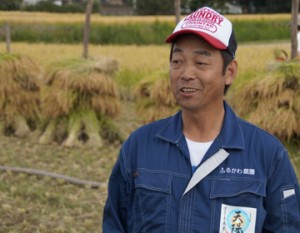
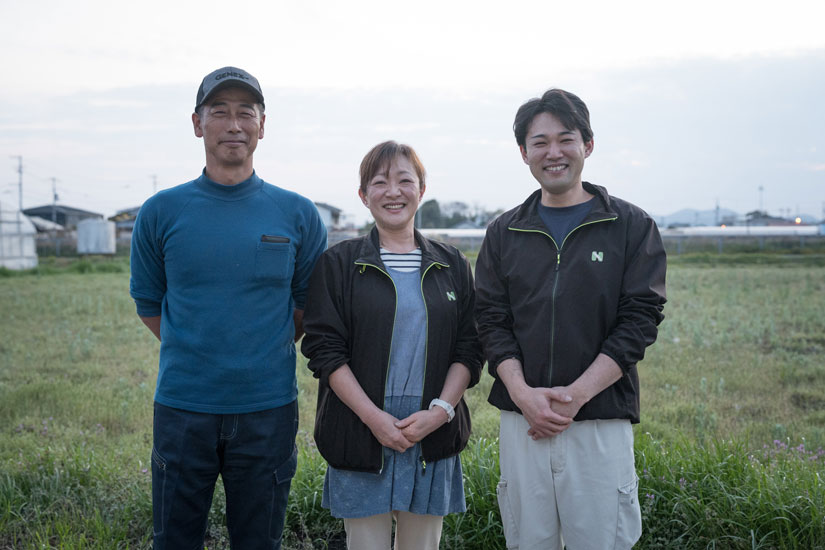
Junichi Mashima, the farm’s owner, says, “Our family has been in the dairy farming business for about 60 years, ever since my father’s generation.” Twenty-six years ago, when his mother was hospitalized, Mr. Mashima moved back to the area from out of state with his wife and son to take over the family business.
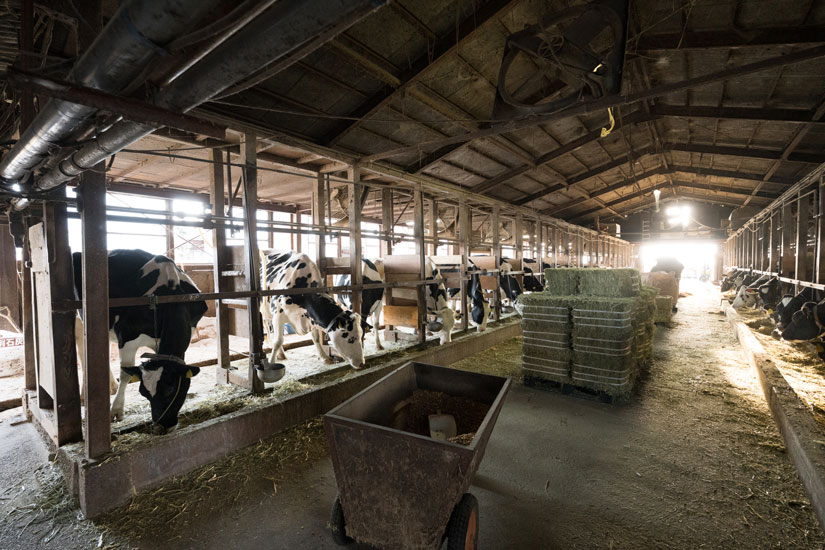
They raise Holsteins, a breed specialized for milk production, and currently care for 35 head. However, the environment surrounding dairy farming is challenging, due to soaring feed prices and a decline in milk consumption in school lunches caused by the falling birthrate. “Dairy farming is becoming increasingly difficult for family-run operations, and there is a trend toward large-scale operations—such as ‘mega-farms’ and ‘giga-farms’—as well as increased use of IT,” says Mr. Mashima.
Amid these challenges, the Mashima family continues to find ways to create a circular system between dairy farming and crop farming while reducing costs—for example, by switching to self-produced feed. Today, Mr. Mashima primarily handles the dairy operations, while his wife, Mika—who holds a certification as a vegetable sommelier—is in charge of tomato cultivation, and their son, Sho, works alongside them as the couple’s successor.
Making “Dried Cow Manure Compost” (Highly Concentrated Type)
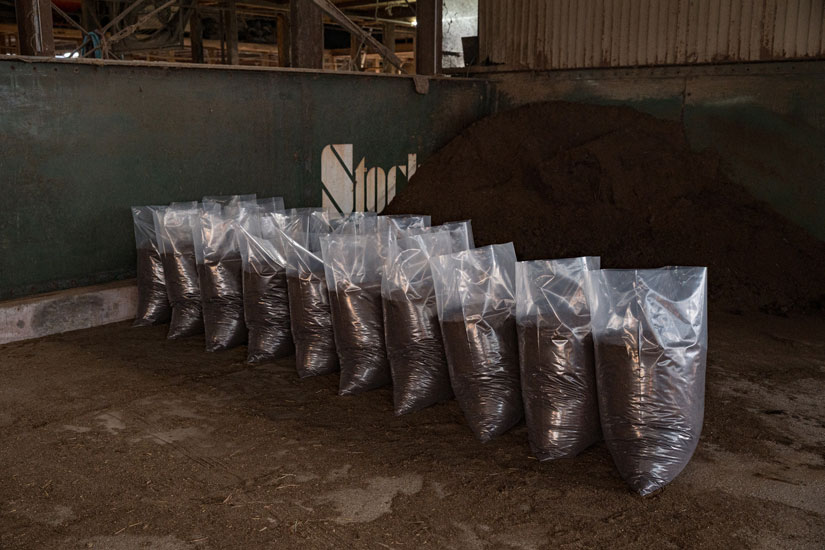
Since taking over the dairy farm from his father, Mr. Mashima has reportedly gone through a process of trial and error to find ways to make effective use of manure and urine, which are byproducts of dairy farming.
He wondered how he could take the composting efforts his father had started and develop them into a marketable product. He researched various methods, including reading books, and devised a unique technique: using a drying machine to reduce the moisture content of the manure and urine to less than 10 percent, then reusing the dried compost as a moisture-regulating agent.
“By mixing in the dried compost once it’s ready, we can adjust the moisture content and produce more high-quality compost. By repeating this process, we’re able to consistently produce high-quality compost without adding materials like sawdust.”
At the same time, with an eye toward sales, my father began growing ‘fruit tomatoes’ around the year 2000 to verify the effectiveness of the compost. He learned cultivation techniques from a relative who ran a tomato farm, and two years later, my husband and I took over the know-how. As a family, we conducted repeated trials, including optimizing the amount of compost applied.
“Once people started saying our tomatoes were delicious and they began selling well, the high quality of our compost was proven, and we were able to start selling the compost as well—but it took about five or six years to really get the business on track,”
It’s not uncommon for dairy farmers to produce compost. Generally, compost with a moisture content of 60% or higher is made by mixing manure and urine with rice husks or sawdust and allowing it to ferment. However, cases like Majima Farm’s—where dried manure is used to adjust moisture levels—are extremely rare.
Mashima Farm’s “dried cow manure compost”—an ultra-concentrated type consisting of 99.9% cow manure—is lightweight, easy to handle, and of high quality as a fertilizer. As word has spread, orders from farmers have increased, and they reportedly can’t keep up with production demand.
“We’re proud that even a small amount is highly effective as a fertilizer for crops,” says Mr. Mashima.
Start with large tomatoes and gradually cultivate them into high-sugar “fruit tomatoes.”
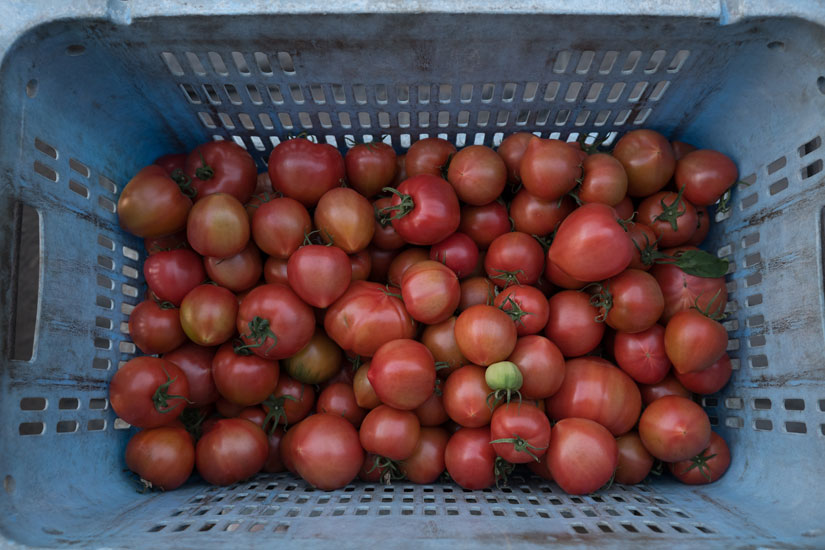
To begin with, “fruit tomato” is not the name of a specific variety. Regardless of variety or size, any tomato with a sugar content of 8 or higher is called a “fruit tomato.” Small “cherry tomatoes” are often confused with fruit tomatoes, but “cherry tomatoes” is simply a general term for small tomatoes classified by shape. Unless they exceed the specified sugar content, they cannot be shipped as fruit tomatoes. Therefore, cultivation methods designed to increase sugar content are crucial. Generally, it is said that selecting smaller tomato varieties and growing them with restricted water intake makes it easier to increase sugar content, but Majima Farm has established its own unique cultivation method.
At Majima Farm, they use the large-fruited variety “Momotaro Fight.” They selected this variety after testing various types based on criteria such as flavor, tenderness, and skin firmness. They say the texture of the skin makes it enjoyable even for older people to eat.
“We’re still experimenting, but over the past few years, I think this variety has been the best fit for our cultivation methods,” says Mika.
The Mashima School takes more time than anywhere else
What sets them apart most is their philosophy of taking their time to grow healthy plants and then “slowly developing them to achieve high sugar content.” Because they take longer to grow their tomatoes than other farms, they sometimes receive inquiries from customers asking, “Other fruit tomatoes are already on store shelves—when will your tomatoes be shipped?”
While many farmers use “isolated cultivation”—which restricts root spread and strictly controls watering—to quickly increase sugar content and produce “fruit tomatoes,” Majima Farm does not restrict root spread. Instead, they take the time to grow healthy plants with strong root systems. Water restriction is also implemented gradually. Their commitment lies in the fact that they deliberately choose not to treat the plants as “fruit tomatoes” from the very beginning.
“To begin with, there are no seeds specifically for ‘fruit tomatoes’; we take large-fruit tomato varieties and cultivate them using methods that transform them into fruit tomatoes. In our case, we don’t use grafting; instead, we grow the plants so that the stems become thick and the roots spread widely. Furthermore, to ensure the effects of the compost last as long as possible, we apply a slightly larger amount of compost at the start. As a result, the plants initially produce large fruits. From there, we gradually restrict water to increase the sugar content. As a result, the tomatoes do end up smaller, but we produce tomatoes that are larger than average and have a high sugar content.
“I don’t find tomatoes appealing if they’re just sweet,” says Mr. Mashima. “I want them to have a tomato-like sweetness that comes from a balanced blend of sweetness and acidity, and I place great importance on the unique umami flavor derived from our homemade cow manure compost.”
トマトの目利きは、妻と息子
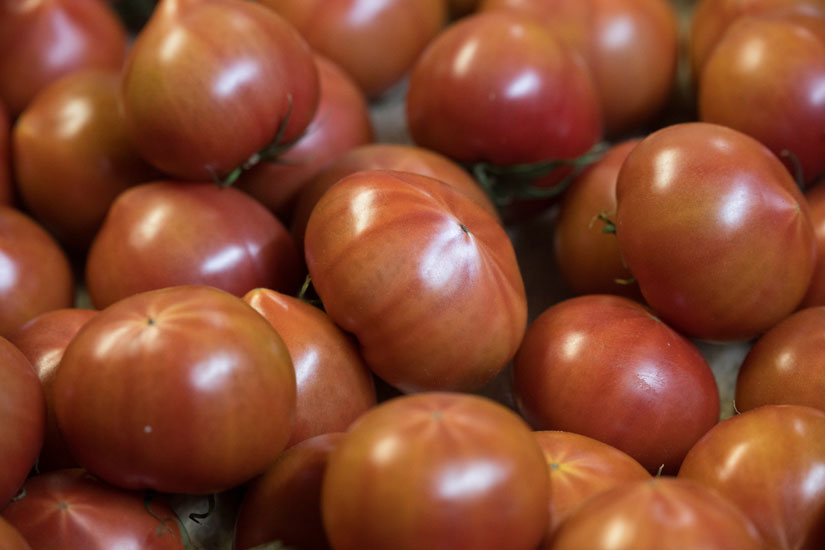
The sugar content is largely determined by the time the fruit begins to change color; as ripening progresses from there, the acidity transforms into umami, and the sweetness becomes more pronounced, resulting in subtle changes in flavor.
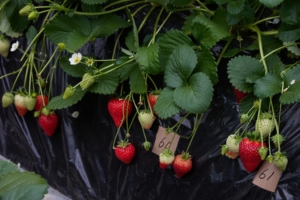
“As the sugar content rises, the flesh inside the tomato becomes translucent. Another indicator of high sugar content is a dark green line called ‘base green’ that appears at the stem end of a green tomato. The ‘star mark’ has become well-known, but we also use that as a guide while tasting the tomatoes daily to check their condition. When it comes to judging quality, my wife and son are simply in a league of their own,” says Mr. Mashima. His wife, Mika, continues:
“We divide up the task of assessing the tomatoes among the family. I do think we need to train the next generation, and if we were looking for uniformity, we could just use a sugar content sensor instead of relying on people. But we want to respond directly to the varying preferences of our customers. After all, we’re selling and interacting with customers face-to-face, so this is something we really want to cherish.”
As expected of Kochi Prefecture, known as a production area for “fruit tomatoes,” there is a lot of competition. Amidst this, Majima Farm meets customer requests with meticulous attention to detail.
A unique “diagonal training” method and the handcrafted work that supports 5,500 vines
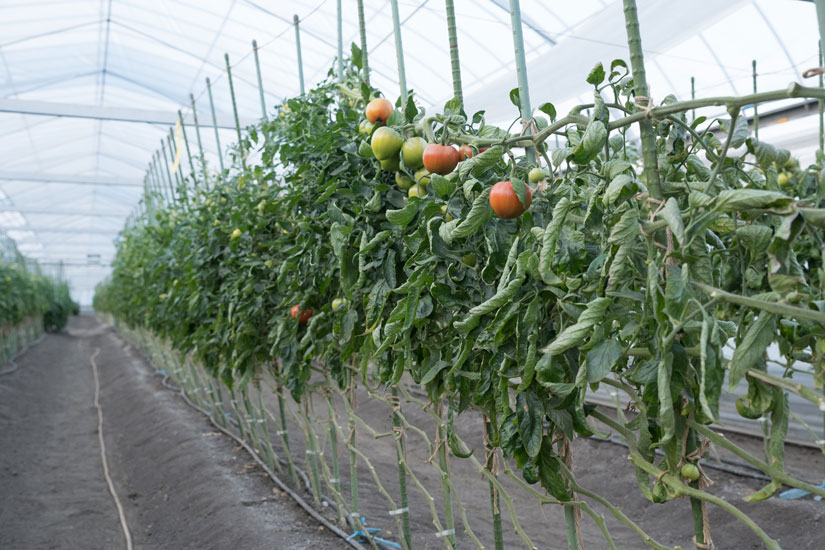
Upon entering the tomato field, the first thing that catches the eye is an unusual cultivation method called “diagonal trellising.” This involves training the plants to grow diagonally while allowing the roots to spread freely. “We tried the hanging method, but we gave it up because the harvesting posture was too strenuous,” says Mr. Mashima.
With diagonal training, the harvest height rises as the plants grow, making the work easier. However, it requires an enormous amount of labor. All 5,500 plants must be tied with string, side shoots removed, and tended to daily. During peak season, the family alone isn’t enough to handle the workload, so they enlist help. This was the method he was first taught. Since then, for over 20 years, Mr. Mashima has spared no effort in continuing this tradition of diagonal training.
Furthermore, they have managed the temperature and humidity in the greenhouse not through computer control, but through experience and intuition honed over the years. True to its reputation as the “tropical region” of Kochi, it remains warm even in winter, with daytime temperatures ranging from 12 to 16°C. Moreover, while climate change has led to days when the temperature inside the greenhouse reaches 30°C, “We manage it with our own eyes and senses,” says Mika. Their refusal to cut corners and the experience they’ve accumulated over the years make all the difference.
Pest control involves “environmentally friendly agriculture,” which reduces the use of pesticides and utilizes natural predators.
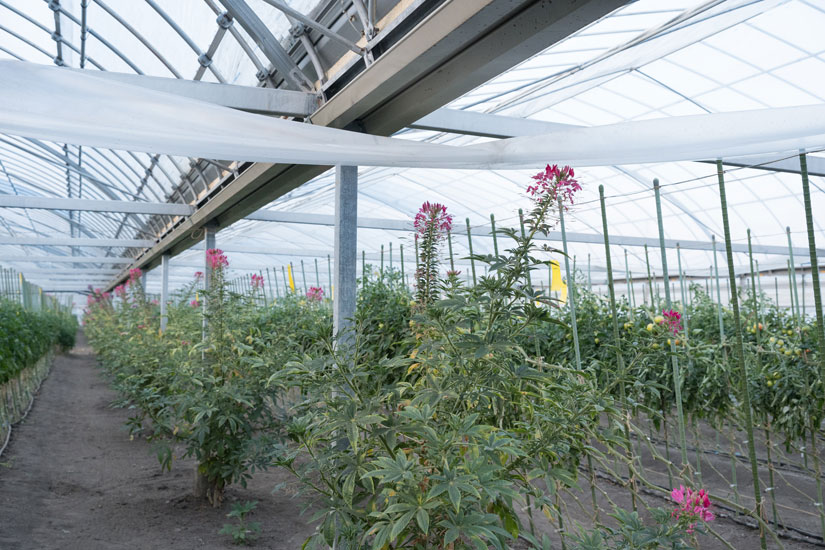
Furthermore, to control whiteflies—which damage tomato crops—they grew sesame alongside the tomato seedlings and collected seeds for the natural predator, the tobacco green stink bug. They planted cleome, the tobacco green stink bug’s host plant, to allow it to reproduce naturally and suppress pest outbreaks. They also practiced “environmentally friendly agriculture” aimed at reducing pesticide use. Kochi Prefecture stands out nationwide for its high level of awareness and active practice of this “environmentally friendly agriculture.” Led by the JA (Agricultural Cooperative), the region is promoting cultivation methods that do not rely on pesticides.
The “Ushi no Megumi” network, which spread through word of mouth among fellow vegetable sommeliers
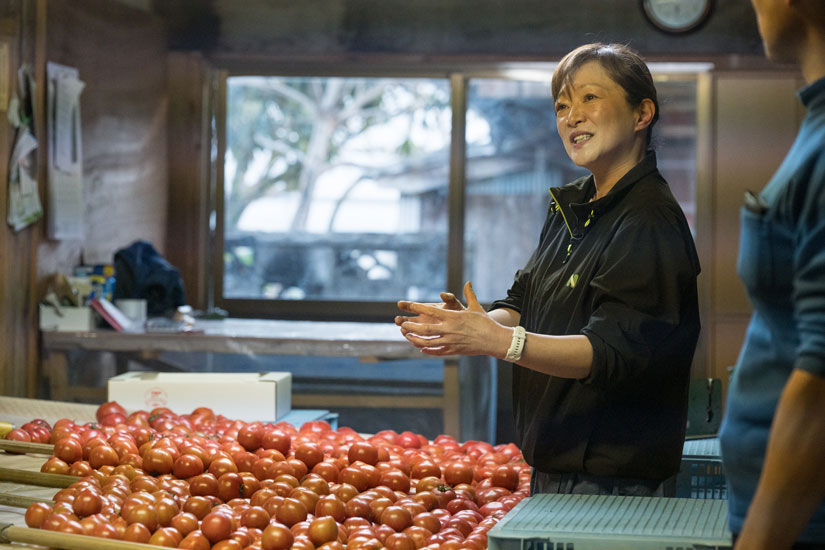
The catalyst for expanding their sales channels was when Mika, the owner’s wife, earned her vegetable sommelier certification. A few years after moving to the area with her husband, Mika commuted from Kochi to Kagawa every weekend with five friends to earn her certification. The fellow vegetable sommeliers she met afterward—both within and outside the prefecture—showed their support by connecting them with restaurants and department stores and sharing their story on social media. Word of mouth spread in this way, and orders from outside the prefecture began to increase.
“Our customers bring in more customers,” they say.
For a family-run business with no time to go out and promote themselves, this has been a tremendous help.
Their greenhouse covers 25 ares. Although people ask, “Why not expand further?” they deliberately choose not to in order to maintain quality.
“25 ares is the limit we can manage properly between the two of us,” the couple explains.
Taste over scale. Their top priority is making their current customers happy. That commitment continues to grow their fan base.
Caring for cows leads to delicious milk
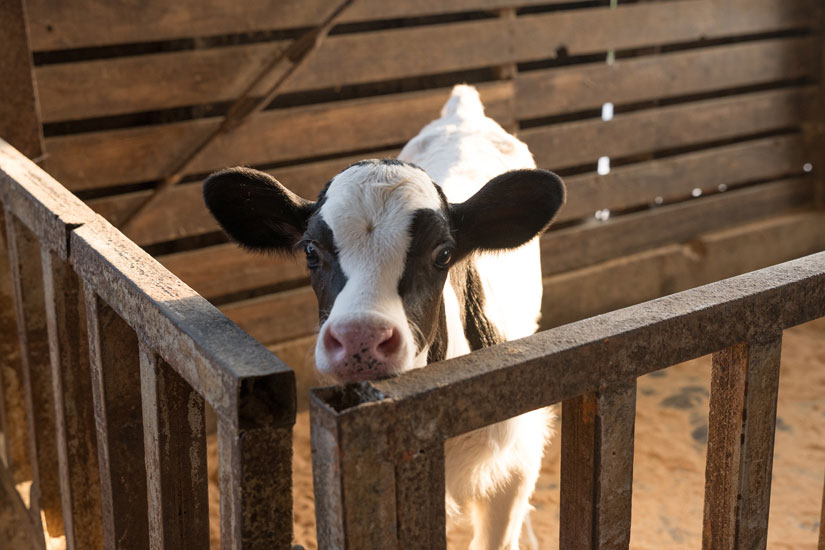
Meanwhile, peering into the barn, I saw the dairy cows peacefully grazing on the grass. A calf looked over at me with curiosity. “Sakura-chan, Sakura-chaaan,” Mika called out. Apparently, every cow in the barn has a name, and she’s been telling them “You’re so cute” ever since they were calves. Even though keeping the cows stress-free is the number one requirement for producing delicious milk, Mika’s voice is as gentle as a mother calling out to her child.
The barn is equipped with misting systems and large fans to protect the cows, which are sensitive to heat. Their horns are cauterized and removed during early childhood to prevent injuries. Four times a day, each cow eats 25 kg of feed and produces about 30 L of milk. Breeding is also handled with great care. The first insemination takes place at 14 months of age, and the gestation period is 10 months. Milking is stopped two months before calving to ensure the nutrients go to the calf.
Furthermore, as part of a prefectural initiative, the farm cooperates with the embryo transfer program for “Tosa Akaushi.” Holsteins serve as surrogate mothers, supporting the region’s livestock industry.
To Surpass “Last Year’s Deliciousness.” A Family’s Ongoing Challenge
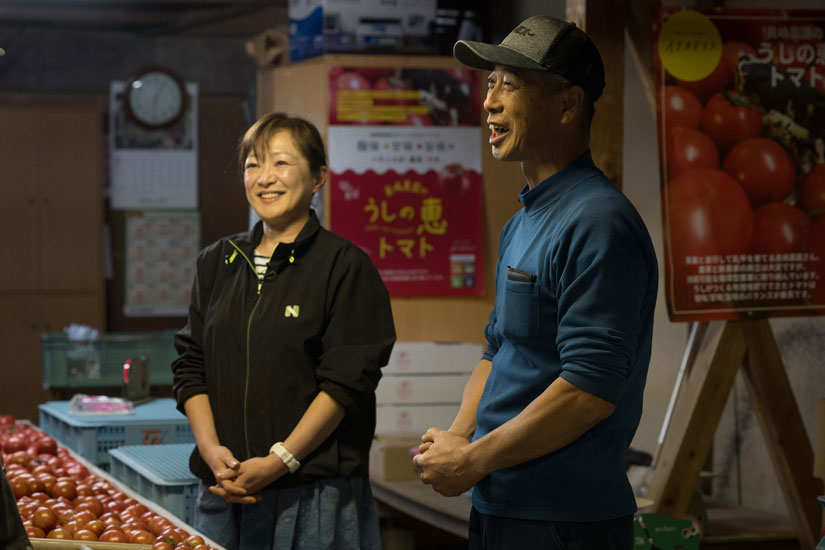
The cycle in which compost from dairy farming nourishes crops, becomes feed for the dairy cows, and ultimately turns into delicious milk is what sustains Majima Farm.
At Majima Farm, the tomato harvest runs from December through the end of June. After that, they take a brief break before starting the next planting cycle, but Mika laughs and says that the period of tending the plants after planting is “the most fun.” Conversely, she says that once the harvest begins, the days become quite nerve-wracking.
“Up until now, we’ve made continuous efforts to improve our produce, and thanks to that, we’ve been able to build a loyal customer base. So now, we’re focusing on maintaining the same great taste as much as possible. My son is working hard on this, but in recent years, I’ve come to realize that managing the farm while anticipating future conditions is extremely difficult in the face of climate change.”
Mika adds, “The memory of ‘delicious’ in our customers’ minds becomes more idealized with each passing year. That’s why I grow tomatoes with the determination to surpass those memories—putting my heart into them so that customers will say they’re ‘delicious’ again next year,” she says.
Water management, adjusting fruit size, and meticulously assessing growth conditions with her own eyes every day—without relying on machines—are just some of the many efforts made to preserve the flavor. Combined with the “expert eye” that only a family can provide, these efforts will bring this year’s tomatoes to fruition.
The “cycle of blessings” created by cows, compost, and tomatoes will continue into the future, sustained by the power of the family.