

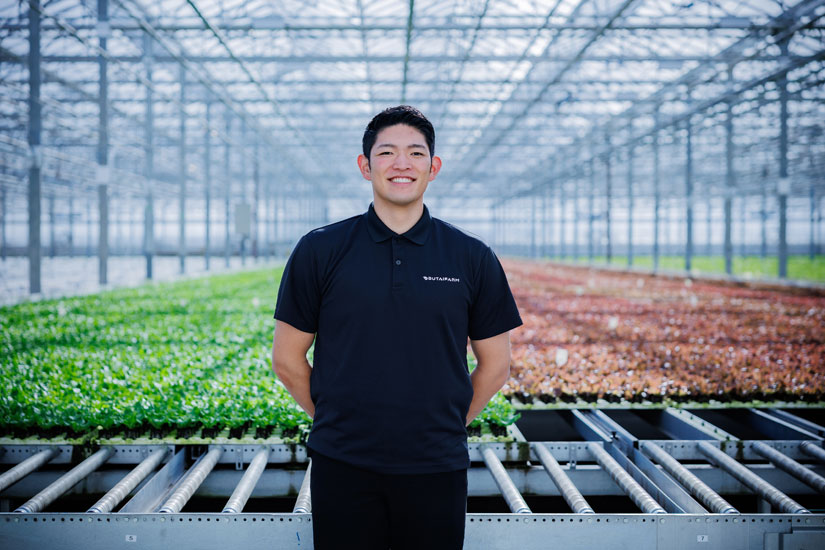
Misato Town is located in the northeastern part of Miyagi Prefecture. In this region, where agriculture is deeply rooted in daily life—with rice paddies and fields accounting for about 70% of the town’s land—”Butai Farm Co., Ltd.” operates large-scale greenhouse facilities for lettuce production. In addition to crop cultivation, production, and product development, the company also handles logistics and agricultural consulting, pursuing a diversified agricultural business model. By collaborating with farmers and companies nationwide, it has grown to generate annual consolidated group sales of 6.1 billion yen. Behind this success lies a unique management strategy that transcends the boundaries of traditional agriculture.
A long-established farm that has pioneered agricultural digital transformation, transcending the boundaries of a family-run business
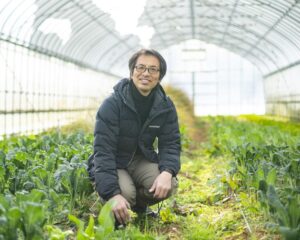
The Hariu family has been farming since 1720. A major turning point came when Nobuo Hariu, the 15th generation and current President and CEO of Butai Farm Co., Ltd., took over the family business.
At a time when family-run operations were the norm, Nobuo recognized early on the critical issues of an aging farming population, labor shortages, and a lack of successors. He actively embraced digital transformation (DX) using cutting-edge technology and invested in new equipment. Through management decisions unbound by conventional wisdom, he laid the groundwork for a large-scale farm that transcended the framework of a family business. Behind this was a profound sense of urgency. Since joining the family business, he had worked long hours every day, thinking, “If things continue this way, will we ever achieve a sustainable model, no matter how long we keep working?” It was this realization that prompted him to fundamentally reevaluate the business.
“Sustainable Agriculture” as Envisioned by the 15th Generation of a Farming Family with a History of About 300 Years
“The 15th head of the family married at the age of 22 and succeeded to the family headship from the 14th head the following year. Given the custom among farming families that children typically live under the head of the household until around the age of 50, I think that was a rather early decision. ‘Just as the Tokugawa clan returned political power to the Emperor in the 15th generation, the 15th generation tends to mark a major turning point. That’s exactly why you must hold your ground,’ he was often told,” explained Nobuhiro Hariu, the 16th-generation head and a director of Stage Farm.
In the 1980s, when the 15th-generation head took over the family estate, agriculture was undergoing a major transition toward modernization. It was an era when individual effort alone was insufficient, and investment in agricultural machinery and facilities capable of supporting large-scale operations was essential. In fact, among the farmers who took the bold step of making significant capital investments and incorporating their businesses during this period, there are cases where they subsequently expanded their operations and achieved growth. On the other hand, it is also true that farmers who remained with traditional family-run operations found themselves in a difficult situation. Nobuhiro intuitively grasped the changing times and sought to strengthen the management foundation with the goal of “sustainable agriculture.”
The key to expanding the possibilities of agriculture lay in the “system”
The decline of agriculture stems from a complex interplay of factors, including weather, soil conditions, and a shortage of workers. None of these issues can be resolved by individual farmers acting alone. That is precisely why at Butai Farm, rather than simply continuing along the same path as before, we first envisioned what Japanese agriculture should look like five or ten years from now, and then worked backward from that vision to design our management strategies and technology adoption plans.
From Family-Run to Team-Driven: Behind the Scenes of Scaling Up
The reason Stage Farm was able to transition from a family-run operation to a large-scale farm was its ability to involve people outside the family and manage the business as a team.
They expanded their business by leasing land from aging farmers and entering into contracts spanning 5 to 10 years. Rather than simply securing land, they prioritized building trusting relationships with the local community and have worked to support farmers in incorporating their operations and developing new sales channels. The journey has not been smooth; through repeated dialogue—addressing contract terms and addressing concerns about the future—they have sought a sustainable model for the entire region.
Significant improvements in production efficiency through “management transparency” implemented by the 16th-generation leader
In 2020, Nobuhiro, the 16th-generation successor, joined Stage Farm. Nobuhiro began by teaching himself bookkeeping and accounting, and started by reading the income statement (PL), balance sheet (BS), and cash flow statement to gain an understanding of the company’s financial health. By making the company’s operations transparent, he identified tasks best performed by people, processes that could be automated, and areas for improvement, and took action on each one step by step.
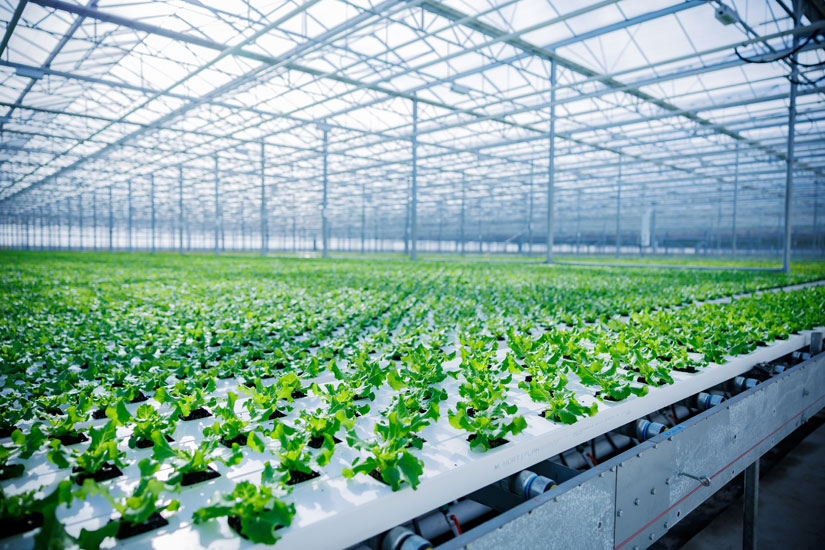
Today, the company is implementing a series of initiatives to modernize agriculture, including the operation of “Misato Green Base”—one of Japan’s largest leaf lettuce production facilities—and the introduction of IoT and AI technologies.
“Misato Green Base,” which achieves approximately 80 times the production efficiency of open-field cultivation
Mr. Nobuhiro believes that agriculture falls into two categories: “agriculture that supports our daily meals—the agriculture we must rely on for sustenance”—and “luxury agriculture that offers added value for enjoyment.” Stage Farm aims for the former: to deliver the vegetables we eat every day with consistent quality and at fair prices.
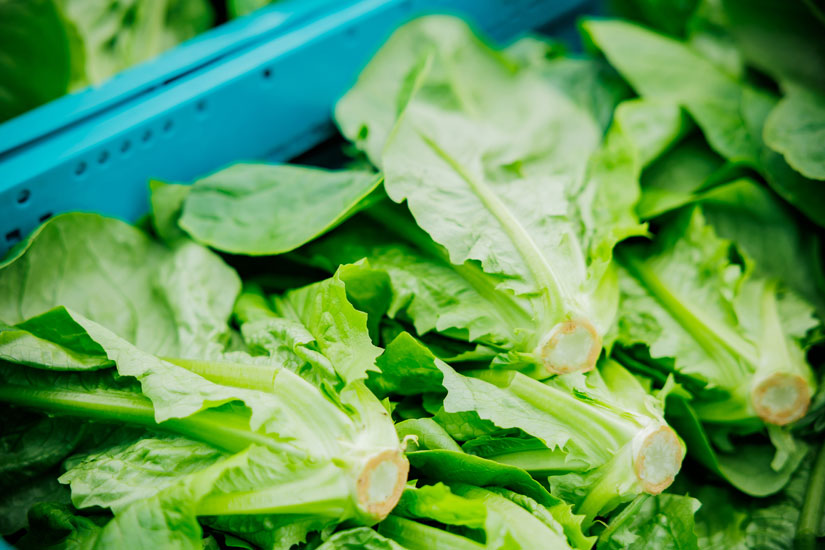
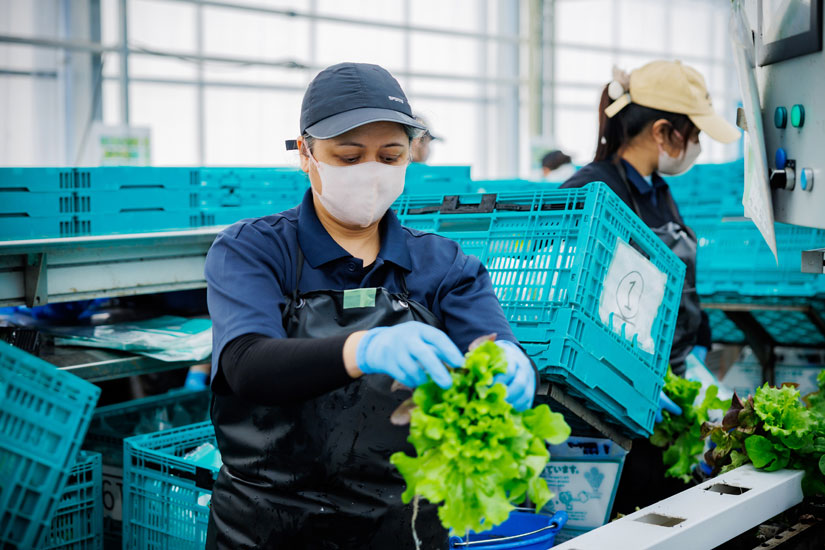
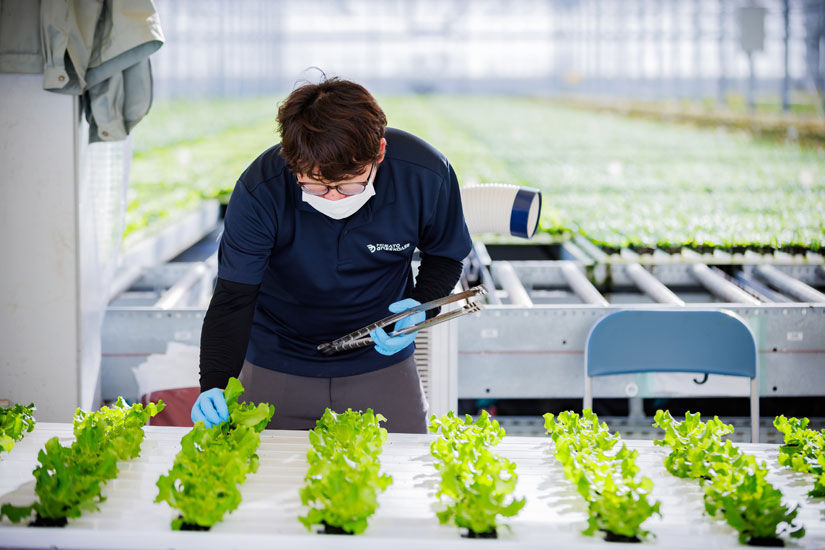
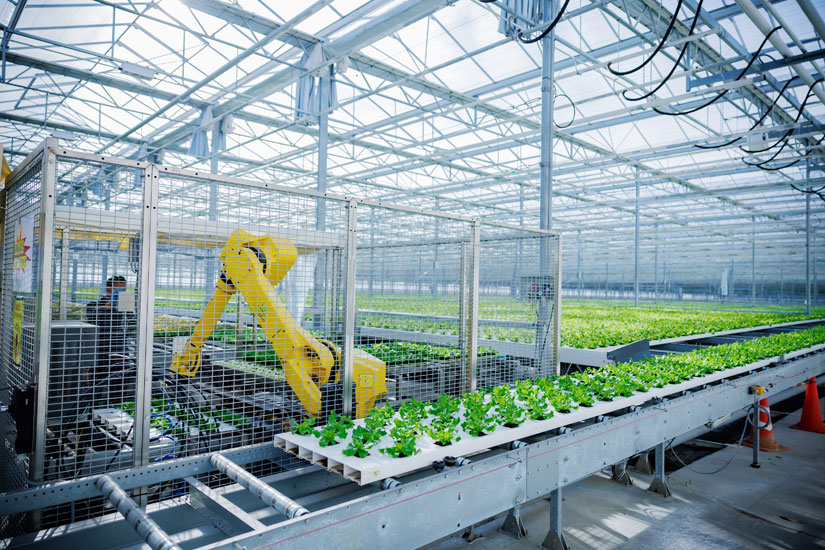
At the heart of this endeavor is the “Misato Green Base,” a next-generation plant factory located in Misato Town, Tōda District, approximately 60 km north of Sendai City. Using hydroponics in a massive greenhouse stretching 500 meters deep, the facility ships approximately 40,000 heads of leaf lettuce daily, unaffected by weather or seasonal changes. Leaf lettuce is well-suited to automation and year-round cultivation in plant factories, making it a crop that easily balances consistent quality with high-efficiency production. Production efficiency is said to be approximately 80 times that of open-field cultivation. By studying domestic and international examples, Stage Farm has built its own unique operational model.
Thanks to planned production, the waste rate is virtually zero. Furthermore, by using electricity as the primary energy source and implementing solar sharing, they have established a system that reduces both environmental impact and costs. This facility, which balances stable supply with operational efficiency, stands as a symbolic presence supporting “agriculture that must be sustained.”
Generating electricity on farmland: The option of solar sharing
Agriculture is, at its core, an industry that converts solar energy into food. At Stage Farm, we have introduced “solar sharing,” a system in which solar panels are installed on poles erected on farmland. By establishing a system that produces both rice and electricity on farmland, we are transforming the land from “underutilized assets” into “income-generating real estate.”
Turning Agriculture into a Profitable Industry: Simple Management Based on Volume and Price
At its core, farming is a business. While family-run operations tend to rely on rough estimates, the “quantity × unit price” approach is essential for increasing revenue. Therefore, expanding farmland, adopting double or triple cropping, securing pricing power, and implementing rigorous cost management are all critical.
At Butai Farm, rather than leaving shipping entirely to the JA (Agricultural Cooperative), they set their own prices. They observe market trends and trading activities to understand the selling prices of various wholesalers. Based on this, they visit retail stores in person to negotiate prices and secure direct contracts. Regarding necessary expenses such as fertilizers, they constantly explore how to procure high-quality products at the lowest possible cost. Even for fertilizers that must be imported, they make every effort to minimize the use of middlemen.
To pass on local cuisine to the next generation
Nobuhiro, who has extensive overseas experience including studying in the United States, believes that “no country has a regional food culture as rich as Japan’s.” He feels a strong sense of urgency that this richness is being lost due to a shortage of people to carry on the tradition.
He identified four pillars necessary for passing on the region’s food culture to the next generation: energy, food, employment, and education. Building on the foundation of a “town where energy and food are reliably available,” the plan is first to create jobs, and then to provide distinctive educational opportunities. As a local agricultural producer, he is actively engaged in food and agriculture education, conducting special classes at junior high schools and other institutions. By teaching students about the structure of agriculture and business management, he promotes career education and is advancing a vision to build a town where people feel, “I want to come here.” Through the creation of systems—including energy sharing—he aims to make agriculture a profitable industry and speaks with conviction about raising the food self-sufficiency rate, which stood at 38% in fiscal year 2023, “to at least 50% or higher.”
Behind these words lies more than just a numerical target. It is a determination to create jobs in the region and build a future where the next generation can take pride in agriculture. Stage Farm’s challenge is not merely the growth story of a single company. It is a practical effort to pass on the region’s potential to the next generation.