
With its vivid and bold colors and patterns, Ryukyu Bingata is a dyeing technique passed down in Okinawa since ancient times. Bingata was originally crafted and presented as garments for the royal family of the Ryukyu Kingdom. Toma Chinen, the 10th-generation head of the Chinen Bingata Research Institute in Naha, engages with Bingata every day while infusing it with a fresh perspective.
One of the three leading families of Bingata, which used to present Bingata textiles to the royal family
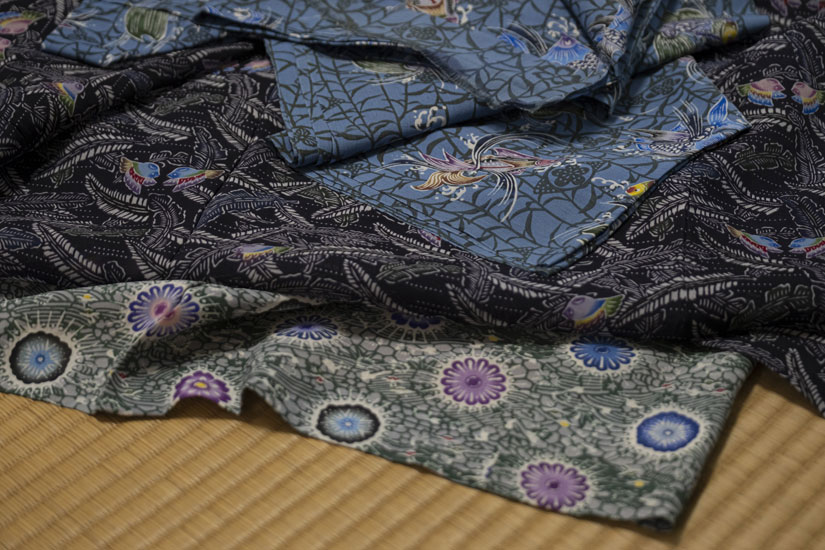
Bingata is a traditional craft unique to Okinawa and the only form of dyeing practiced there. In ancient times, it was produced exclusively as clothing for the royal family of the Ryukyu Kingdom, but today it is widely enjoyed in the form of kimonos, obi sashes, and accessories. Originally, it was written in hiragana as “bingata,” but it is said that during the Showa period, it came to be written in kanji as “Bingata.”
During the Ryukyu Dynasty, which lasted until about 120 years ago, Bingata was crafted as a tribute to the royal family by the three Bingata master families: the Shirogane family, the Takushi family, and the Chinen family.
The Decline and Revival of Bingata Due to the War
However, with the abolition of the feudal domains and the establishment of prefectures, as well as the invasion of Satsuma, the monarchy was dismantled, and the work that had been passed down through generations for some 450 years came to an end. Although they could no longer sustain it as a livelihood, some families continued to produce Bingata after the Meiji era, determined not to let the technique die out. The Chinen family, while making a living through other work, continued to carefully preserve their Bingata tools and materials. As time passed, during Okinawa’s postwar reconstruction in the Showa era, Fuyuma’s grandfather, Sadao, learned the Chinen-style Bingata from a relative who had kept the tradition alive and revived it as a family business.
Artisans began producing Bingata for Ryukyu dance costumes and souvenirs, reviving it as an Okinawan craft. Around 1972, orders began coming in from the mainland for use as Japanese-style clothing, bringing new vitality to the Bingata industry. Consequently, in 1984, “Ryukyu Bingata” was designated as a Traditional Craft by the Minister of Economy, Trade and Industry.
The 10th-generation successor to the historic Ryukyu Bingata tradition
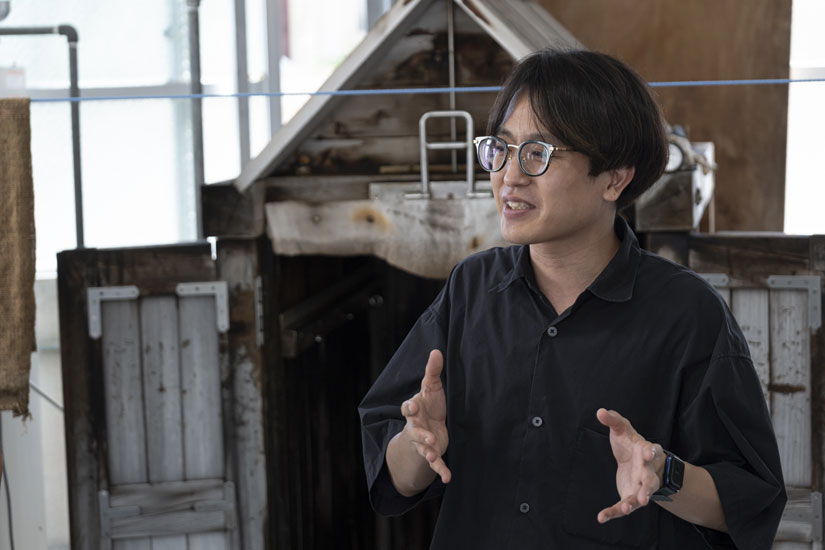
The Chinen Bingata Research Institute is located in a workshop near Naha Airport. The current head of the institute, Fuyuma Chinen, studied graphic design in Kyoto and worked as a designer in Osaka before moving to Milan, Italy, to further his studies in art. There, surrounded daily by works of art and historic buildings that have stood the test of time, he realized, “I want to create things that endure rather than being consumed. I want to express my own world.” The Benibana craft, the family business he had always intended to inherit one day, perfectly aligned with the vision he had arrived at.
With that resolve in his heart, he returned to Okinawa, and his days of dedicating himself to Benibana at the Chinen Benibana Research Institute began. Returning home at the age of 22 was sooner than she had anticipated, but considering that honing her skills was her top priority, it was the best choice. However, shortly thereafter, her grandfather, who had been running the workshop, passed away suddenly, and within just a few months of joining the workshop, she found herself having to take over its management. Looking back, she recalls those years as a time when she was truly struggling.
Chinen has received numerous awards, including the Newcomer Award from the Japan Traditional Crafts Exhibition and the Japan Crafts Association in 2021. She currently serves as a director of the Ryukyu Bingata Promotion and Preservation Consortium and as vice director of the Ryukyu Bingata Business Cooperative.
The Process Behind Okinawa’s Unique Bingata
Bingata is created using stencils carved with the designed patterns. The stencil is placed on the fabric, and resist paste is applied over it. After drying, pigment is applied in layers to the areas not covered by the paste. Next, resist paste is applied to the dyed areas, and finally, the base color is applied to the remaining areas. To set the colors, the fabric is steamed, rinsed, and dried to complete the process. While this is a general overview, there are actually more than 10 distinct steps involved in the process.
There are no strict rules regarding the fabric material, but silk and cotton are commonly used. Because there are no restrictions, a wide variety of dyeing techniques can be employed.
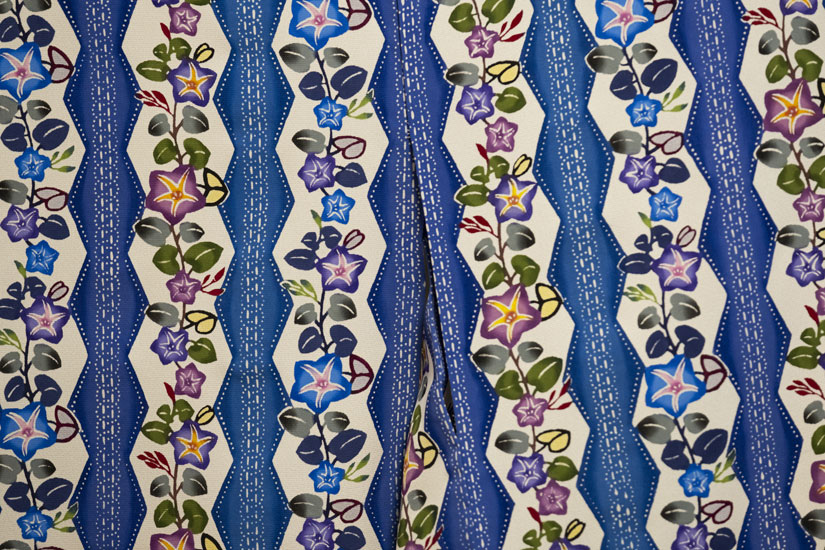
This beautiful indigo-colored pattern is called “Amefibana.” In the Okinawan language, this means “rain flower,” and the design features morning glories. The blue background is dyed with Ryukyu indigo. Ryukyu indigo is characterized by a deeper, more intense blue hue than the indigo found on the mainland.
The background color is created using natural dyes derived from plants, while the pattern itself uses pigments; the vivid pigments are used to express the boldness of Bingata. Since the dye is water-soluble and penetrates deep into the fabric, it blends seamlessly with the base material, while the pigment adheres to the surface as particles, allowing for vivid colors. The contrast in colors, which leverages the distinct properties of each, is a key focus.
Chinen explains, “The pigment comes to the forefront, while the softer dye recedes slightly into the background. This creates a dynamic three-dimensional effect, resulting in a work with great depth.” She uses a variety of pigments and blends the colors specifically for each design.
When she returned to Okinawa and began working with Bingata in earnest, she was strongly motivated to create her own original designs that differed from her grandfather’s. While she did experiment with various approaches, she says that as she continued her daily work, she increasingly came to appreciate the ease of dyeing the traditional patterns passed down through generations and the beauty they exhibit when colored.
Since many people still love the classic patterns that have been popular for generations, she continues to create these historic designs. In addition, she consciously incorporates modern patterns that appeal to younger people, aiming to produce products that will be cherished for a long time as the times change.
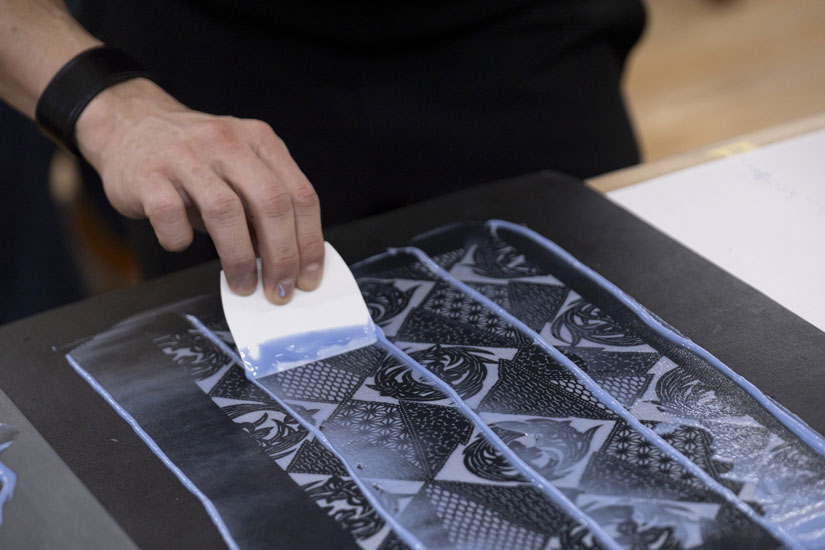
This involves a process called “katazuke,” where a stencil is placed on the fabric and resist paste is applied with a spatula. The paste acts as a mask to prevent the dye from penetrating the areas covered, ensuring the pattern remains intact. The artisan scoops up the paste, spreads it evenly, gently peels off the stencil, and places the next one adjacent to ensure the pattern connects seamlessly. If the process is too slow, the paste dries too quickly and clogs the fabric, or the stencil may tear, leaving holes in the design. Chinen’s movements are fluid and smooth. She explains that when she first returned to Okinawa, she could only complete one roll of fabric per day, but now she can produce as many as 15 rolls a day.
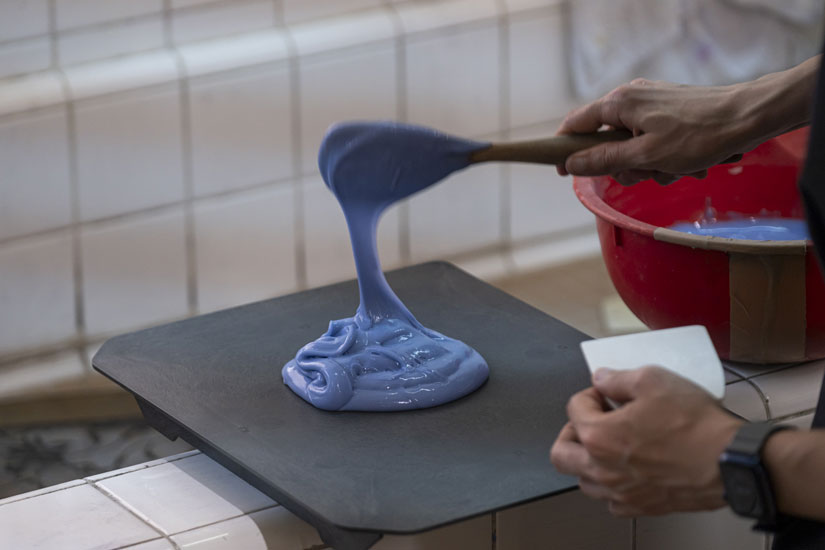
The resist paste, made by hand from glutinous rice and rice bran, is mixed with blue pigment. Apparently, this enhances the color intensity when the fabric is dyed later.
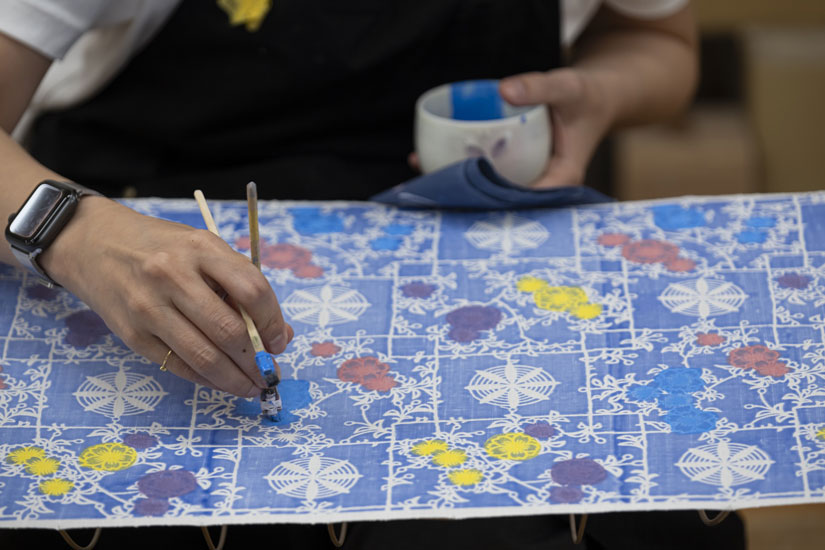
“Color application,” the process of layering fine colors, is performed by holding two brushes simultaneously. Pigment is applied with a dipping brush, and then a rubbing brush is used to work the coarser pigment into the fabric to help it penetrate more easily. In the next step, to emphasize the design, color is applied further while blending with the brush to create a sense of depth.
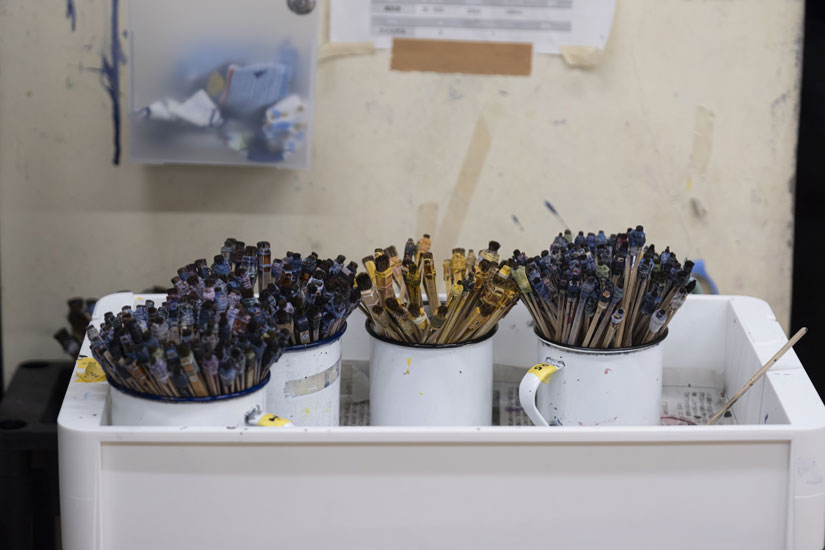
There are several types of brushes, and the one used varies depending on the fabric. Many of the tools are handmade.
Every year, I take on the “Oboro-gata,” a major project that requires twice the effort
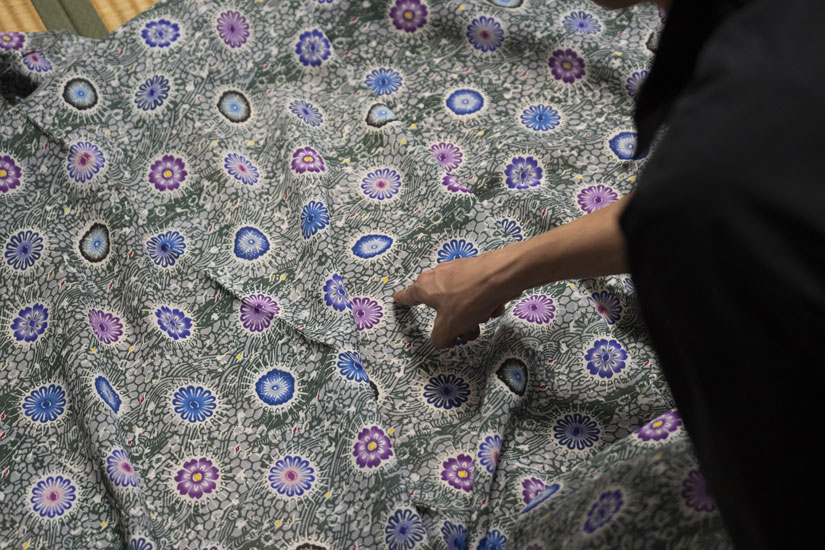
This kimono, named “Island of Falling Flowers,” is made using a technique called “oborogata,” in which two stencils with different patterns are layered and dyed together. Since this process takes twice as much time and requires a high level of skill, few artisans attempt it. Although it’s labor-intensive, Ms. Chinen loves this oborogata technique and often works with it. The fabric used is a thin silk known as “kakujou-nuno,” produced in the nearby town of Haebaru.
Growing the Bingata Fan Base Through Social Media
She also actively pursues collaborations with other industries, working on projects that combine Okinawan specialties—such as transferring Bingata patterns onto local pottery or incorporating Bingata designs into Awamori bottle labels. She believes this creates opportunities for people who aren’t interested in dyeing to discover the art, and vice versa.
Currently, Mr. Chinen is actively posting on social media. He shares content designed to spark interest in Bingata, such as videos showcasing the production process. He reportedly handles not only the posting but also all video editing himself.
Perhaps as a result, the number of visitors to the workshop continues to grow, and it seems that our social media posts are reaching younger generations across the country who were previously unfamiliar with Bingata.
I also frequently visit the kimono shops on the mainland that carry our products. While interacting with customers there, I’m able to directly hear about their preferences—which differ from those in my hometown of Okinawa—tailored to each specific region. I often bring these insights back to incorporate into my work.
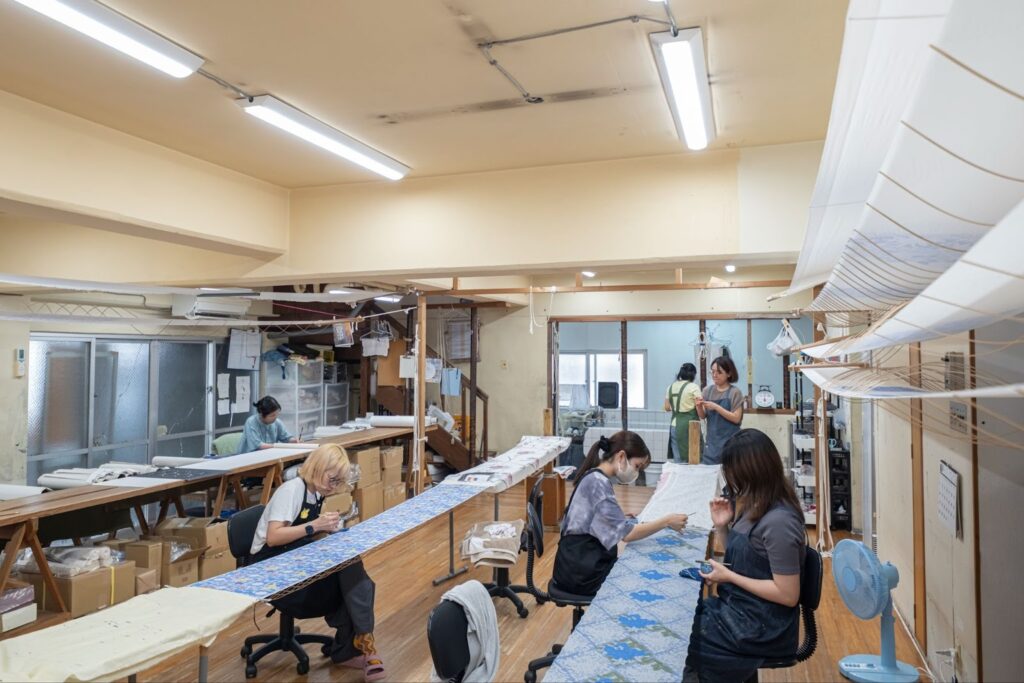
Currently, about 10 people work at the Chinen Bingata Research Institute, ranging from seasoned artisans to young people who have come with the goal of becoming Bingata artisans, and they all work briskly at their respective stations.
Looking Toward the Future of Ryukyu Bingata
“It’s not about it being culture or tradition—it’s not something special. We’re continuing it as a profession. I believe that’s how it becomes part of our history and culture,” says Chinen. His words convey a sense of determination to look ahead to the future of Ryukyu Bingata and carry that responsibility.
“If it isn’t fun, you can’t keep it up, and because there are challenges, you don’t get bored and can take on new ones. I want to show my staff that I’m taking on these challenges myself, and I want to keep pushing myself to create a form of Bingata that fits the modern era,” he says with sincere conviction.
As he continues to pass down the craft to ensure Ryukyu Bingata’s ongoing development, he will likely continue to take on challenges with a light yet stoic spirit, brightly leading the way for the Ryukyu Bingata community.