

“Fuyukoi” is a special apple brand from Iwate Prefecture, featuring only the finest “Haruka” apples that meet stringent criteria for sugar content and honeycore. Available only during the brief start of winter, its rich sweetness and crisp texture offer truly premium flavor.
Iwate: A Diverse Apple-Producing Region with “Original Varieties”
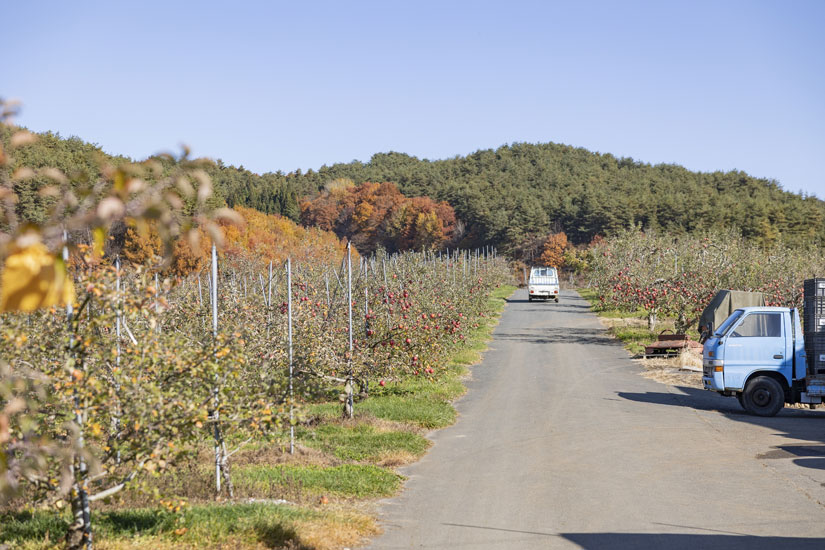
Iwate Prefecture ranks as Japan’s third-largest apple-producing region, following Aomori and Nagano. Leveraging natural conditions like significant temperature fluctuations and rich soil, high-quality apples are cultivated primarily in inland areas.
The first Western apple seedlings were imported to Japan in 1871, shortly after the country opened its doors. The following year, Western apple cultivation began in Iwate Prefecture, making it one of the earliest regions in Japan to engage in apple production.The region focuses not only on productivity but also on quality improvement and variety development. Through collaboration among producers, agricultural cooperatives (JA), local governments, and research institutions, Iwate has created numerous “original Iwate varieties,” such as the “Beni Iwate” with its deep red skin and strong sweetness, and the juicy, large “Ooyume.” One of these is the “Haruka” variety, which serves as the base for the “Fuyukoi” apple.
The Iwate-born apple variety “Haruka”
Haruka was born in 1976 in the orchard of Iwate University’s Faculty of Agriculture and made its market debut as a registered variety in 2002. Its name comes from the grandson of its creator, the late Professor Emeritus Kiyoshi Yokota.It is a late-season variety with yellow skin, known for its abundant honey, rich sweetness, and crisp, juicy texture. However, it also has characteristics that initially hindered its popularity: smaller fruit size and a tendency to develop “rust” – a condition where the skin discolors and becomes rough. As a result, it was considered “unattractive” when first introduced, and few producers initially took up its cultivation.
However, some recognized Haruka’s potential. In 2006, dedicated growers from across the prefecture gathered and established the “Iwate Haruka Research Group” (now the Iwate Fuyukoi Research Group) with fruit-growing organizations. They began working to improve quality and establish cultivation methods, aiming to “develop Haruka into Iwate’s brand apple.”
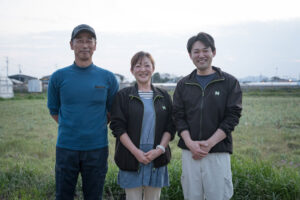
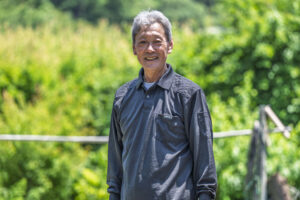
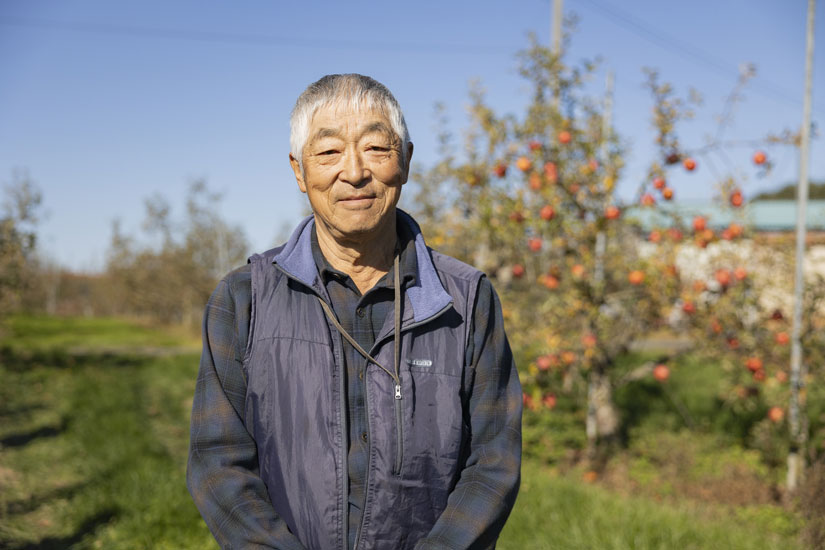
One of the founding members was Mineo Kumagai of Shimokubo Farm in Morioka City. Having dedicated over 20 years to improving Haruka’s quality and establishing cultivation methods, and serving as chairman of the Iwate Fuyukoi Research Group until 2024, Kumagai reflected on the group’s origins: “While its appearance isn’t great, Haruka’s excellent honey-infused sweetness and high sugar content are major attractions. I wanted to find a way to make the most of that.”
Overcoming Weaknesses with “Bagging”
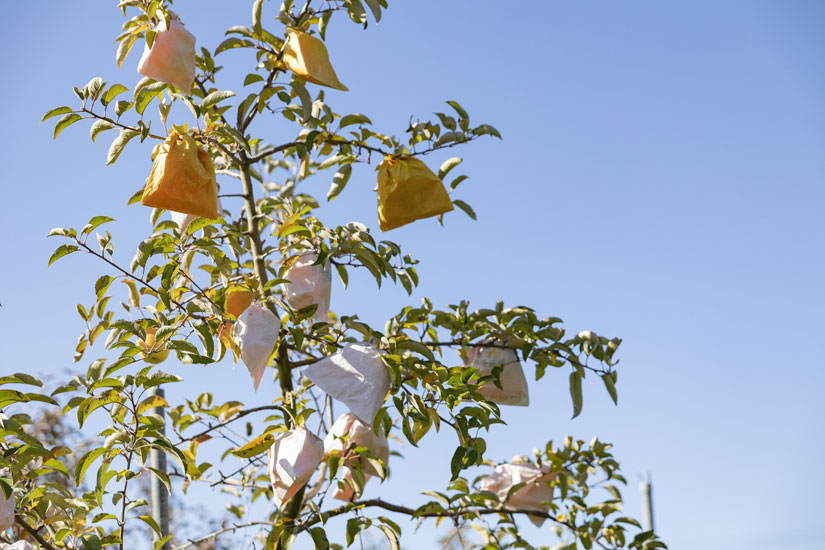
Members of the “Iwate Haruka Research Group,” who cultivate apples across the vast regions of Iwate Prefecture, grew Haruka in a corner of their respective orchards. Through repeated information exchange and discussions, they tested various cultivation methods. One year, a member accidentally bagged a Haruka tree instead of a neighboring one. Surprisingly, it produced a clean, rust-free yellow fruit.
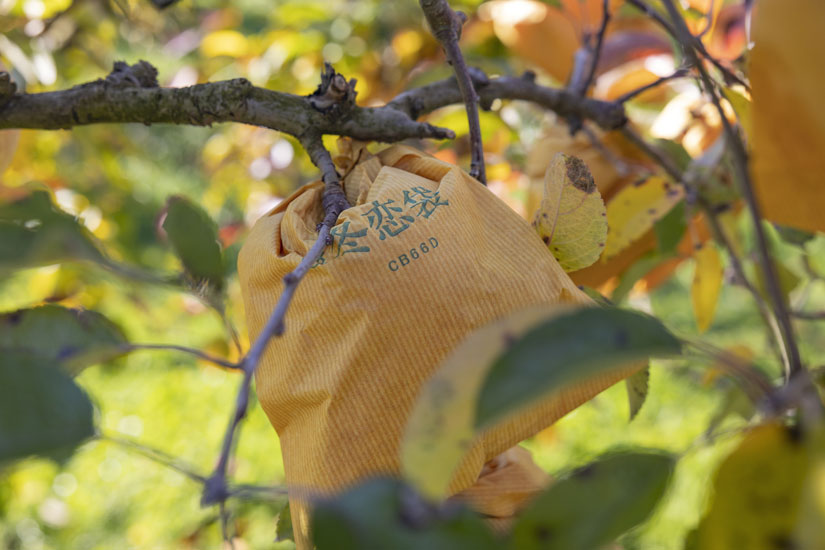
“Bagging” refers to the cultivation method of placing bags over apples after thinning. This protects against disease and sunburn, maintains freshness and quality post-harvest, and improves “storage life” for longer preservation. Additionally, removing the bags just before harvest to expose the fruit to sunlight promotes coloring, resulting in an even, vibrant hue.
Feeling confident that “this could work,” Mr. Kumagai and his team switched Haruka cultivation from “unbagged” to bagged. As a result, the occurrence of rust and blemishes decreased significantly.
However, bagged apples develop lower sugar content compared to unbagged apples that grow with ample sunlight. To overcome this, they experimented extensively: testing multiple types of bags with different materials and specifications, and drastically reducing the number of fruits per tree to concentrate nutrients on each remaining fruit.After years of effort, they succeeded in growing larger fruit without compromising its inherent flavor. Today, techniques for cultivating high-quality Haruka apples are becoming established, including using specialized bags for bagging and allowing the fruit to fully ripen on the tree before harvest.
“Still, apple cultivation happens only once a year. Even after growing Haruka for 20 years, I’ve only experienced 20 harvests. There might be a more suitable bag, or other better methods—research never ends,” says Kumagai. This relentless accumulation of effort is steadily elevating Haruka’s quality and reputation.
Only the most meticulously selected apples become “Fuyukoi”
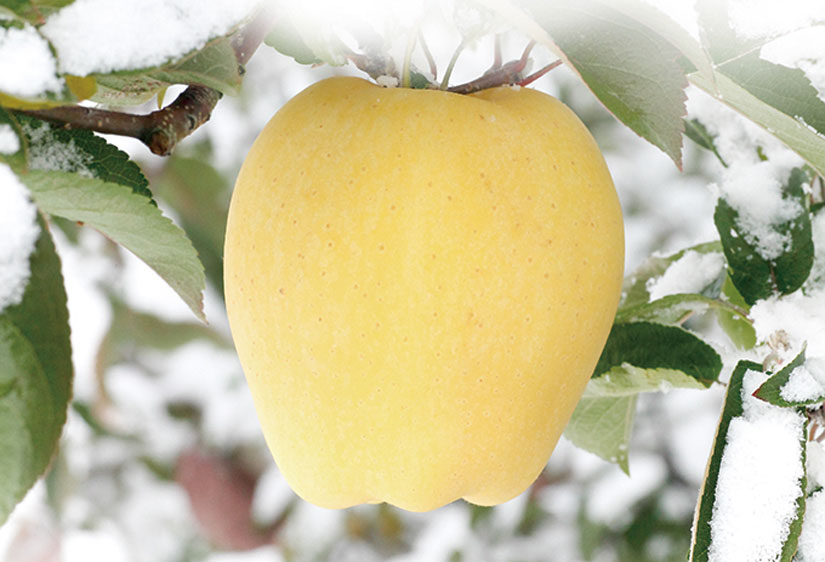
Among the Iwate-grown “Haruka” apples cultivated this way, only those meeting specific standards—such as sugar content, honeycore presence, and appearance—are granted the “Fuyukoi” designation.
“Fuyukoi” is a branded apple handled by JA Zen-Noh Iwate. Harvested Haruka apples are individually measured using light sensor sorting machines, selecting only those with “sugar content of 15 degrees or higher,” “honeycore,” and “excellent appearance.” Only these selected apples are shipped as “Fuyukoi.”Furthermore, those meeting even higher standards—”sugar content of 16 degrees or higher and honeycore” and “free of rust spots or blemishes”—become “Premium Fuyukoi.”
The shipping period is late November to December. Named “Fuyukoi” (Winter Love) because they are harvested just before winter, the latest among apples produced in Iwate Prefecture, and their high sugar content evokes the image of sweet love, “Fuyukoi” is gaining recognition year by year and is popular as a gift. It is also handled by department stores and high-end produce shops.
“Haruka is inherently a high-sugar variety that easily develops honeydew. The Haruka we grow averages around 18 degrees Brix, with many exceeding 20 degrees,” says Mr. Kumagai. The typical sugar content for apples is around 13 degrees Brix. Considering this, even Haruka apples not selected for Fuyukoi are sufficiently sweet.
“So what makes Fuyukoi special? Its visual beauty. For personal consumption, even unbagged Haruka with rust spots is fine—I even think it might taste better that way. But when giving them as gifts, you naturally want something that looks beautiful.”
Haruka’s skin is extremely delicate. Even when carefully cultivated with bags to protect it from external stress, bruises or blemishes can sometimes appear. Fuyukoi’s flawless, smooth texture is the crystallization of the grower’s meticulous work.
Adding value through labor
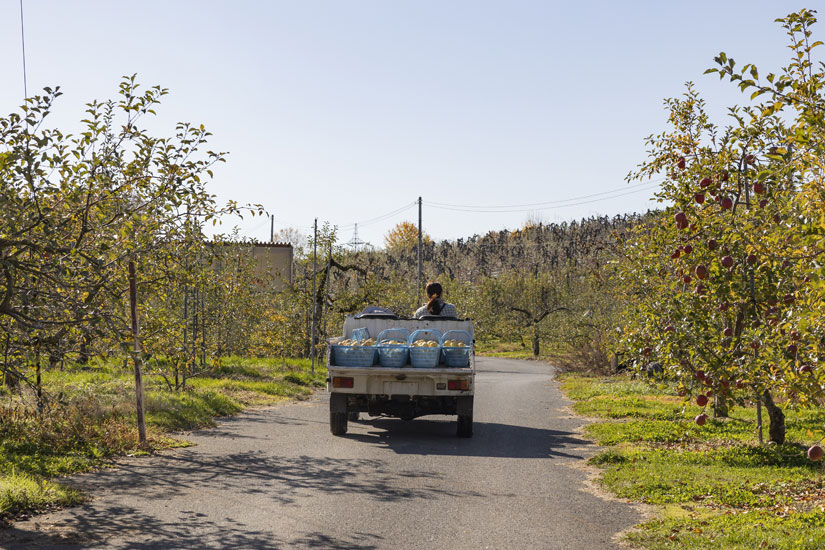
To grow large, high-quality apples, thinning young fruit—known as “fruit thinning”—is essential.Apples rely on leaves for photosynthesis to deliver nutrients to the fruit, making the balance between leaves and fruit crucial. Typically, thinning aims for a ratio of about 40-50 leaves per fruit. For Haruka, however, it’s astonishingly 100 leaves per fruit. By drastically reducing the number of fruits on the tree, nutrients are concentrated, resulting in sweeter, larger apples.
Haruka apples, cultivated through this “select few” approach, are still grown on a relatively small scale with limited production, making them rarely seen in stores. The “Fuyukoi” and “Premium Fuyukoi” grades selected from these are even more scarce.”We want to turn that rarity into value and return as much profit as possible to the growers,” says Kumagai. He explains that the research group was established precisely because they wanted to create a system where “hard work producing excellent fruit is properly valued and leads to profit.”
A Voice for Iwate’s Apple Appeal
As chairman of the Iwate Fuyukoi Research Group, Kumagai actively promotes the apples at events and markets both within and outside the prefecture. “Over the past few years, I’ve really started to feel that Haruka and Fuyukoi are gaining fans,” he says. “More producers are supporting this initiative, and our membership is growing. We want to ride this momentum and bring in even more partners.”
Haruka is a variety born in Iwate, but there are no restrictions on where it can be grown, and it is now cultivated outside the prefecture as well. However, only Haruka apples grown in Iwate can carry the “Fuyukoi” brand name. “Nationally, when people think of apples, they probably think of Aomori or Nagano,” Kumagai says with hope. “I want to spread the word widely that ‘Iwate also has such excellent apples.’ I believe Fuyukoi and Haruka are major selling points for that.”
There are no limits to “making good things”
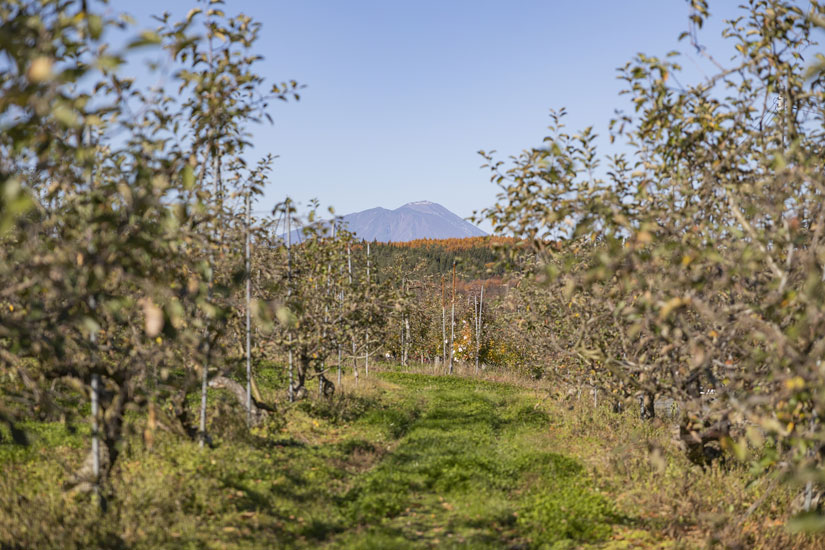
The apple orchards of Shimokubo Farm spread across the rolling hills overlooking Mount Iwate. Located at an elevation of approximately 360 meters, it is one of the highest apple farms in Iwate. Compared to lower-lying areas, the temperatures are cooler. When the farm acquired this land 40 years ago, they struggled because the fruit didn’t grow large. However, with global warming, temperatures have gradually risen. “Now, we grow better apples than other farms at lower elevations,” Kumagai explains.The higher elevation also means a greater temperature difference between day and night, resulting in apples with a firm, crisp texture,” says Kumagai.
Nevertheless, global warming remains a serious problem. Apples thrive in cool climates, and high temperatures cause various issues like poor coloring, sunburn, and diminished flavor. They also tend to develop less honeycore, which could undermine the brand value of varieties like Haruka and Fuyukoi that pride themselves on this characteristic.
Furthermore, soaring material costs and rising labor expenses are major burdens. Unlike crops like rice, where mechanization is advancing, apple cultivation remains largely manual. Tasks like bagging and harvesting, which require delicate handling of the fruit, must be done by hand, one by one. “If we could mechanize, maybe my son and I could manage it, but that’s not possible. So we have to hire people, and the more labor-intensive it is, the higher the labor costs,” says Kumagai.The environment surrounding apple farming grows harsher each year, with global warming, persistent abnormal weather patterns, and rising production costs all taking their toll.
“I’m completely exhausted. It’s like hanging on by a thread, barely managing to keep going,” he says with a wry smile. Yet he adds, “Even while being swept up by changes in the times and environment, I feel fortunate to have made it this far.” His eyes still burn with passion for apple growing. “This work is enjoyable because I can devise my own methods and experiment. I know there’s still so much I don’t know, and I believe there’s still more I can do. There are no limits to making something truly good.”
To avoid cutting down apple trees
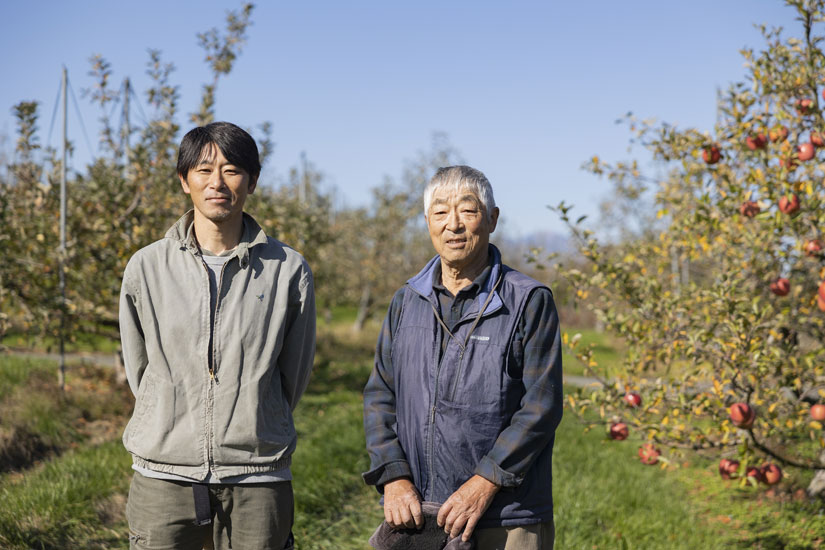
“It would be easy to quit apple farming and just cut down the trees. But then all the years of care invested up to that point would be lost in an instant, and if I ever wanted to get it back, it would take just as much time. That’s why I want to keep going as much as possible. So I won’t have to cut down the apple trees I’m growing now.”
His son Katsuhiko, who runs the orchard with his father, shares this sentiment. “With global warming continuing like this, I wonder if there will come a time when we can’t rely solely on apples. That’s why we’re also growing other crops in separate fields. But I don’t want to give up apple farming. It’s hard work, but it’s still enjoyable.”
“Growing apples is fun,” the Kumagai father and son say in unison. Despite facing various challenges and hardships, their sincere commitment to “producing something better” is what underpins the special flavor of Haruka and Fuyukoi apples.