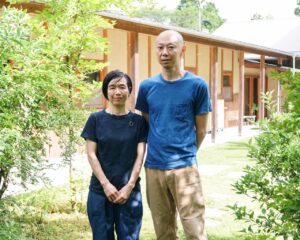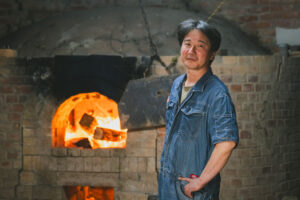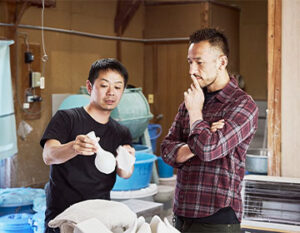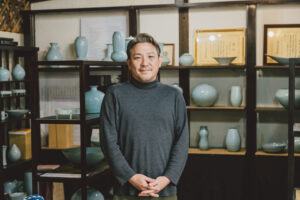


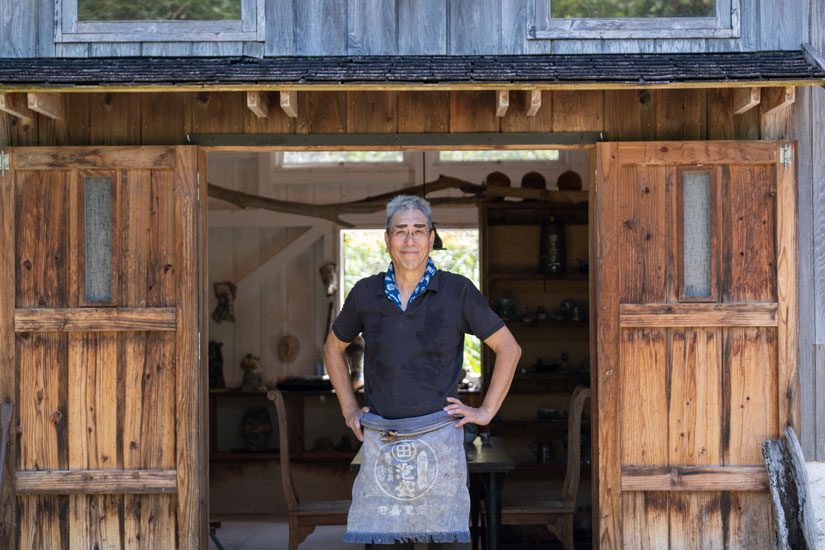
“When I was in elementary school, I used to enjoy finding fragments of earthenware and piecing them together. That’s where it all began.” These are the words of Manabu Yamagami, who runs the “Jinjin-yō” pottery studio in Takazato, Ogimi Village, Okinawa Prefecture. After traveling throughout Japan, what “form of his own” did he discover at the foot of the Yanbaru mountains?
The Place I Kept Searching For

About a 45-minute drive north from the northern terminus of the Okinawa Expressway—Kyoda Interchange—lies a nature-rich area known as “Yanbaru,” where Mr. Yamagami’s studio, “Jinjin-yō,” and the adjacent “Gallery TATI” are located.

Mr. Yamagami, a native of Osaka Prefecture, was inspired to become a ceramic artist after finding a fragment of pottery near his home when he was a child. That formative experience sparked a deepening interest in clay and pottery, leading him to choose the path of ceramics as his career.
For the young Mr. Yamagami, collecting pottery shards was a pastime that captivated him just as much as riding his bike or playing baseball. Every time he dug into the land being developed for the World’s Fair, ancient pottery would emerge from the soil. His heart would race at the moment when traces of human hands from long ago would emerge. By the time he entered high school, it had become a habit for him to gaze at pottery from around the world in museums, and he began to vaguely imagine what it might be like to be a potter.
He considered pursuing higher education through baseball, a sport he was deeply committed to, but he sensed he had reached a limit. Although attending an art university was another option, he felt that a world spent endlessly drawing for entrance exams wasn’t right for him. Around that time, through a connection with his father—who was well-versed in the arts—he visited a potter who encouraged him, saying, “You can become a potter even without graduating from an art university.” Thus, Mr. Yamagami chose a path of traveling from one pottery-producing region to another, seeking only the necessary skills. He learned the potter’s wheel at the Seto Ceramic Training School in Aichi, studied glazes and Kiyomizu-yaki in Kyoto, and further honed his craft at a school in the tradition of the Vienna Workshop.
Having honed his skills in this way, Yamagami worked at a Kasama-yaki pottery studio in Ibaraki Prefecture before striking out on his own at the age of 27. He later moved through Mashiko, a pottery-producing region in Tochigi Prefecture, before settling in this area in 2004. It was a place he finally arrived at around the age of 45, after traveling through pottery-producing regions from Hokkaido to Kyushu and Okinawa.

When it comes to Okinawan pottery, known as “Yachimun,” it is characterized by its thick, substantial forms and dynamic designs. Among these, “Tsuboya-yaki”—which has been produced for generations in Tsuboya, Naha City—is synonymous with Yachimun. “Tsuboya-yaki has its own unique traditional production methods, so I was interested in it,” says Ms. Yamagami. She came all the way to Yanbaru not to pursue traditional craftsmanship, but to create her own original works. Captivated by the natural surroundings, the play of light, the unique culture, and the customs and events of each village, she began her creative journey in the Yanbaru region.
The environment shapes things

Mr. Yamagami, who had previously worked with Kasama-yaki and Mashiko-yaki, also created traditional pieces reminiscent of Mashiko-yaki and so-called “Yachimun” when he first arrived in Okinawa. “But once I came here, I wanted to recreate colors like green and the color of the ocean,” he says. “I thought it might be okay to explore the opposite of ‘beauty through function.’” As a result, his work began to evolve, incorporating the beauty of the ocean and stunning sunsets—the things he experienced—into the “function” (usability and practicality) of his pieces.

“I believe it’s the environment that shapes what we create.” These words resonate with the spirit of Matsuo Bashō, who once traveled throughout Japan, visiting beautiful landscapes and famous sites, and captured his impressions of the local nature in haiku. “As a ceramic artist, I don’t just strive to master technique for its own sake; rather, I strive to master the techniques needed to express what I see and feel in nature. That’s what makes it so irresistibly fascinating, and I believe that is the true, wholesome way to create.” Feeling nature and capturing it in form—this was the approach to creation that Mr. Yamagami had discovered.
A Fusion of Jomon and Coral
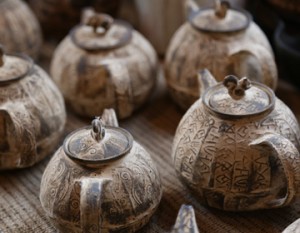
Mr. Yamagami’s pottery-making process begins with a trip to the ocean to collect shells and fragments of coral. He then creates the base of the vessel using a clay mixture of his own original blend—combining Okinawan clay with clays from Mino, Shigaraki, and other regions—and presses the collected coral fragments, both large and small, into the surface to create patterns. The technique is reminiscent of that used to make Jomon pottery.

“I thought it would be interesting to combine Jomon pottery with coral.” Jomon pottery features patterns created by braiding rope and pressing it firmly against the surface of the vessel. It’s also said that pressing the rope against the clay compacts it, making the pottery less prone to cracking. Rather than using only Okinawan clay, Yamagami creates thinner-walled vessels and applies patterns one by one using shells and coral instead of rope to compact the clay.

When I’m creating, I envision the ocean. The random patterns formed by coral reflect the beauty and transience of nature, which changes its appearance in the blink of an eye. I also intuitively add delicate bubble-like patterns using thin metal tubes. By using just a touch of an artificial tool, the effect becomes even more realistic—much like a chemical seasoning.

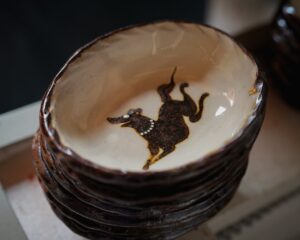
Finally, he applies pigment with a brush to each individual pattern. While imagining how the piece will look once fired, he varies the placement of the colors and their shades, and in this way, Mr. Yamagami’s work is completed.
Yanbaru-yaki

It has been over 20 years since Yamagami moved to the Yanbaru region and began creating her work. “It’s finally taking shape,” she says. Her pieces evoke the beauty of Okinawa’s ocean and have garnered a strong response from travelers who encounter them at Gallery TATI and at craft fairs such as “Igimi Teguma,” held annually in Ogimi Village, where the gallery is located. “While it’s wonderful to bring joy to others, I don’t create solely to please them; I believe that when I create with the intention of bringing joy to myself, others will be pleased as well.” Recently, she has also produced pieces that incorporate playful elements beyond mere practicality, such as beer mugs designed with hollow interiors filled with ceramic beads to produce a ringing sound. Although these are still in the prototype stage, they have been well-received by those around her, and she hopes to develop them into a series in the future.

Mr. Yamagami has long drawn attention within Okinawa for creating works that differ slightly from traditional Yachimun. The years he has spent engaging with the clay of various regions and conversing with the flames are now taking deep root in this land.
“I hope to give shape to ‘Yambaru-yaki’ here as the culmination of my pottery experiences across Japan. There’s still so much I want to do from here on out.”
The clay nurtured by the forests of Yanbaru, the light and wind of Okinawa—Yamagami’s work, which seeks to imbue all of these elements into the form of his pottery, is still a work in progress. Gallery TATI will continue to quietly yet steadfastly showcase the creations that emerge from this journey.