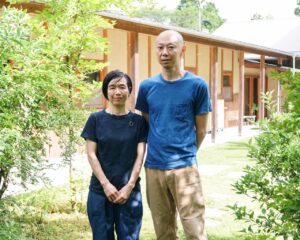


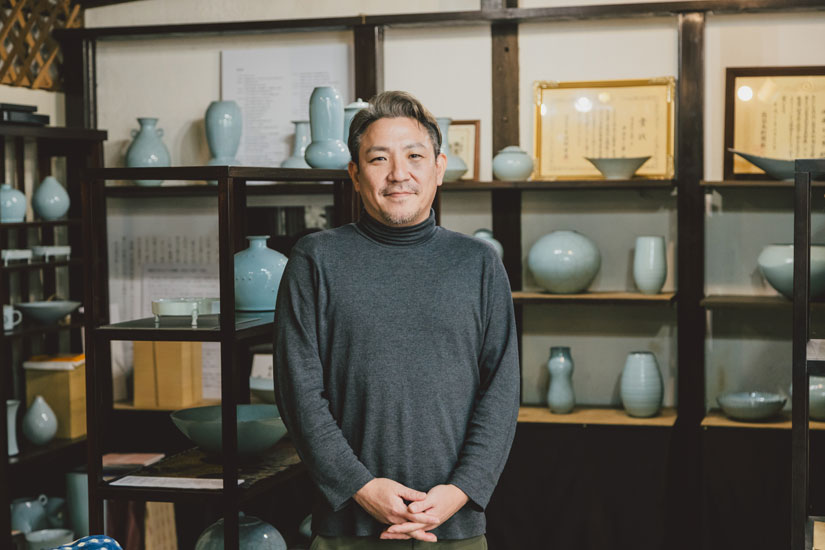
In the gallery of “Mifune Kiln,” nestled in the mountains, two types of pottery crafted by twin brothers are on display: “yakishime,” in which clay and fire create a powerful texture, and “seiji,” which captures light within its layered glazes. The younger brother, Hitomu Tsugane, chose the path of seiji, considered the most difficult form of pottery.
My Father’s Kiln: The Era of Everyday Tableware
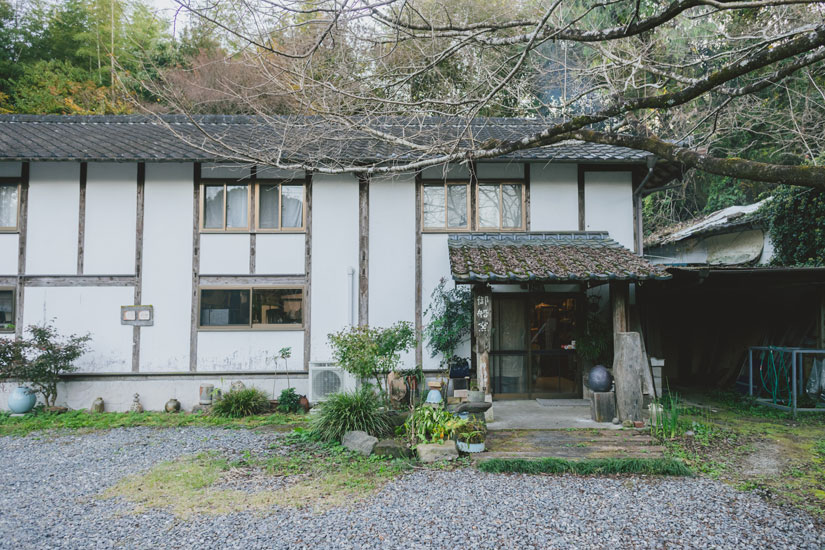
The Mifune Kiln is located in a forest nestled in the mountains, a short distance from the city center. About 40 years ago, my father left his corporate job to study the techniques of Takada-yaki—a ceramic tradition with a history of some 400 years in Yatsushiro City, Kumamoto Prefecture—and eventually struck out on his own. That was the beginning of his journey, when he built his kiln here. While Takada-yaki is known for its celadon, my father did not pursue celadon. Instead, he focused on creating everyday tableware, such as ash-glazed pottery—using glazes made from plant ash derived from straw and wood—and powder-coated ware. It was an era when pottery studios were springing up everywhere amid a pottery boom, but my father’s pieces gained popularity, and on weekends, so many people visited the kiln that the parking lot could not accommodate them all.
From Pottery Studio to Artist: The Gamble of Celadon
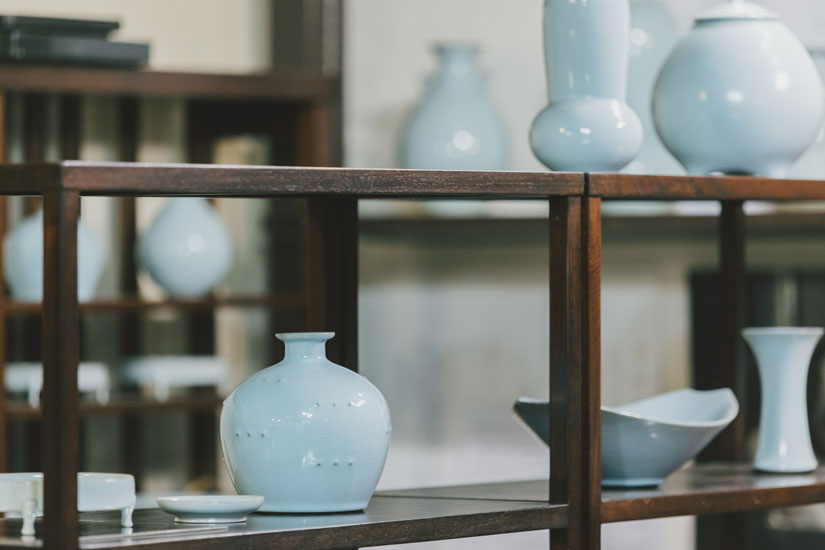
Raised in such an environment, Mr. Tsugane studied the fundamentals of ceramics at the nation’s only vocational school specializing in ceramics, located in Arita, Saga Prefecture, and returned to his hometown after graduation. Following graduation, he worked as his father’s right-hand man, producing dozens of tea bowls for daily use and receiving a lump-sum payment once the exhibition was over. It was a “craftsman”-like way of working, producing the required quantities in a predetermined form. However, the times had changed, and it had become difficult to sustain the kiln by simply making everyday tableware in a kiln nestled in the mountains and waiting for customers, as had been done before.
“We can’t go on like this.”
Realizing this, Tsugane began to consider a path focused not on quantity, but on engaging with the works themselves.
“If so, what should I do as an artist?”
When he asked himself this question, he arrived at celadon. It is considered one of the most difficult genres in the world of ceramics, and few potters attempt it. That is precisely why he wanted to master it. The origins of celadon date back to ancient China. When a transparent glaze is applied to the clay body and fired in an oxygen-deprived kiln, the iron in the glaze reacts to produce a blue hue. However, since glazes made from natural raw materials have unstable iron content, the final color varies depending on the clay body and the conditions of the fire. Producing the exact shade of blue one envisions is no easy task. Due to this difficulty, celadon was once said to be a craft that “ruins your livelihood if you try it.” With virtually no formal training available, Tsugane collected books and, supplementing his understanding of difficult concepts with other texts, pursued his research into celadon entirely on his own.
“I started working with celadon because I felt I couldn’t go on as I was, but once I began, I found myself becoming more and more engrossed in it.”
Thick Glaze, Thin Clay—The Art of Crafting Celadon
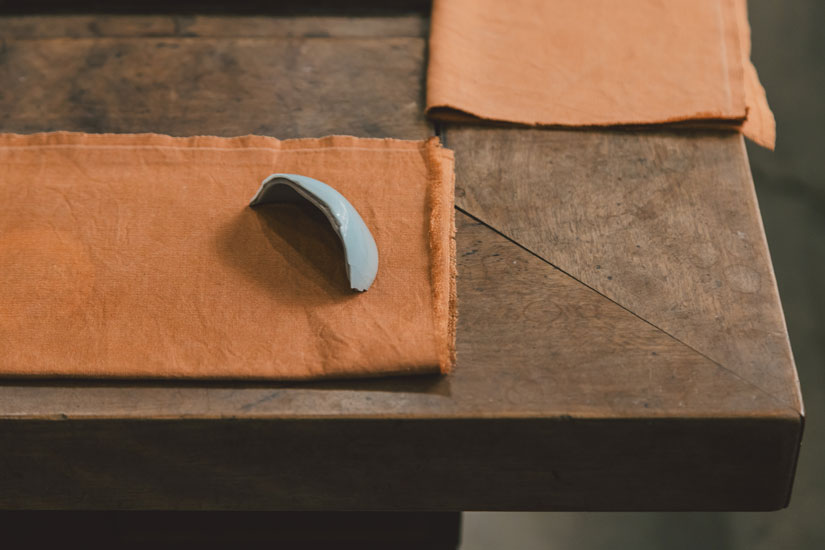
At first, things went surprisingly smoothly. I even won an award at a regional exhibition. But when I entered the world of the Japan Craft Association, I was told, “That’s not celadon. Have you ever seen the real thing?”
In the world of the Japan Crafts Association, the evaluation criteria are completely different from those of regional exhibitions. It is a world where “whether it is authentic craftsmanship” is rigorously scrutinized, taking into account not only the quality of the work but also the materials, techniques, and historical context. Tsugane’s understanding was completely overturned. Celadon is not simply about appearing blue or green. Its defining characteristic is the application of an astonishingly thick layer of glaze. While the glaze on ordinary pottery is less than 1 millimeter thick, on celadon it is 2 millimeters or more, and in some cases exceeds 4 millimeters. Within this thick layer of glaze, light reacts with the iron content to produce that deep hue.
Because the glaze is so thick, the underlying vessel must be made extremely thin to achieve the desired elegance. However, the thinner the vessel, the more likely the clay is to collapse or warp during firing.
This is where the process of creating the clay itself becomes essential. Mr. Tsugane tested clays from all over Japan, gradually adjusting factors such as strength to withstand firing, ease of shaping, and stability in the finished piece to develop his own unique blend. Even when he thinks, “This is good,” he feels compelled to make further adjustments. It is a constant cycle.
The lines drawn by time. An expression called “crazing”
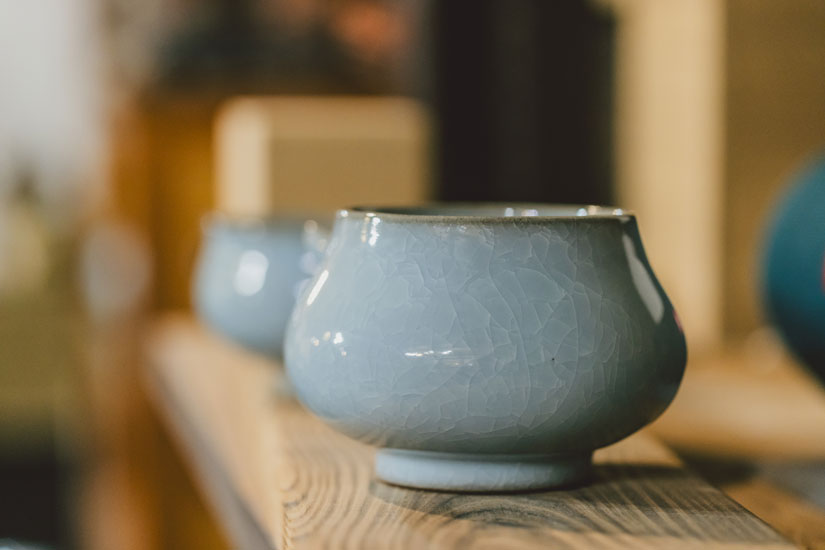
Applying the glaze is just as labor-intensive. Three coats on the inside—drying and building up each layer—and three on the outside. Before firing, the piece looks so far from the finished product that one might doubt it will ever truly become celadon. Moreover, even the slightest change in conditions inside the kiln can easily throw off the color. “Depending on the oxygen levels alone, celadon can even take on a yellowish hue. It’s not about creating the color; rather, it’s about drawing out the coloration of the iron within the thickly applied glaze. That, I believe, is what celadon pottery is all about,” says Mr. Tsugane.
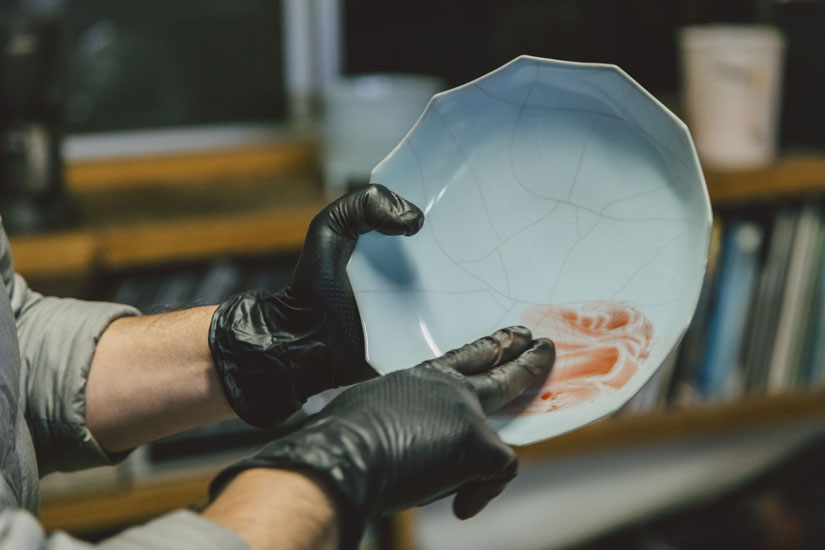
Among Tsugane’s works, the most distinctive are those known as “crazed celadon.” Crazing refers to the fine cracks that form on the surface of a piece as it cools after being removed from the kiln. In celadon, slight differences in the shrinkage rates of the clay and the glaze cause fine cracks to appear in the glaze. Some pieces look as if a thin layer of ice has formed, while others feature red lines created by rubbing vermilion into the cracks. Generally, these cracks are considered to occur by chance. However, Tsugane meticulously adjusts the thickness of the glaze, as well as the firing and cooling conditions, to deliberately shape the pattern of the cracks themselves into an integral part of the work’s expression.
Crackling does not necessarily occur the moment the piece is removed from the kiln. Sometimes, several days or even a month later, it may appear with a sudden “crack.” The red lines that emerge and the transparent lines that appear later—their interplay transforms the vessel’s appearance the more it is used.
What Defines the Quality of Celadon
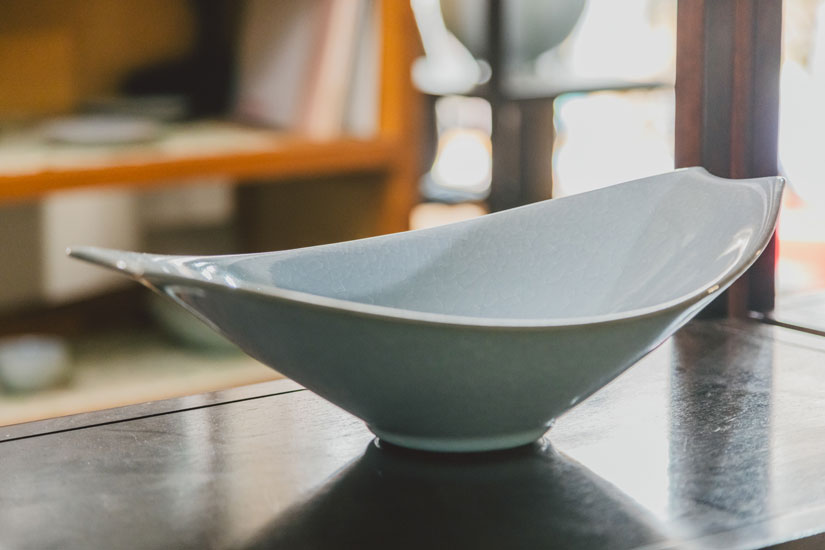
Since being selected for the first time for the “Japan Traditional Crafts Exhibition”—Japan’s premier open-call exhibition organized by the Japan Crafts Association—Tsugane has gained increasing recognition, with his works even being purchased by the Imperial Household Agency. Furthermore, through achievements such as winning the “Japan Crafts Association Award,” he has established a solid reputation in the field of celadon. At the same time, however, he notes that attitudes toward awards have changed significantly over the past decade or so. In the past, winning an award would attract department store events, and customers would visit specifically to see the winning pieces. Now, however, more people choose tableware based on their personal taste, and Tsugane notes, “We are no longer in an era where awards decide everything.”
Nevertheless, what remains unwavering for him is the “dignity” expected of celadon. His goal is to achieve a water-like, clear blue known as “Uka-tensei” (the blue of the sky after rain). To approach this ideal, he studies the lineage of Chinese celadon and travels to China. He believes that understanding the roots provides a solid foundation for new forms of expression.
He uses a gas kiln. His philosophy is not to be particular about the type of kiln, but to choose the flame that best suits the work. For celadon, a strong, stable flame with few impurities is essential.
Furthermore, in recent years, the raw materials themselves are becoming scarce. Fewer people are digging for clay, and he has even been told that the clay he has used for many years “can no longer be obtained.”
Tsugane secures whatever clay he can while searching for new sources, and he meets with suppliers on-site to build relationships. “If there are no longer people digging for clay, we won’t be able to make our work either.”
It is perfected through use
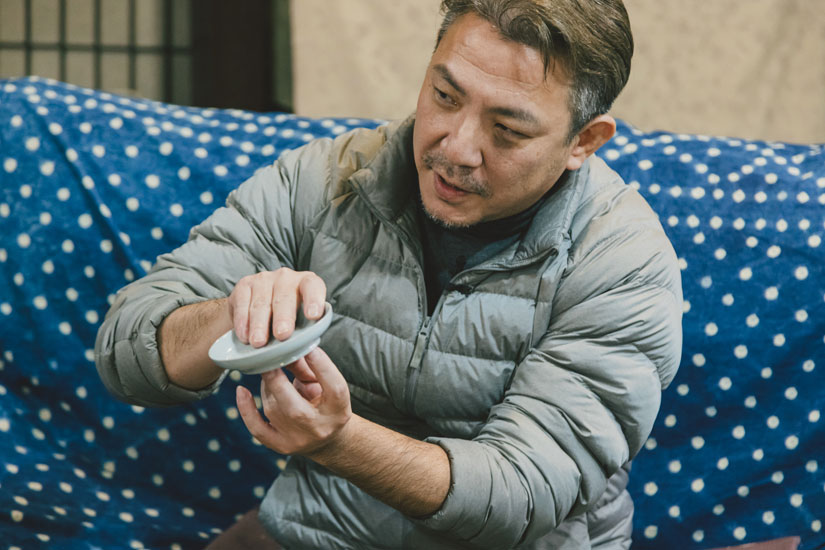
My goal is to become a potter who makes people think, “Tsugane celadon is beautiful. I’d love to own one.” I don’t want to make pieces that are simply displayed in a box; I want to create tableware that is actually used at the dinner table—the kind that makes someone ask, “Whose is that?”
Celadon is understated, and the apprenticeship is long. The yield rate is by no means high. Yet, drawn to the dignity that lies beyond the difficulty, I never gave up. “Even master craftsmen over 70 have mountains of failed pieces in their scrap piles.” When I heard that, I felt the tension melt away.
“I’ll do this for the rest of my life.” I quietly savor those words.
A piece of pottery isn’t finished once it comes out of the kiln; it is gradually completed through use. Tsugane’s work, too, is being built up slowly in that same way.