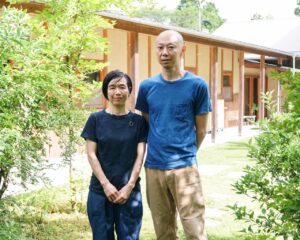


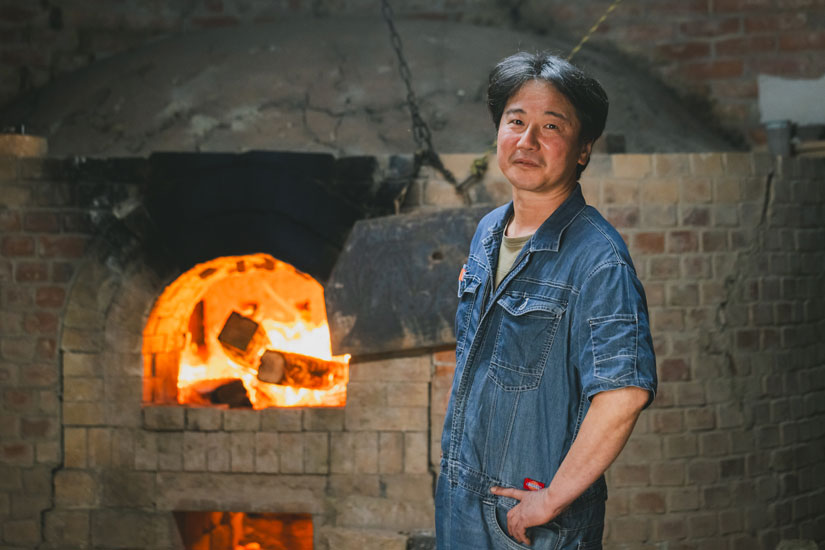
You could call him a thoroughbred. Born into the “Fumoto Kiln”—which boasts six climbing kilns, among the largest in the Kodai-yaki tradition with its nearly 400-year history—Naoyuki Inoue is the son of Yasuaki Inoue, considered a master of Kodai-yaki. While this privileged environment was a source of pride, it also meant he was constantly subject to comparison and judgment.
Is what I want to do really pottery?
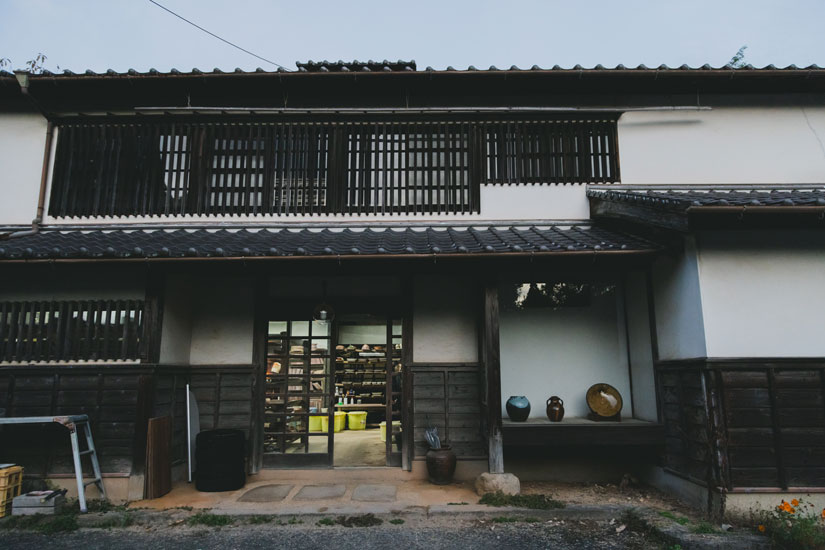
The sound of firewood crackling fills the air. As the flames spread upward, seemingly racing up the slope of the climbing kiln and breathing life into the pottery, I see the history of Kodai-yaki—passed down unbroken for nearly 400 years—overlapping with this scene.
Kodai-yaki is one of Kyushu’s representative ceramics. Its origins are said to date back to 1632, when Hosokawa Tadatoshi, accompanied by potters, established a kiln at the foot of Mount Shodai in northwestern Kumamoto Prefecture.Characterized by a rustic, robust texture created using Shodai clay—rich in iron and small pebbles—and bold designs achieved by applying glazes made from local natural materials, such as straw ash and wood ash, its appeal lies in a simple yet profoundly deep presence.It was designated as a National Traditional Craft in 2003, and today, 11 kilns remain, primarily in Arao City and Minamikan Town, Tamana District.
Among them, the “Kodai-yaki Fumoto Kiln” in Fumoto, Arao City, is a renowned kiln that has produced many apprentices and boasts six climbing kilns—the largest number among existing Kodai-yaki kilns. The founder, Yasuaki Inoue, won the top prize at the Japan Folk Crafts Museum Exhibition and received awards at numerous other exhibitions; he is known as an indispensable figure in the development of Kumamoto’s traditional crafts.
Born in 1975 as Yasuaki’s eldest son, Naoyuki Inoue has incorporated his own identity into the craft’s approximately 400-year history and tradition. He is a popular artist renowned for his unique “slipware” (pottery decorated with a slip, a type of decorative clay) inspired by old British ceramics.As a child, he played with chipped pottery pieces as if they were a dollhouse set, and naturally assumed he would become a potter one day. However, during high school, he suddenly paused to reflect. Was pottery really what he wanted to do? Though he enrolled in a local design college while still uncertain, the answer remained elusive. Looking back on that time, Naoyuki lowers his eyebrows and laughs, saying, “To be honest, I was just drifting along.”
The Fusion of Traditional Kodai-yaki and Slipware
Naoyuki set out on a journey. He visited acquaintances of his brother Taishu in Tokyo, Tochigi, and Okinawa, and while he was shown pottery and workshops in each place, nothing really clicked. But for some reason, Koishiwara was different. Upon seeing the “Ota Tetsuzo Kiln,” a representative of Koishiwara-yaki, he naturally felt, “I want to study here.”After that, he spent four years apprenticing under the kiln’s founder, Tetsuzo Ota, before returning to his family’s Futomogama kiln. Feeling anxious as he watched his senior apprentices far ahead of him, he continued his training. But when he finally sat down at the potter’s wheel, Naoyuki felt at a loss. Now that he was actually in a position to create, he couldn’t see what he wanted to make.
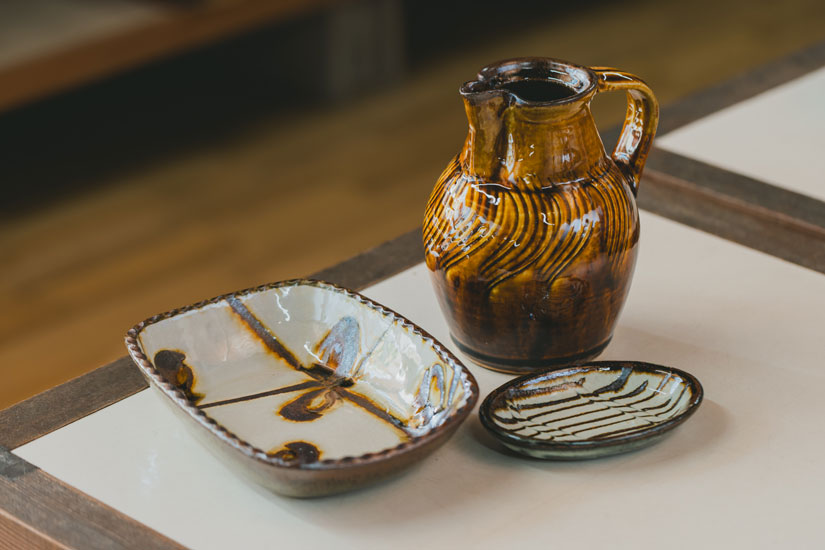
The clue came from “pon-gaki,” one of the techniques he had learned under Mr. Ota. This decorative technique involves pouring glaze from a special container onto the surface of the vessel to create lines and patterns.Naoyuki sensed a kinship between this “pon-gaki” and “slipware”—pottery decorated with slip, a tradition originating in England—and sought “what he wanted to create” by studying old slipware and related literature. He eventually arrived at a unique style that fuses Kodai-yaki with slipware. He had found his identity within the approximately 400-year history and tradition of the craft.
Creations Born from Local Materials and Universal Designs
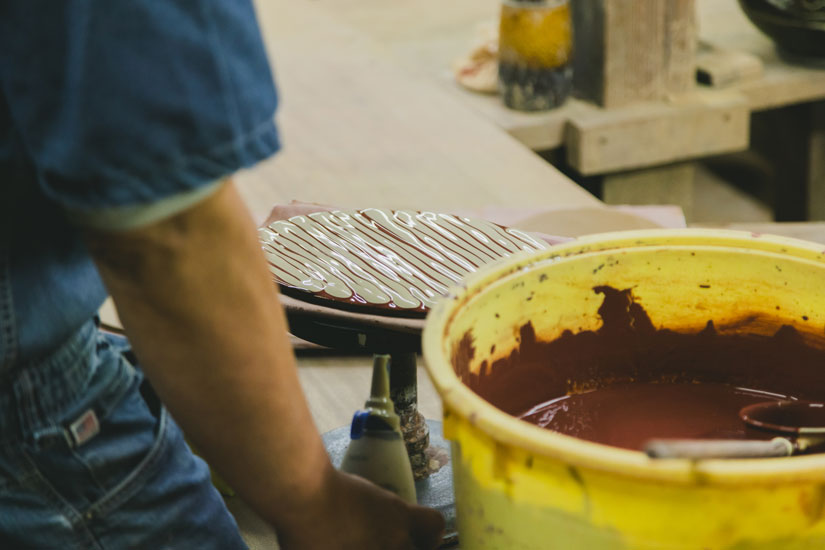
Naoyuki’s works utilize Kodai clay that he excavates himself. Just like traditional Kodai-yaki, he uses local natural materials: wood and straw for the ash used in glazes, and pine wood for firing fuel. Before the shaped clay has completely dried, he pours over it a mixture of clay dissolved in water, and then drips another color of clay dissolved in water from a syringe-like tool onto the surface to create patterns.
His designs are based on universal patterns selected from old British texts, which he reinterprets and reconstructs in his own unique way. This stems from his belief that “universal things have been passed down to the present precisely because people never grew tired of them.” The variations are diverse, ranging from wavy lines and crosses to shapes resembling ribbons. His free-flowing, dynamic lines reflect Naoyuki’s easygoing and carefree personality.
While Naoyuki’s style is now widely supported by consumers, he faced strong criticism when he first began, with critics claiming, “This is not traditional Kodai-yaki.” However, the words of a certain benefactor—“Even if nine out of ten people are against you, there is one who is on your side. I am on your side”—became a source of strength for Naoyuki and have sustained him to this day.
A Craftsmanship Rooted in the Earth and Fire
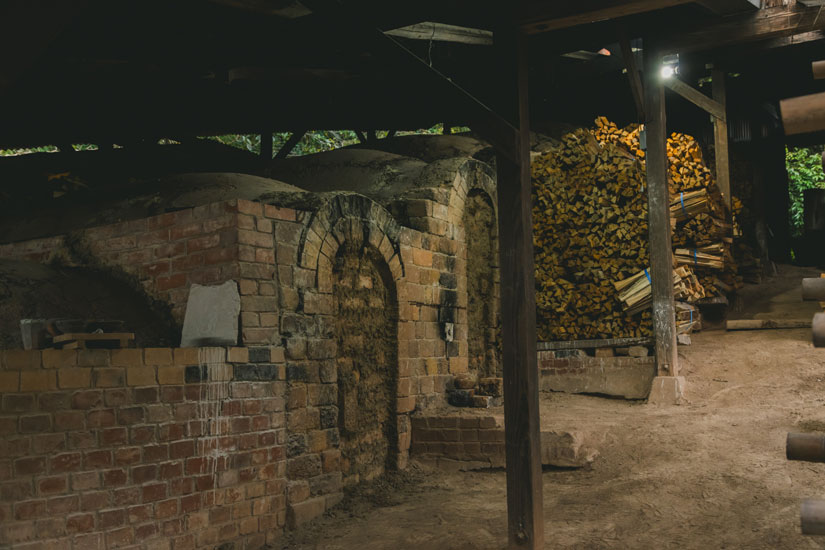
Naoyuki uses a six-chamber climbing kiln to fire his works. It was completed by Taishu approximately 50 years ago, in 1977. A climbing kiln, which requires continuous feeding of firewood and temperature management over several days, is much harder to control than a gas kiln. It is said that “it might take a lifetime to fully understand it” and that “the condition of the kiln determines the quality of the work.”Because conditions inside the kiln—such as temperature and oxygen levels—cannot be kept uniform, defects like cracks and warping are common; at the “Kodaiyaki Fumoto Kiln,” the yield rate remains around 60%. Even so, many ceramic artists are captivated by the beauty—beyond human understanding—woven from the ash and flames produced by the firewood. Naoyuki, however, states firmly, “I don’t want to use the climbing kiln as either the reason for the quality of my work or as an excuse.”This is because he believes that the method of firing is not what matters; rather, the quality of the finished piece itself should be the focus of evaluation.
The interior of the kiln deteriorates with repeated use. The “Kodai-yaki Fumoto Kiln” has long since exceeded its estimated lifespan of 100 firings and continues to be used while undergoing repeated partial repairs. Naoyuki is unconcerned, stating, “I’m not fixated on climbing kilns, and even if it becomes unusable, I have a plan in place, so it’s not a problem.” Yet he also acknowledges its appeal, noting, “There is a unique charm found only in climbing kilns.”
After a long period of uncertainty and inner conflict, Naoyuki has found his place within history and tradition. Now, standing beside him is his son, Ryoga, who returned to the family home in 2024 as the third-generation head of “Kodaiyaki Fumoto Kiln” after completing his apprenticeship at “Iwai Kiln” in Tottori Prefecture. Not only the tradition of Kodaiyaki itself, but also the craftsmanship rooted in a continuous dialogue with clay and fire is now being passed on to the next generation.