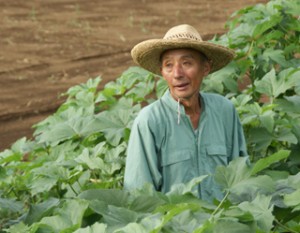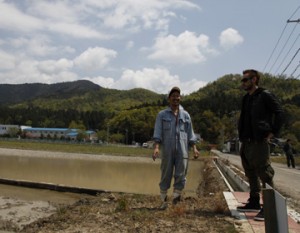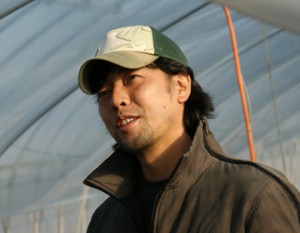

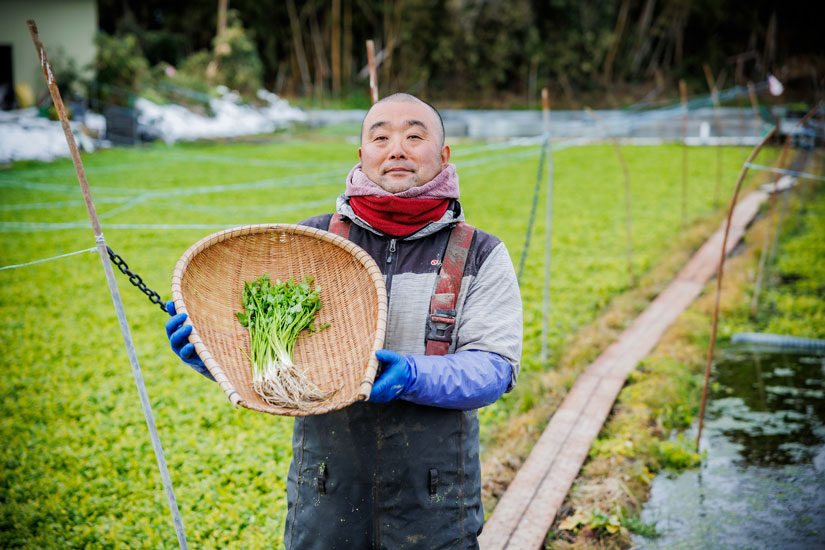
Seri (Japanese parsley) has long been an indispensable part of Japanese cuisine and is used in spring dishes such as shichigusa-gayu (rice gruel with seven herbs). Natori City in Miyagi Prefecture is famous for Sendai Seri. Takahiro Miura, the representative of “Miura Noen,” is the driving force behind the spread of “Seri Nabe,” a Sendai/Miyagi specialty. The Seri grown by Mr. Miura are in great demand by restaurants, and are hard to find. What is the reason why “Seri nabe” has become a representative gourmet dish of Sendai?
Sendai Seri” has been grown in the soil of Natori City for 400 years.
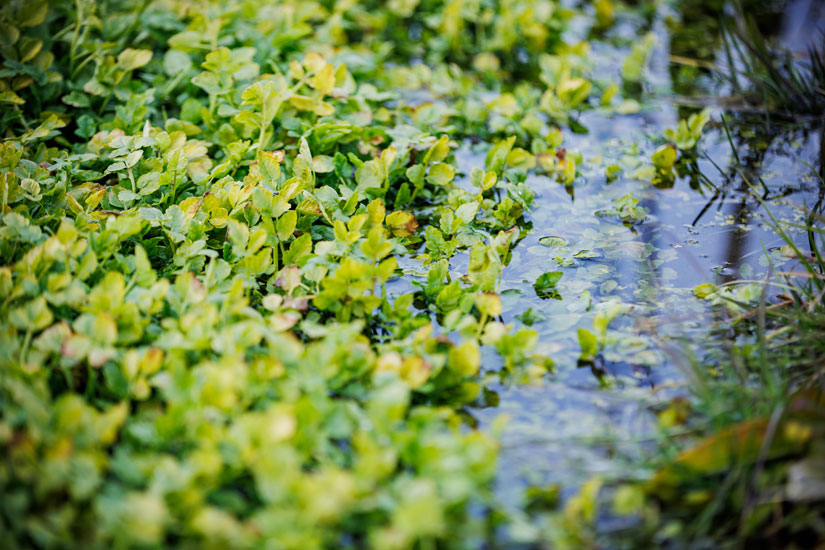
Production of Seri started in Natori City about 400 years ago, and people in Sendai used to eat it as Zoni or Nanakusa-gayu (rice boiled with seven herbs). Seri has been grown in this area because the soil is suitable for its cultivation. According to Mr. Miura, the soil is suitable for growing lotus root and kuwai, which are grown in marshy areas where “water comes out when the soil is dug a little. Mr. Miura makes the most of such blessed soil and practices agriculture that is close to nature.
Connecting Nature and People as a “Translator of the Land
As a seri farmer, there is one thing that Mr. Miura values most. He makes sure that his produce arrives on the plates of those who eat it in good condition.
He says, “I don’t want to just sell them and be done with it. I always think that I have to be the most demanding customer. The role of a farmer is to be a “translator” of the soil, ecosystem, and water. I try to verbalize what kind of creatures and plants exist in the land,” says Miura calmly.
Miura believes that conveying the value of things rooted in the land is the meaning and value of being a farmer, and that he is a link between the past and the future.
Aiming for Nature-Positive Cultivation
Mr. Miura’s goal is to cultivate his crops in a nature-positive manner. This means reducing the negative impact of human activities on the natural environment and promoting the restoration and diversity of ecosystems.
He does not use pesticides or chemical fertilizers, but instead incorporates organic matter to create an environment that pleases the creatures in the soil, such as Japanese stoneworms and gengorou (Japanese gengorou). The more organisms that are introduced, the richer the soil becomes, which in turn leads to tasty crops. Organic fertilizers used include fermented grouper, soybean oil meal, and chicken manure. Although chicken manure is fast-acting, it tends to be high in phosphoric acid, so he increases the use of fish meal and other amino acid-based fertilizers to maintain a good balance.
Careful manual labor at Miura Farm
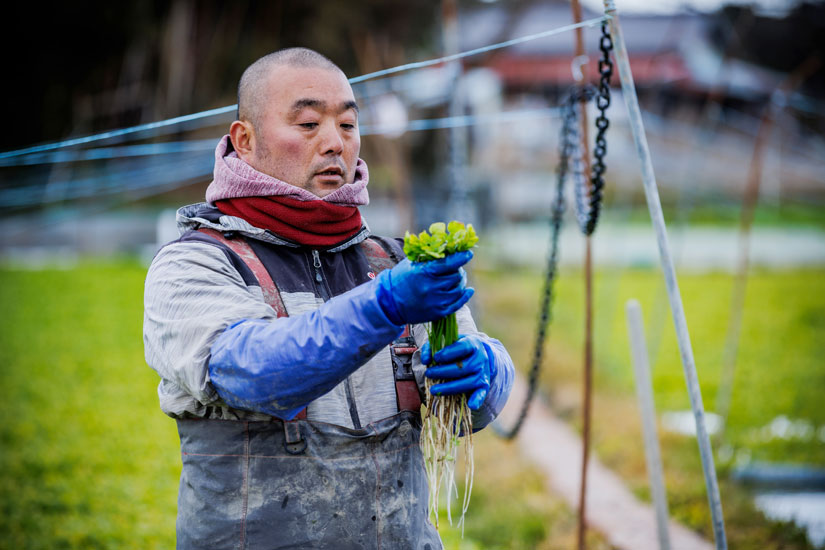
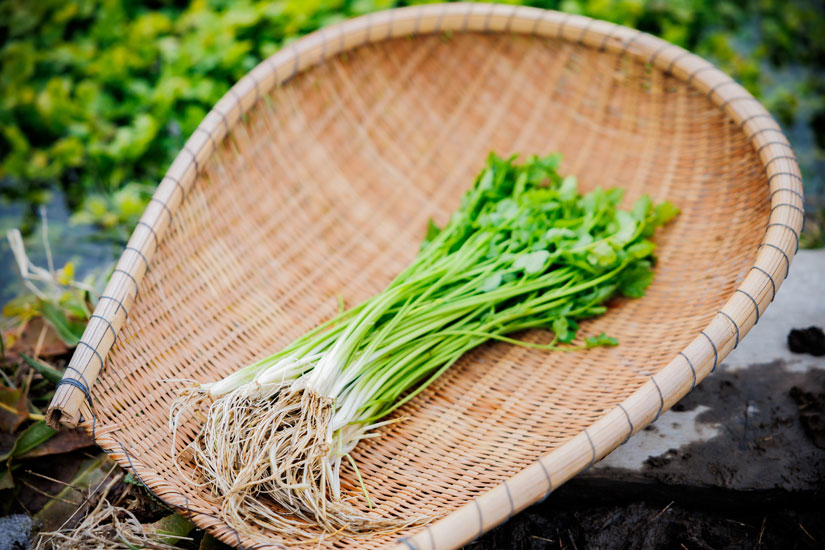
The cucumber harvest season is from September to May. When the sprouts turn green and grow to about 50 cm in length, it is time to harvest. The farmers enter the rice paddies wearing waterproof ties and pull out the celli one by one by hand, then rinse off the mud and begin shipping. After harvesting, yellow or damaged leaves are sorted out. Only about 40% of the cherries are actually shipped. The remainder are all omitted from the sorting stage. I try to produce only what I would like to eat myself, thinking of the faces of the people who will eat it,” he says.
Local ingredients take center stage. The Origin of Seri Nabe
Speaking of nabe using Japanese parsley, “Kiritanpo nabe” in Akita is well-known. However, the main ingredient is kiritanpo, and seri does not appear in full force. In Sendai, however, the star of the Seri nabe is the Sendai Seri.
Mr. Miura invented this “seri nabe” about 20 years ago. Although Sendai is famous for its beef tongue, sasakamama, hagi no tsuki, and zunda, many of the ingredients are not from Miyagi Prefecture, so he wanted to create a specialty using local ingredients.
A unique Miyagi specialty that took shape through collaboration with chefs
At the time, celeri was eaten mainly by the stem, and the leaves and roots were often discarded.
But all parts are delicious. So I thought it would be nice to have a dish where you can taste the whole thing,” he says.
After consulting with the owner of Inaho, a kappo restaurant near Sendai Station, Mr. Miura developed “seri nabe” around 2003 to 2004. The dish gradually spread, especially among restaurants in Sendai, and gradually became established as a winter delicacy.
It was also the time when social networking services were becoming popular, and he made sure to put the Seri in heaps and put the roots on top to draw people’s attention to the dish. He says, “You can’t tell what it tastes like unless you eat it. But if you can get people interested in the appearance, you can create opportunities,” says Miura.
Tasting all aspects of the Japanese parsley, from the leaves to the roots
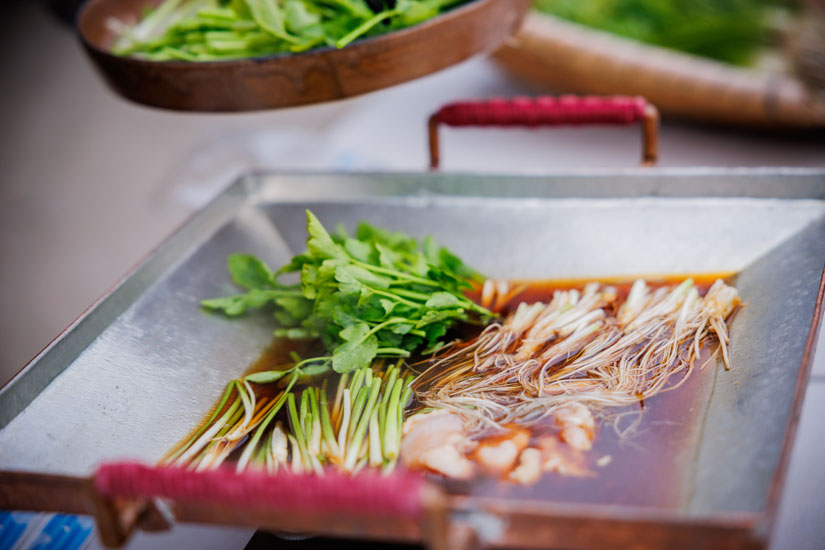
One of the main characteristics of seri nabe is that the roots are eaten. Organically grown Seri have a distinct sweetness and aroma at the base of the stem and near the roots, and when added to the nabe, their delicious flavors blend together perfectly. Until then, people in Sendai had never eaten the celeri root, but as more and more people became aware of its deliciousness, it has become the symbol of “Sendai celeri. The tasty parts also vary with the season, with the roots in fall and winter and the sprouts in spring.
As for meats that go well with “seri nabe,” the restaurant recommends chicken and duck, as well as fish and gibier. Miura says that there is no set rule for the broth, and that the fun part is being able to compare different restaurants.
Seri-nabe culture spread after the earthquake
At first, seri nabe gained a reputation among local “foodies” for being “delicious. However, it was not until the Great East Japan Earthquake that it became widely known. In support of the recovery efforts, many people began to ask for the “Seri nabe” to be paired with Miyagi sake. Since many other dishes relied on ingredients from outside the prefecture, the use of locally produced Seri was a significant contribution to the local economy. The use of locally produced Seri was also a major factor in promoting awareness of Seri nabe, as visitors to the disaster-affected areas were encouraged to eat local food and show their support.
Mr. Miura believes that “the original taste of Seri can be conveyed only in this region. Therefore, with a few exceptions, sales are limited to stores in Sendai City. He says, “Getting people to eat it here will ultimately help to revitalize the local economy.
Over the past 20 years, he has doubled the price of his products. Connecting Local Agriculture to the Future
Thanks to the popularity of “seri nabe,” demand for seri in Miyagi Prefecture has increased over the past 20 years, doubling its price. In fact, according to data provided by the Miyagi Agricultural Cooperative, in 2007, shipments totaled 622 tons and the value was 490 million yen; in 2019, despite shipments of 345 tons, the value was over 550 million yen. It can be seen that the amount of shipments has halved due to the aging of producers and other factors, yet the value of these shipments has risen.
This has led the younger generation to choose seri farming as a career, which is helping to solve the shortage of successors.
Miura says, “I think this is an example of how important local connections can be made if the producer, distribution, and the place where the food is consumed are well connected. And by incorporating local gastronomy, or the climate, history, and culture of the region into the cuisine, this example can be made in many different regions. Just as the success of “seri nabe” has doubled its price, Miura offers hope that there is a better future if we delve into the culture of our own region.
Raising the Next Generation of Seri Farmers and Revitalizing Sendai
Mr. Miura’s dream is to increase the number of Seri farmers and expand environmentally friendly farmland while protecting wetlands. He also hopes to create a platform and textbooks that will help the younger generation enter the farming industry and serve as role models. We will also continue to educate the younger generation, such as through nutrition education.
Mr. Miura has continued to promote “seri-nabe” and has made it a Miyagi specialty. He will continue to serve as a role model for regional and local gastronomy.