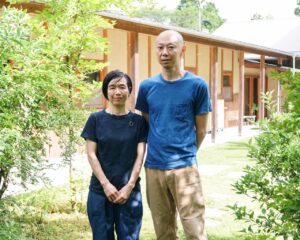


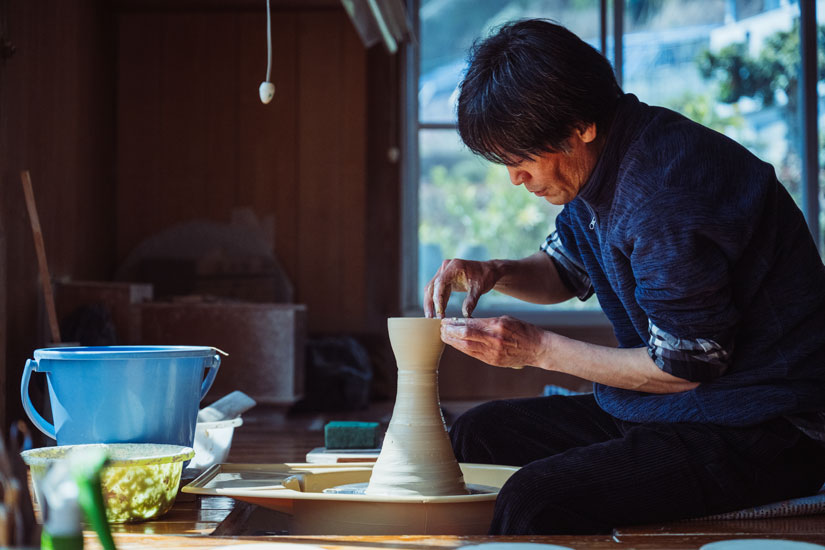
Tobe pottery was born in the town of Tobe, Ehime Prefecture, and boasts a history of 250 years. Currently, there are about 80 kilns, one of which is the “Midorikogama” run by Shigeki Kameda (Midoriko) and his son Shigetomo. They are pursuing an unprecedented expression of blue-and-white porcelain by taking advantage of the characteristics of Tobe’s clay.
Tobe Pottery has been handcrafted for 250 years.
Tobe ware, produced in and around Tobe Town, Ehime Prefecture, has been handed down since the mid-Edo period. It began in 1777, when Yasutoki Kato, the lord of the Oshu domain who ruled this area, ordered the production of porcelain as a new specialty. Tomochi had long been known for its whetstone, called “Iyoto,” and he wondered if it would be possible to use the waste stone produced when the whetstone was quarried as a raw material. Josuke Sugino, who was entrusted with this development, succeeded in firing porcelain in 1777, despite repeated failures. This was the beginning of Tobe ware.
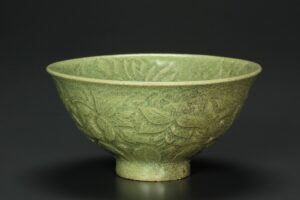
During the Edo period (1603-1867), there was little information available from other clans, so the pottery developed only with its own techniques, but during the Meiji period (1868-1912), techniques from Kyoto and Karatsu were introduced, and in the early Taisho period (1912-1926), tea bowls known as “Iyo bowls” were well received overseas, and exports accounted for much of the production volume. After the war, there was a period of decline due to modernization, but a turning point came in 1953 when Muneyoshi Yanagi and Shoji Hamada, promoters of the folk art movement, visited Tomochi. While other production centers were turning to mechanization, the quality of Tobe pottery, which is made by hand, was reevaluated. Under their guidance, the prototype for modern-day Tobe ware, in which thick white porcelain is painted with arabesque and chrysanthemum designs in gosu, was created. In 1976, Tobe ware (four types: white porcelain, some-glaze works, celadon, and tenmoku [iron glaze]) was designated a national traditional craft.
A kiln of Tobe ware that has continued for half a century
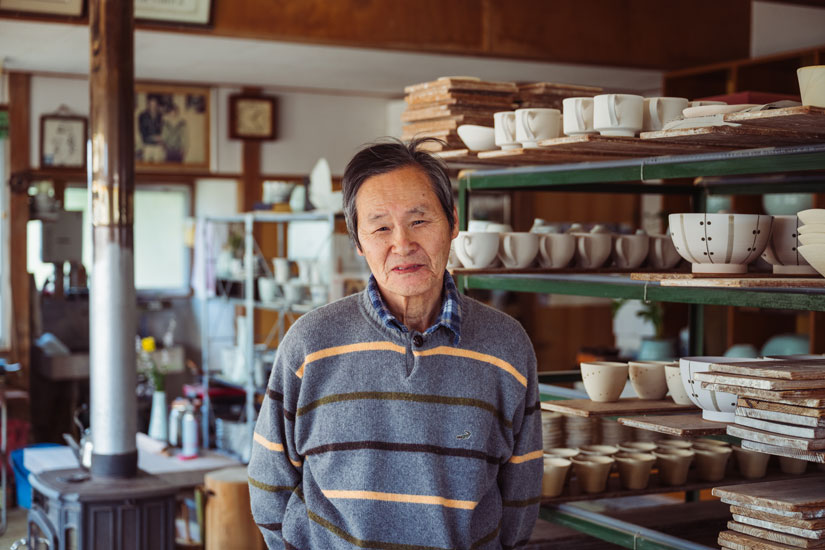
The Ryokko Kiln was opened by Shigeki (Ryokko) in 1974. The kiln was named “Midorikogama” after the lush greenery of the original location where he opened the kiln and after the name of the “Houkogama” kiln where Shigeki learned pottery making.
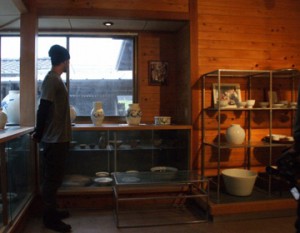
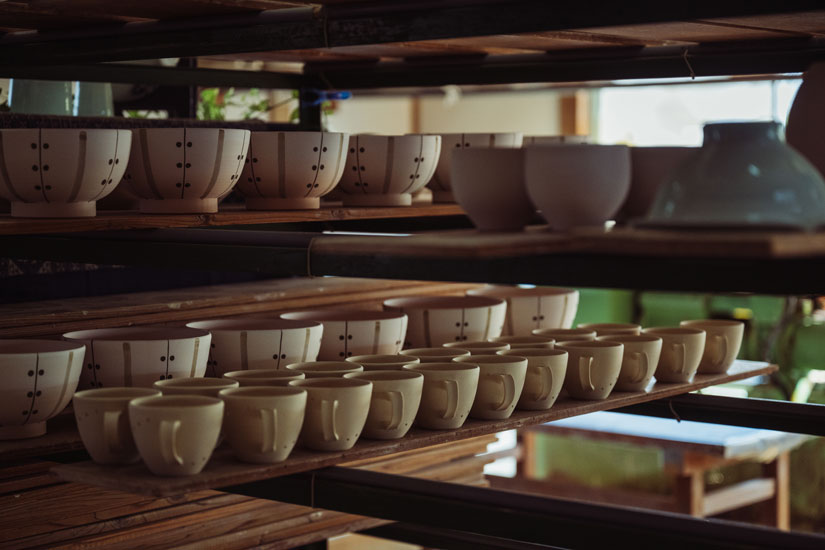
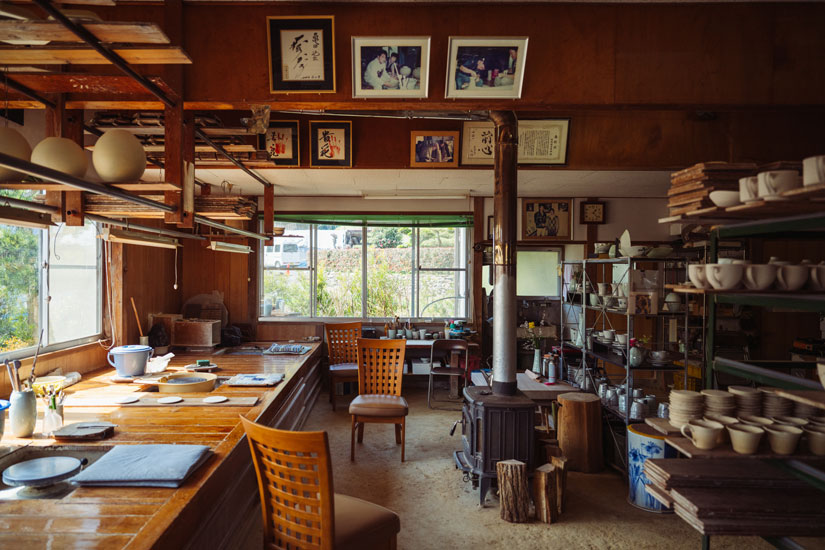
Shigeki is a master potter who has won numerous awards at the Japan Traditional Crafts Exhibition and the Japan Ceramic Art Exhibition, and was registered as an intangible cultural asset by Ehime Prefecture in 2019. His current studio is located in Kitakawage, Tobe Town, and also serves as a sales and gallery. The wide range of items on display includes everyday use vessels, couple’s tea bowls, and flower vases of various sizes, as well as traditional and new styles.
A potter’s path started with his father as a mentor
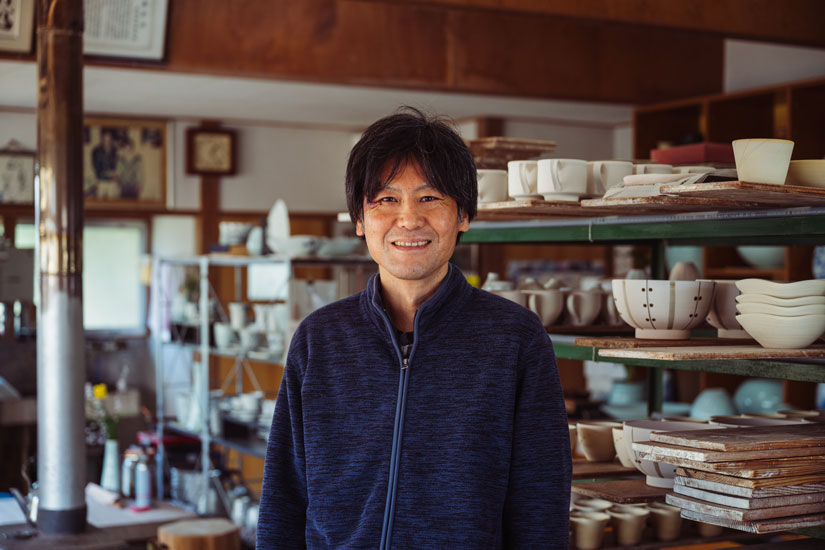
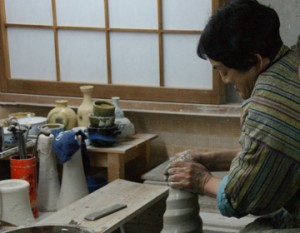
With his father as his teacher, Shigeyu began his career as a potter at the age of 26. His blue-and-white porcelain sculptures have won numerous awards at the Japan Traditional Crafts Exhibition, the Japan Ceramic Art Exhibition, and other exhibitions.
Most of Tomoitomo’s pottery is used in daily life. Our main production is tableware,” he said. I also try to make large pieces for exhibitions. If the size of the vessels is too large, I have to create a design that will not be overwhelmed, so it is difficult to find the right balance,” says Motomo.
He continues to challenge himself to create new expressions by using a variety of techniques, such as carving patterns and glazing in a gradation of colors.
Use local materials. Depth is born from restrictions.
The characteristic of Tobe ware is its beautiful white porcelain surface with a sense of transparency. This is due to the unique clay of Tobe.
Tomochi says, “Tomochi pottery is not pure white like Arita-yaki, but has a slight grayish tinge. Therefore, it is necessary to take advantage of the characteristics of this clay when painting. Even if you use Arita-yaki clay for arabesques, the coloring is different,” says Shigeki.
The clay of Tomochi contains iron, which makes it easy to produce blue colors. In the end, when I was doing something that suited the clay, it naturally took this shape,” he says. This is what Tobe pottery is all about,” he says, with a sense of conviction backed by many years of experience.

Recently, an increasing number of porcelain production areas are importing raw materials from other places, and the true meaning of “production area” seems to be disappearing, but the duo is determined to use only the soil from Tobe.
However, the duo is determined to use only the best clay from Tobe. “If there is one restriction, we can pursue it in depth within that range. So I think it is better to have restrictions. If I can take an approach that has not been seen in previous Tomochi pottery, it will become my new expression. That is what I have been pursuing for the past 10 years or so,” says his son, Shigeyu. He has been pursuing his own expression in a very honest manner.
Seeking the possibilities of blue-and-white porcelain and creating an expression that only he can create
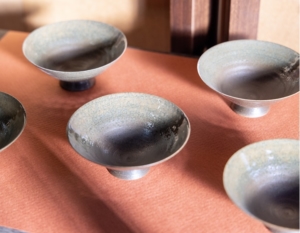
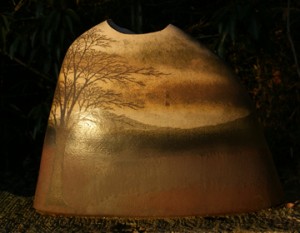
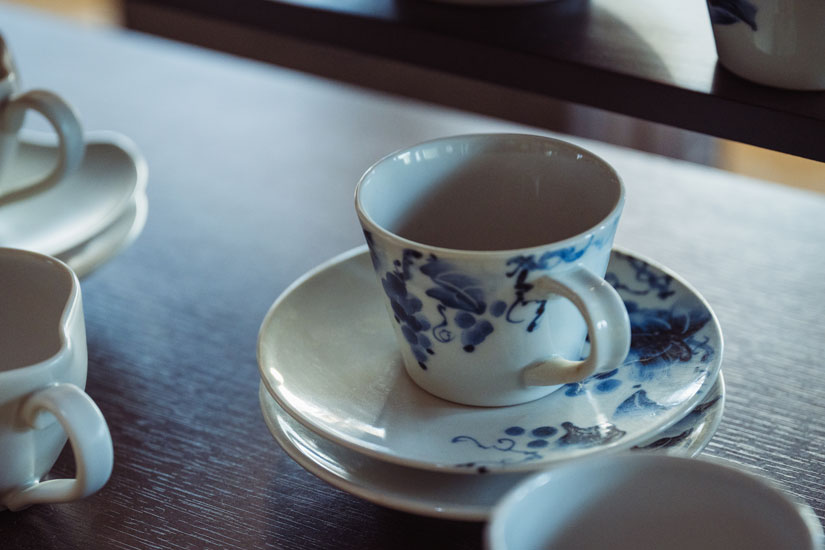
Blue-and-white porcelain, with its translucent shades of blue that ripple and spread, is synonymous with Ryokko-gama.
Blue-and-white porcelain is made from porcelain clay made from white stones and fired with a glaze containing a small amount of iron. The molten blue glaze collects in the engraved patterns and creates a beautiful puddle-like expression.
The difficulty with blue-and-white porcelain lies in the fact that the thicker the glaze is applied, the more stress is placed on the vessel during the firing process, making it susceptible to cracking. The thicker the glaze is applied, the more beautiful the shading will stand out, but if too much is applied, the glaze will run into unintended places. This is where the skill of the craftsman really shines.
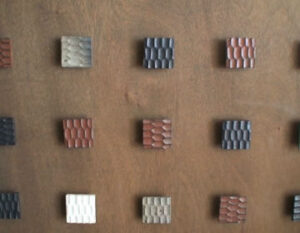
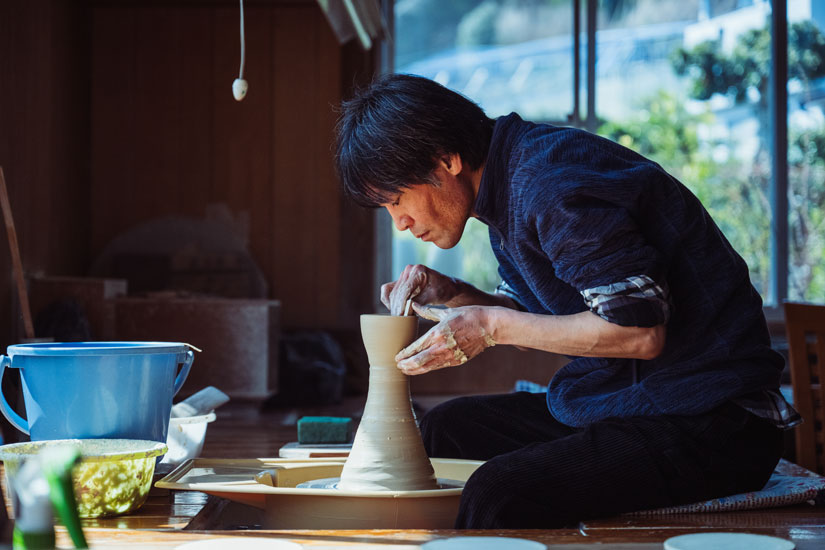
The wavy patterns are carved. After carving with a round carving knife, Shigetomo polishes and smoothes the surface before applying the glaze.
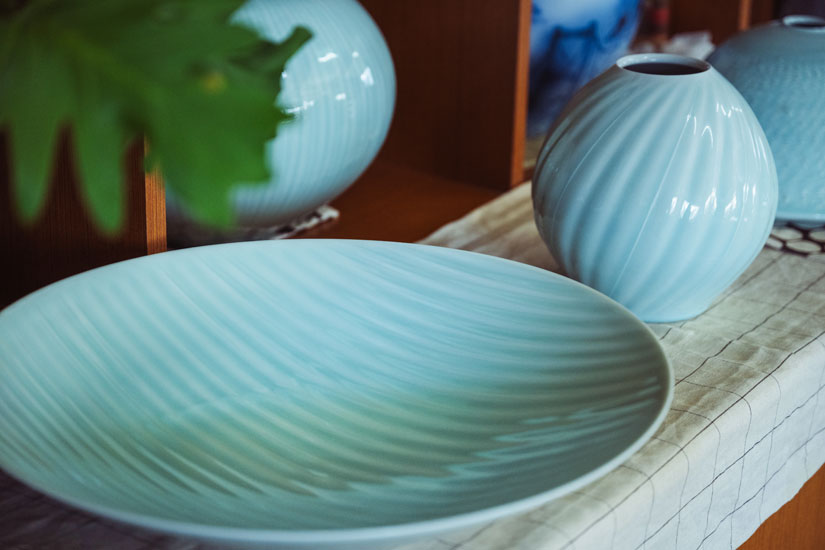
The glaze melts and flows a little during firing, so the glaze in the mountainous areas flows a little to the left and right. The glaze in the mountainous areas flows a little to the left and right, and the glaze in the valley areas accumulates and the color becomes darker. This is how gradation is created.
This is the same principle as seawater. If you scoop sea water, it is clear, but the sea itself looks blue. Even if the same glaze is applied, the thickness of the glaze makes such a difference.
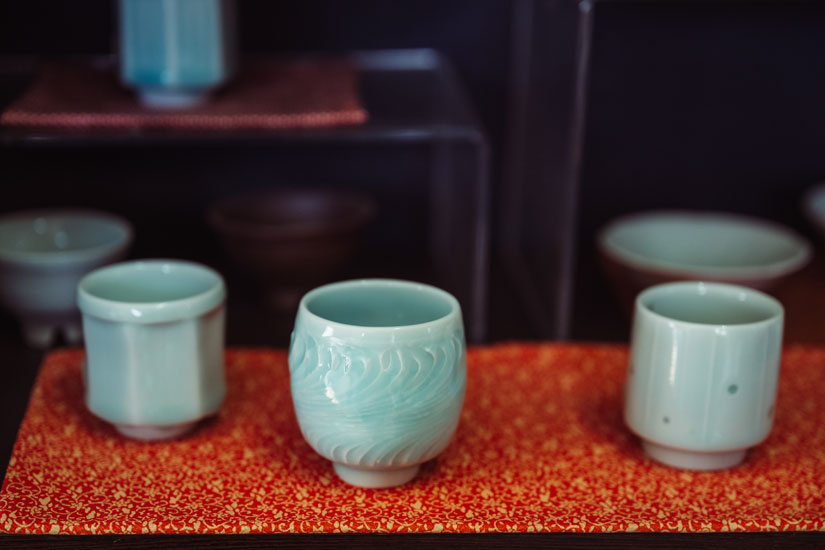
Although he creates his pieces with an image of how the glaze will flow in advance, he does not know how they will turn out until after they are fired and pulled out of the kiln. Unlike painting, it is not possible to create a clear design with colors, which makes it both interesting and difficult. The two say that this is one of the most exciting aspects of ceramics.
Aiming to create vessels that fit comfortably in the hand
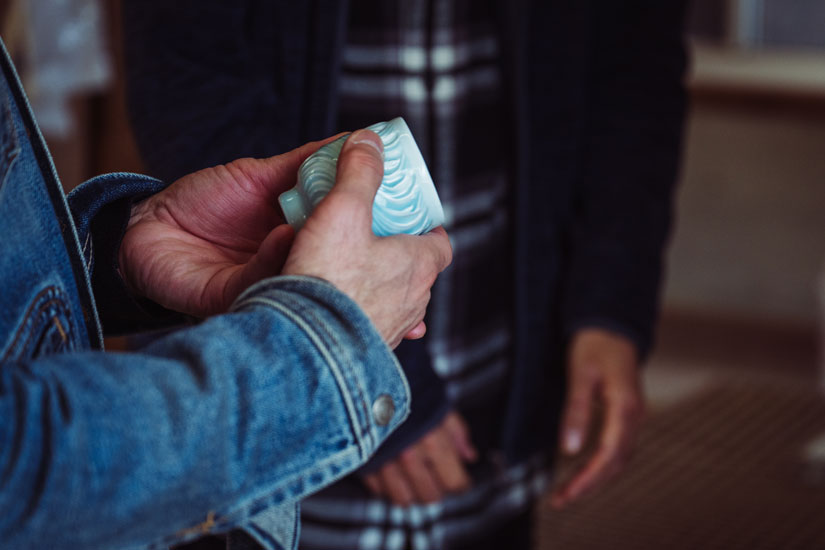
Tomochi’s pottery is for daily use. That is why Shigetomo also places importance on the user’s point of view. The blue-and-white porcelain teacups he makes have an uneven surface due to carving, so they are easy to hold even when hot tea is served. This is where I feel the beauty of utility.
When choosing tableware, I want people to hold it in their hands and choose the one that fits comfortably in their hands,” he says.
Passing on skills to the next generation
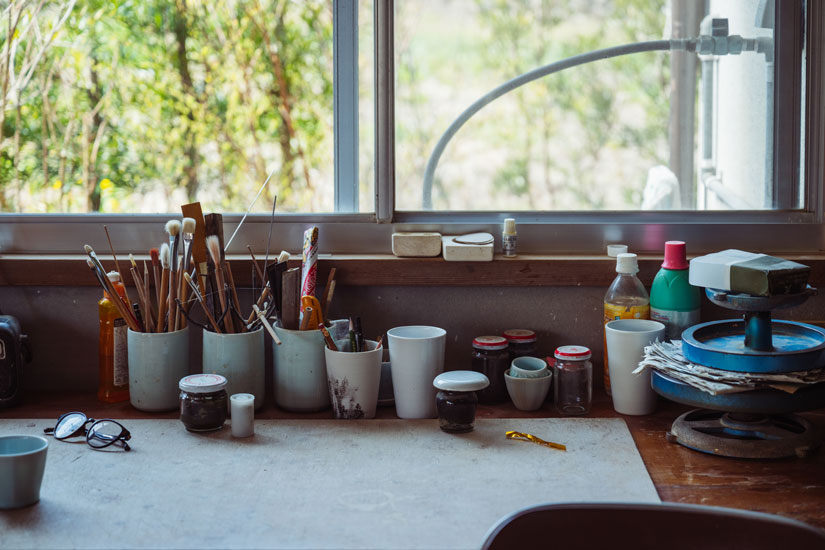
In recent years, an increasing number of potteries have been closing due to a lack of successors and the aging of the workforce. The aging of the kiln operators is very noticeable. How to nurture the next generation is a major issue,” says Shigeki with a sense of crisis.
The road to mastering Tobe pottery is a long one. The simpler the piece, the more difficult it is to make.
At first, there are many failures, and I sometimes feel like giving up. But if you don’t get over that, you won’t be able to master the technique. It is important to learn the basics until you can express yourself. If you don’t have a ready supply of techniques, you will eventually get stuck,” says Shigetomo.
Together with the clay of Tobe, they continue to seek new expressions beyond tradition. From their backs as they work silently on their ceramics, I could sense their deep love for Tobe pottery, which boasts a history of 250 years.