

In recent years, “seagrass die-off”—a phenomenon in which seaweed can no longer grow in the ocean due to rising sea temperatures—has become a global marine environmental issue. It is said that Japan’s natural seaweed beds are disappearing at a rate equivalent to 1,200 Tokyo Domes worth per year. Alarmed by this situation—in which the foundation of the marine ecosystem is being undermined, affecting the fishing industry as a whole—Kochi Prefecture-based “Sea Vegetable LLC” (hereinafter “Sea Vegetable”) launched the world’s first land-based cultivation of aonori using underground seawater in 2016. By expanding seaweed farms across the country in collaboration with local partners and actively pursuing both land-based and offshore cultivation, the company aims to preserve the richness of the ocean and the culinary culture centered on seaweed.
Cultivating Aonori, Which Disappeared from the Shimanto River, on Land
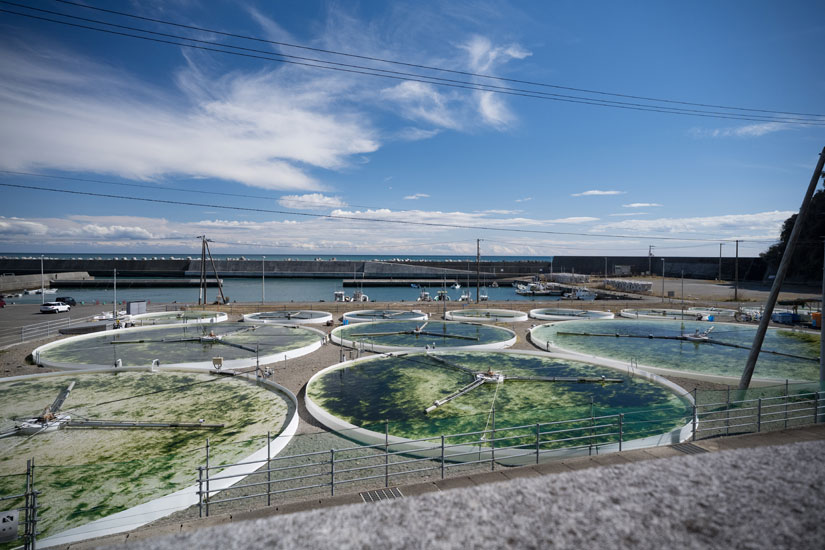
Kochi Prefecture is known for its intense sunlight streaming down from the blue sky and its warm climate. The prefecture has a narrow, east-west shape, with the Pacific Ocean to the south and the Shikoku Mountains towering to the north. At Sea Vegetable’s land-based facility, “Suji Aonori”—known as the highest-grade variety of aonori—is being cultivated using the world’s first land-based cultivation technology.
My deep love for the ocean, which I’ve felt since my college days
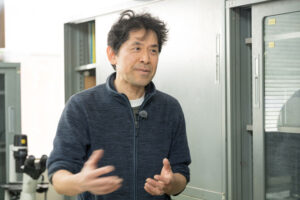
Co-founder Jun Hachiya, a native of Okayama Prefecture, conceived a business plan for “integrated aquaculture of abalone and seaweed using deep-sea water” while still a student at Kochi University. With the cooperation of co-founder Yuichi Tomohiro, he conducted demonstration research aimed at commercializing the project. Deep-sea water is seawater drawn from depths of 320 to 374 meters off the coast of Muroto in Kochi Prefecture; it maintains a stable, low temperature of approximately 10 degrees Celsius year-round.
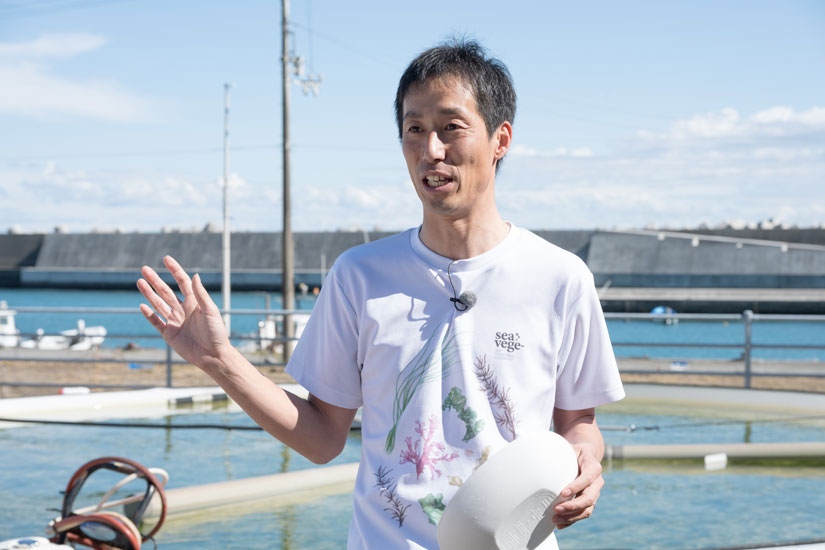
Mr. Hachiya says he originally enjoyed diving into the ocean and catching fish he could see up close. “Every year, whenever I dived in the same spot, the number of fish visibly decreased. I realized that wherever fish gathered in large numbers, there was always seaweed, and driven by a desire to bring fish back to the ocean, I threw myself into seaweed research.”
Rising sea temperatures due to global warming have altered fish habitats and impacted Kochi Prefecture’s seaweed industry. The brackish water zone near the mouth of the Shimanto River—known as “Japan’s Last Pristine River”—where freshwater and seawater mix, was once the nation’s premier natural fishing ground for “suji aonori” (striped green laver), but by 2020, the catch had dropped to nearly zero. It is believed that the decline in catch is directly proportional to the rise in water temperature in the estuary.
Mr. Hachiya took action to revive the “suji aonori,” which could no longer be harvested naturally. He explained that his determination grew stronger as he thought, “If seaweed can no longer grow in the ocean, let’s grow it on land,” and “I want to take on this challenge to ensure that the culinary culture of seaweed does not die out.”
In a large tank built near the Pacific Ocean, blue-veined nori drifts about
When you visit Sea Vegetable’s land-based facility along the coast overlooking the Pacific Ocean, you’ll be amazed by the rows of massive circular tanks. The largest one has a diameter of about 25 meters—roughly the length of an elementary school swimming pool.
Suji aonori grows at an astonishingly fast rate; under the right conditions, it can double in size in a single day, and it’s said to possess such vitality that its appearance changes between morning and evening. The tanks come in four sizes, and about once a week, the grown Suji Aonori is transferred to larger tanks.
“There’s an ideal size for harvesting that’s considered the most delicious, so we designed these four sizes of circular tanks by working backward to ensure the seaweed grows to that size,” explains Mr. Hachiya.
Pump up the “underground seawater” and continue stirring
The tanks are filled with “underground seawater,” which reportedly maintains an ideal environment for seaweed growth throughout the year. Pumped from a depth of 20 meters underground, this “underground seawater” is naturally filtered as it passes through layers of sand and other geological strata from the ocean, ensuring clean water and a stable temperature. Furthermore, when it rains, freshwater mixes in, and on sunny days, photosynthesis flourishes. For seaweed that thrives in brackish waters where the sea and rivers meet, this location provides an environment close to nature.
Furthermore, the “groundwater” in the tanks circulated slowly in a circular pattern. Since striped green laver absorbs nutrients from the surface of its thallus and grows through photosynthesis, an environment with constant water flow and even light exposure is essential. Generally, seaweed grows normally by attaching itself to substrates such as stones or rocks using holdfasts, but here, the blue-striped laver is attached to one another. It spreads radially from the holdfasts—which function as roots—and is cultivated as it drifts through the water in a form resembling a bundle of fine threads, allowing it to grow to a uniform size.
Land-based cultivation, which holds potential different from that of marine cultivation
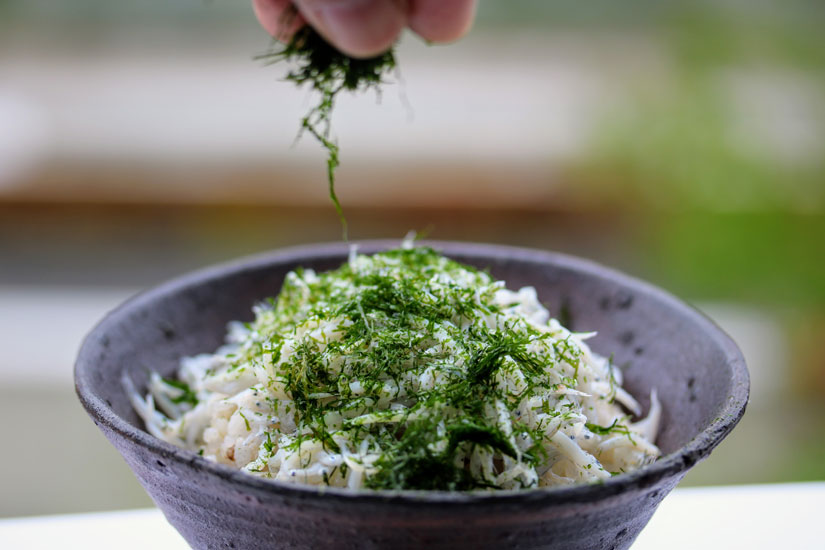
When I reached into the tank, the green suji aonori swayed gently and brushed against my fingertips. When I put it in my mouth raw, its fresh, vibrant green flavor spread throughout my mouth. I’ve heard that dried suji aonori turns a more vivid green and has a stronger aroma than the fresh variety. I’ve also heard that fresh suji aonori can be eaten as tempura, but either way, the natural, refreshing quality of the seaweed is sure to stand out.
Since suji aonori is widely distributed from Hokkaido to Okinawa, even within the same species, characteristics such as temperature tolerance and growth rate vary by region. When Sea Vegetable began land-based cultivation in Kochi, they focused not only on these characteristics but also on selecting elite strains with superior aroma and texture as food ingredients. They reportedly screened suji aonori from across the country and underwent a process of trial and error.
Next, I tried the eating method recommended by Mr. Hachiya. When I sprinkled powdered land-cultivated Suji Aonori onto a bag of lightly salted potato chips, I could taste the umami of the sea and experience its deep aroma. They say that growing it on land allows for meticulous nutritional management, resulting in a richer aroma and umami.
Looking Beyond Aonori: A Vision for the Future
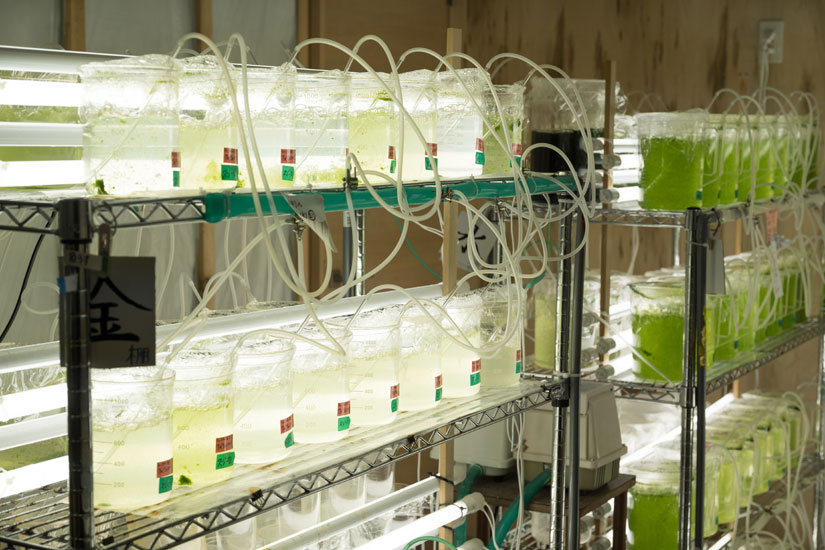
Since seaweed reproduces via spores, the conditions for germination and growth vary by species. At Sea Vegetable, research is ongoing to identify the optimal cultivation methods while unraveling the characteristics of each individual species.
Black nori cultivation is now in full swing
They have also established a land-based cultivation technique for black nori, which has long been a cornerstone of Japanese food culture. They plan to successfully achieve mass production of black nori via land-based cultivation (300 kg or more in dried weight) by fiscal year 2025 and begin preparations for mass production starting in fiscal year 2026.
Mr. Hachiya stated, “There is a huge global market for black nori, so first, we want to establish the technology for land-based production and provide it to fishermen and companies in coastal areas who are losing their livelihoods, thereby creating new sources of income. At the same time, Japan has unique species of seaweed in each region, and quite a few are at risk of extinction. We are also considering raising seedlings for these species on land and releasing them back into the sea in their respective regions to establish aquaculture beds.” Ultimately, the goal is to restore the natural abundance of seaweed in the ocean.
However, per capita consumption of seaweed in Japan has fallen to about half of what it was 30 years ago, due to the diversification of the diet. Seaweed, which once naturally graced dining tables alongside traditional Japanese cuisine, is losing its presence as Western and Chinese cuisines become more widespread in daily life. Mr. Hachiya says, “The potential of seaweed isn’t limited to Japanese cuisine. Aonori goes well with pizza, and sprinkling it on potato chips releases a surprisingly rich aroma. I feel that the key to solving the problem of declining consumption lies precisely in genres we haven’t tried before, so I want to conduct various tests and share our findings.”
Develops Soy Sauce Made from Suji Aonori and Opens a Seaweed Specialty Store
One of their new challenges is “Aonori Soy Sauce,” made from Suji Aonori. This seasoning is produced by fermenting only aonori, salt, and rice—without using soybeans or wheat. It has a pale amber color. When tasted, the aroma of the sea fills the mouth, making it a perfect match for seafood. Because it is gluten-free and soy-free, the company receives many inquiries from overseas, and the product has become a symbol of the new value of seaweed.
Near Tokyo Station, we’ve opened “Sea Veg Stand,” a restaurant specializing in seaweed cuisine. It serves dishes like Suji Aonori Potatoes, dishes featuring “Mirin”—a rare red seaweed traditionally eaten in regions like Kumamoto—and ramen generously topped with seaweed, making it a hub that showcases the appeal of seaweed from multiple angles. This is where our effort to revive the “culture of eating seaweed” is beginning.
Researchers Hold the Key to Success
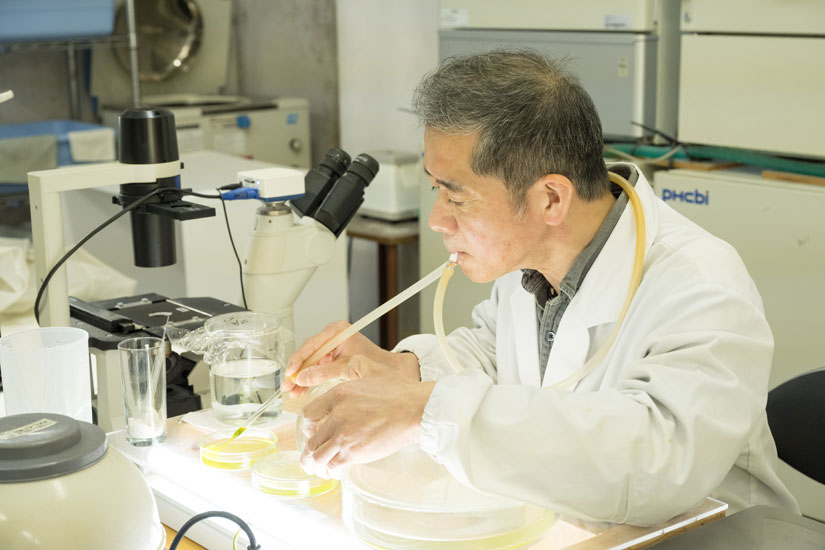
The lab is the key to Sea Vegetable’s business. It handles the most critical initial stage of land-based cultivation of Suji Aonori. Aonori harvested and cultivated at the lab is transferred to the land-based facility after about one month, where it is grown for another month before being harvested.
The mind-boggling task of sorting spores
“To succeed in land-based cultivation, the most important thing is to consistently harvest spores from the parent plants of striped green laver and raise them without letting them die,” says researcher Nigi. “If they die at that stage, there will naturally be nothing to send to the cultivation site. It’s crucial to remove anything—such as bacteria—that could harm the green laver spores and successfully raise them.”
The greatest challenge in cultivating Suji Aonori is maintaining the parent strains in a constantly healthy state to ensure a stable supply of spores throughout the year. It also involves the process of extracting spores from the parent strains and ensuring they grow stably without dying. To raise the spores healthily, it is necessary to thoroughly eliminate harmful impurities, such as bacteria, and maintain appropriate temperature control.
Holding a small petri dish, Mr. Nigi explains, “At first, they’re really just round specks about 10 microns in size.” Ten microns is 0.01 millimeters. Although the spores are invisible to the naked eye, they can be observed under a microscope, and after a few days, you can see them growing into the characteristic shape of aonori.
Nigi was performing a painstakingly delicate task, repeatedly and carefully using a pipette to aspirate the approximately 10-micron spores, isolating only the “high-purity spores.”
シーベジタブルを支える研究者
Furthermore, Mr. Nigi explains, “The harvest season for natural nori runs from fall through early spring; since growth stops in the summer, it wasn’t suitable for harvesting. However, to maximize the utilization of our facilities for land-based cultivation, we need to grow a combination of strains with different temperature tolerances. So, even within the same ‘Suji Aonori’ variety, we’ve tested about 100 different strains from Hokkaido to Okinawa to find the most suitable ones.”
Generally, land-based cultivation involves significant capital investment and operating costs, making profitability crucial. That is precisely why selecting strains that are resilient to environmental conditions and grow efficiently is the key to establishing this as a viable industry. Researchers are tackling this challenge as they strive to pave the way for the future of seaweed cultivation.
When seaweed returns, the future of the ocean will change
Seaweed forms the foundation of the marine ecosystem. As natural seaweed beds decline, a research report by the Good Sea General Incorporated Association reveals surprising results: using seedlings grown on land for offshore cultivation can increase fish populations by up to approximately 36 times compared to uncultivated waters.
As seaweed increases, fish return, and the ocean regains its abundance. Seaweed cultivation is not only a way to preserve our food culture but also an initiative that supports the future of the ocean. Sea Vegetable aims to become a reliable force—extending beyond the borders of Japan—to pass on a bountiful ocean to the next generation.