

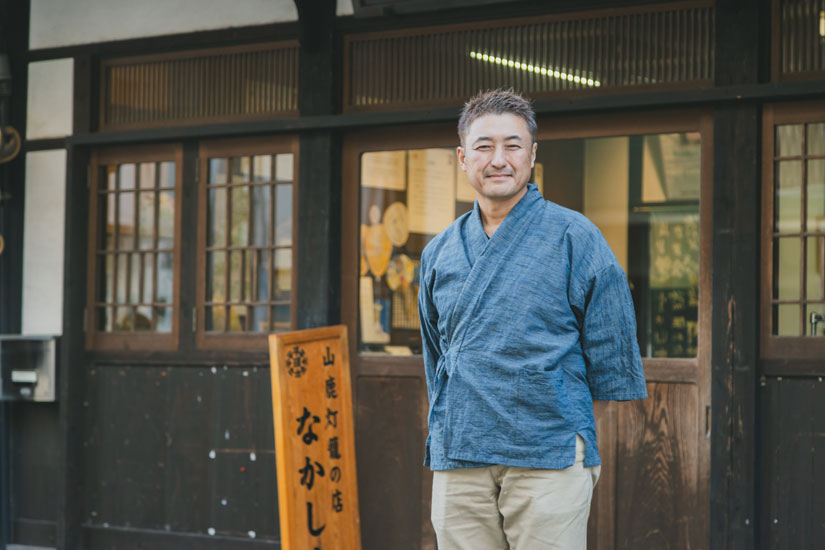
“Yoheho~, yoheho~.”The “Yamaga Lantern Festival” features about a thousand women dancing gracefully to the folk song “Yoheho-bushi.” The lights flickering above the dancers’ heads are Yamaga lanterns, traditional crafts. Hirotaka Nakajima is the fourth-generation master of Yamaga lantern making. While grounded in tradition, he is not afraid to adapt to the times.
The ethereal lights flickering above the dancers’ heads are traditional crafts
————No bones, no flesh, Yoheho, Yoheho————
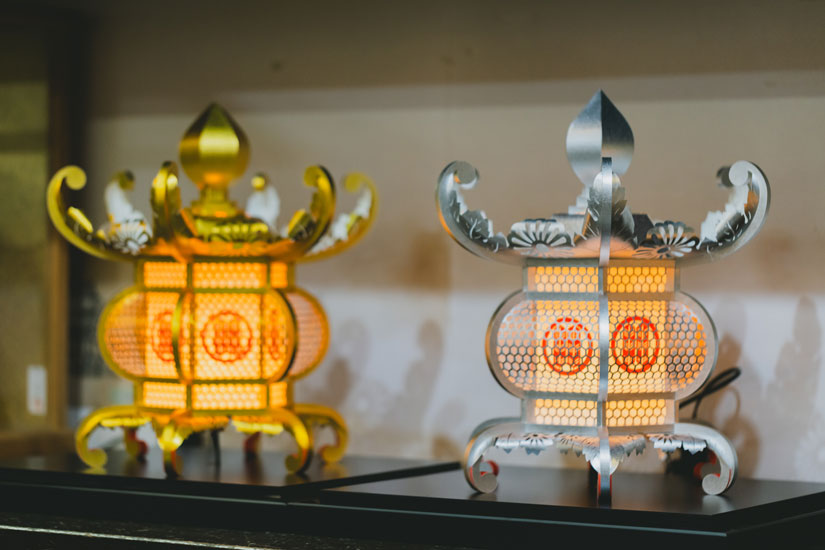
The “Yamaga Lantern Festival” features approximately 1,000 women dancing gracefully with supple movements to the folk song “Yoheho-bushi.” Held every August, it is a major event in Yamaga City that typically attracts over 100,000 visitors annually. Legend has it that the festival originated when the villagers of Yamaga guided Emperor Keiko, the 12th emperor, who had lost his way in thick fog, by holding torches aloft.The source of the fantastical light flickering above the dancers’ heads in the darkness of night is the “Kin-tōrō,” a type of Yamaga lantern that is a traditional craft.Although they appear to be made of metal from a distance, they are actually made of paper. Without using any wood or metal fittings, they are assembled into three-dimensional forms using only Japanese paper and a small amount of glue, weighing a mere 180 grams. Achieving the substantial and luxurious appearance that defies belief that they are made of paper requires exquisite craftsmanship, and their creation is entrusted to artisans known as “lantern masters.”
Hirotaka Nakashima is the fourth-generation member of a family of lantern makers with a history spanning over 100 years. While his great-grandfather and grandfather ran both a lantern-making business and a clock shop, his father’s generation focused solely on lantern-making, and today he operates “Yamaga Lantern Shop Nakashima,” a specialty store along the Buzen Kaido.Born as the second son in a family of lantern makers, Nakajima worked as a company employee until the age of 33. However, realizing that the craft would die out if none of his brothers took over the family business, he made a determined resolution. He became his father’s apprentice, entered the path of lantern making, and has continued on that path to this day.
He switched careers from a different industry and mastered the craft under his father, his master
Making the career switch from a different industry was not easy. Although he had watched his father create lanterns up close since childhood and had been training even before the switch, the skills of a traditional craftsman are not easily acquired. The production of Yamaga lanterns involves a continuous series of meticulous tasks that cause pain in the fingertips, eye strain, and stiff shoulders. It requires extraordinary concentration and perseverance. Moreover, he received relentless criticism from his father, his master.“But looking back now, I’m grateful to my father for treating me as a disciple rather than going easy on me just because I was his son,” says Nakajima. To be recognized as a lantern maker, one must undergo about 10 years of apprenticeship and have one’s skills acknowledged by other lantern makers. Nakajima received his certification in 2017, after he had already entered his 40s.
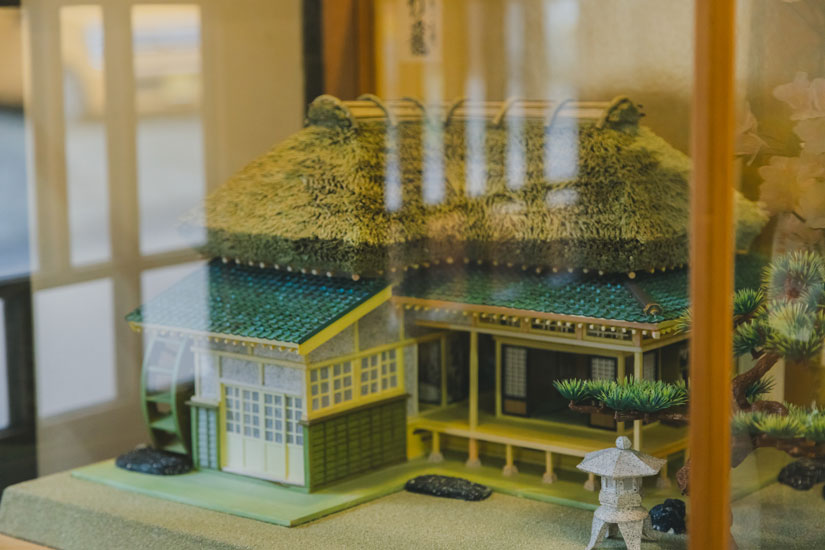
Yamaga lanterns feature traditional styles, including the aforementioned gold lanterns, as well as “Miyazukuri” (shrine-style), which takes inspiration from shrine and temple architecture such as main halls, gate towers, and five-story pagodas, and “Zashikizukuri” (parlor-style), which mimics traditional Japanese houses.In addition, there are many works created by the lantern makers themselves, resulting in a diverse and extensive range of styles. These are primarily used for the “dedicatory lanterns” described below, and some are designed to be displayed without a light. Furthermore, they are often displayed in local homes as substitutes for lanterns during the first Obon memorial service, and custom orders featuring family crests are also available.
There are three criteria for Yamaga lanterns: “use only hand-made Japanese paper and starch paste,” “the main components of the lantern must be hollow,” and “do not create overlapping edges on curved sections.”Consequently, the designs are free and diverse, with examples ranging from Benkei from the *Kanjincho* to trains and battleships. Among these, the gold lanterns attract particular attention, not only because they are the symbol of the Yamaga Lantern Festival but also because they represent a rite of passage for lantern artisans. They embody the full range of skills required of a lantern artisan, and successfully completing a gold lantern is considered the first step toward certification.
A traditional craft deeply rooted in the life of the local community
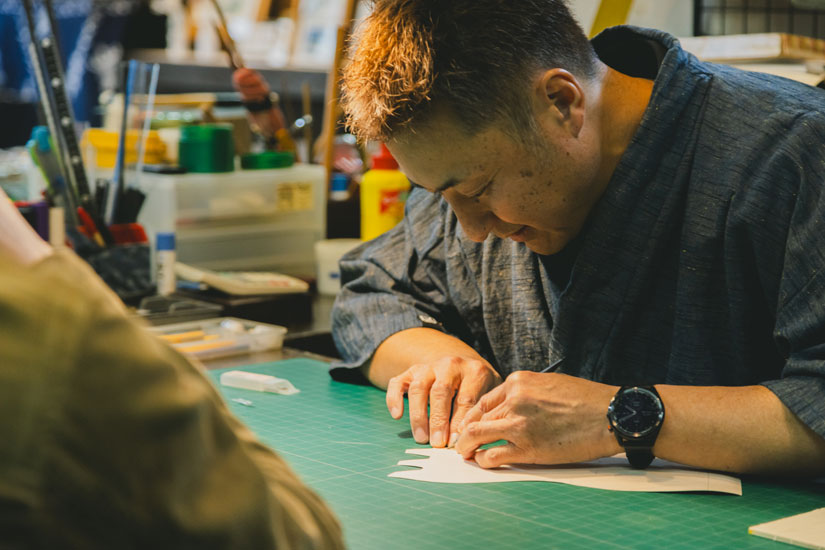
The creation of a gold lantern involves endless work precise to the millimeter.Thick washi paper, onto which the design has been traced, is cut and assembled. While this may sound simple, because the lantern is hollow and lacks a framework, its shape and structural integrity must be maintained solely through the layering of washi paper. This is why the Yamaga lantern is nicknamed the “boneless lantern.” This is also the reason behind the line in the folk song mentioned at the beginning: “No bones, no flesh.”
Since there are neither bones nor flesh, even the slightest misalignment in the layered washi paper causes the structure to collapse. And to ensure a perfect fit, the washi paper must be cut with absolute precision, without the slightest deviation. A gold lantern consists of approximately 200 parts and takes about three days from preparation to completion. Hearing Mr. Nakajima say, “To create a Yamaga lantern, you need the perseverance to see it through without losing focus,” I find myself nodding in agreement once again.
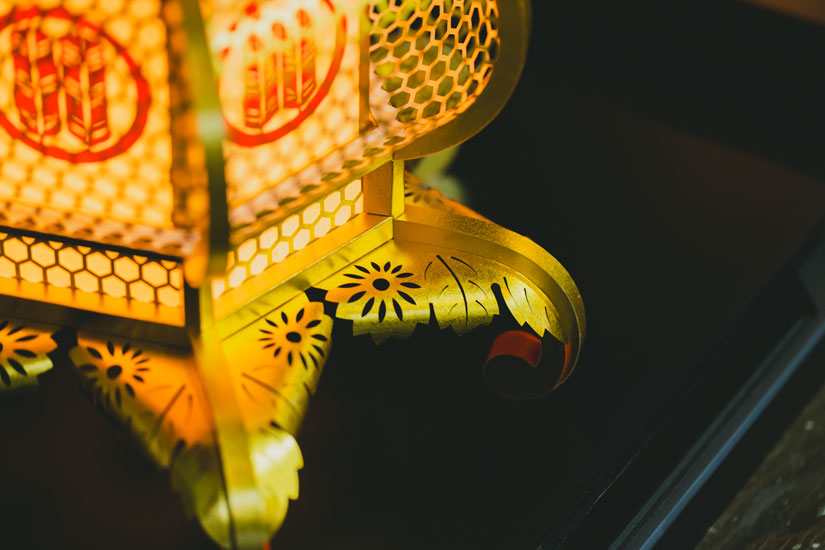
The lanterns made in this way are placed atop the dancers’ heads and are also used as dedication lanterns. Dedication lanterns are those commissioned by neighborhood associations and other groups from lantern artisans specifically for the festival; they are so named because they are dedicated to the local Ōmiya Shrine after being displayed during the festival period. There are no regulations regarding their shape, and the motifs are decided through consultation between the group and the lantern artisan.Every year, 27 to 28 lanterns are made, and after the dedication, they are stored and displayed in the “Lantern Hall” within the shrine. They are replaced with new lanterns one year later in August. “It happens every year, but it truly makes me happy when the clients are pleased. It’s the moment when I feel rewarded for all my hard work,” says Mr. Nakajima.
To Pass Tradition On to the Future, We Must Ask Questions
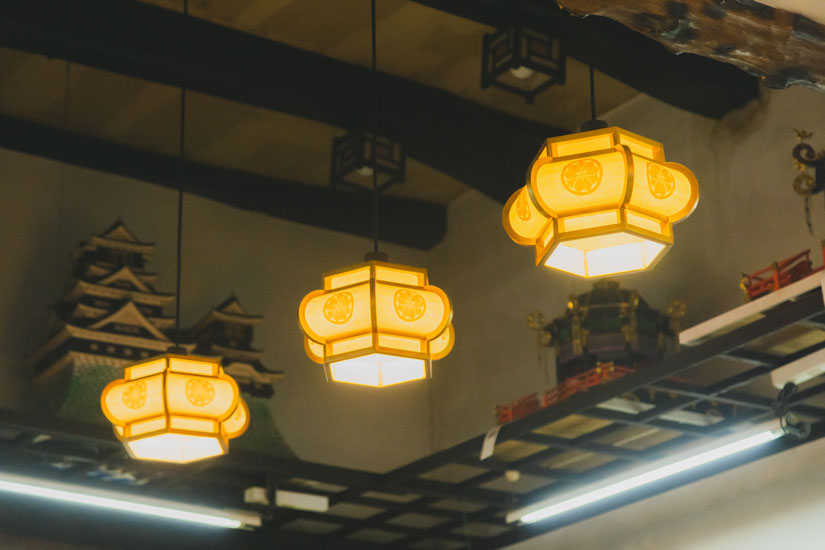
Legend has it that Yamaga lanterns originated about 2,000 years ago when the 12th Emperor Keikō was on a royal tour of the Tsukushi region and his path was blocked by thick fog; the people of Yamaga guided him using torches.Afterward, the people continued to offer torches to Omiya Shrine, which enshrines Emperor Keikō, and during the Muromachi period, these torches evolved into Yamaga lanterns. Then, in the Edo period, influential figures in the town began competing to create the most lavish lanterns for their offerings, leading to the full blossoming of the Yamaga lantern culture.
Currently, there are seven active lantern makers in total. Five of them are women and two are men, with most in their 50s and 60s.There are three apprentices aiming for certification. While the number of lantern makers has remained stagnant over the past few decades, all the apprentices are in their 20s. Nakajima believes, “The future of Yamaga lanterns is by no means a situation to be optimistic about, but it’s not one to be pessimistic about either.” However, he also notes that “questions” are necessary to pass the tradition on to the future.
“I want to expand the occasions where people purchase them not just for festivals, but as traditional crafts for everyday use. If their usage is limited, the tradition will only dwindle. To achieve that, I need to ask: What kinds of products will sell? How can we make Yamaga lanterns feel more accessible to consumers…?”
By constantly asking these questions, Nakajima strives to bring new creations to the world. “By making gradual updates in line with changing times and needs, there are surely traditions we can preserve.” Continuing to craft lanterns while holding these questions in mind—it is this accumulation of effort that will carry the light of Yamaga into the next generation.