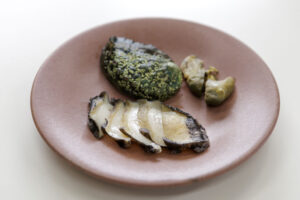


Koishihama Scallops. What a wonderful name! Among the scallops produced along the coast of Iwate Prefecture, the “Koishihama scallops” from the fishing port of Koishihama, Ayari, Sanriku-cho, Ofunato City, are renowned as a brand of scallops. Jun Sasaki, the producer and president of the Iwate Prefecture Fishermen’s Association, has overcome the disaster and continues to produce high quality scallops.
What is Koishihama, Ofunato City, where Koishihama Scallops are produced?
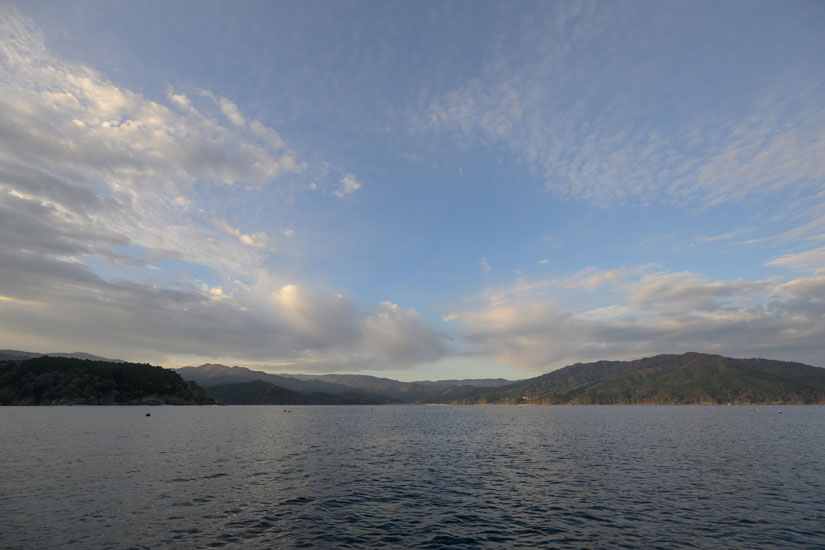
The area off the coast of Sanriku is known as one of the best fishing grounds in the world, where the Oyashio tide from the north meets the Kuroshio tide from the south. Of the three prefectures of Sanriku (Aomori, Iwate, and Miyagi), the coast of Iwate Prefecture is characterized by a series of bays and a saw-toothed rias coastline.
Ofunato City, located in the southern part of the coast of Iwate Prefecture, has a number of bays, including Yoshihama Bay, Okirai Bay, Ayari Bay, and Ofunato Bay, where various types of fishing have been practiced since ancient times. In the bays where the waves are calmer, wakame seaweed, scallops, and ascidians are cultivated actively.
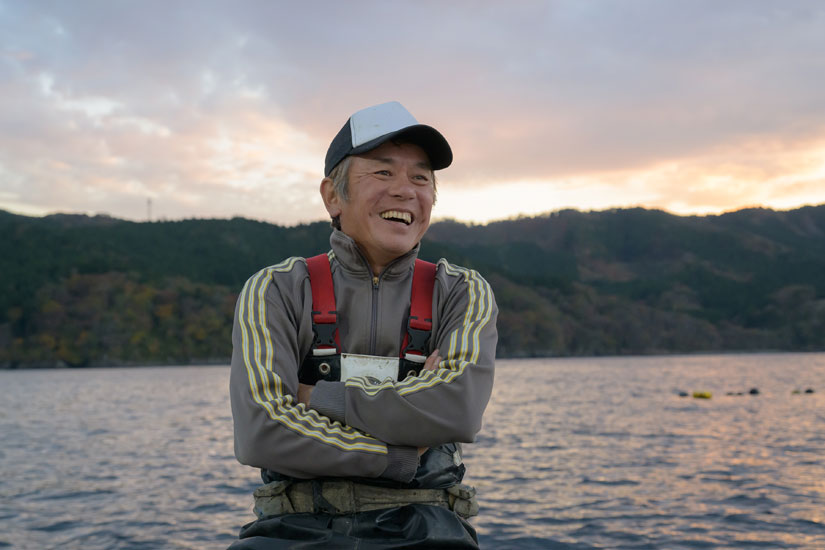
Koishihama in Ayazato, Sanriku-cho, Ofunato City, has been particularly active in scallop cultivation. Jun Sasaki, a fisherman from Koishihama and president of the Iwate Prefecture Fishermen’s Association, has been farming scallops here since his father’s generation.
What are “Koishihama Scallops”?
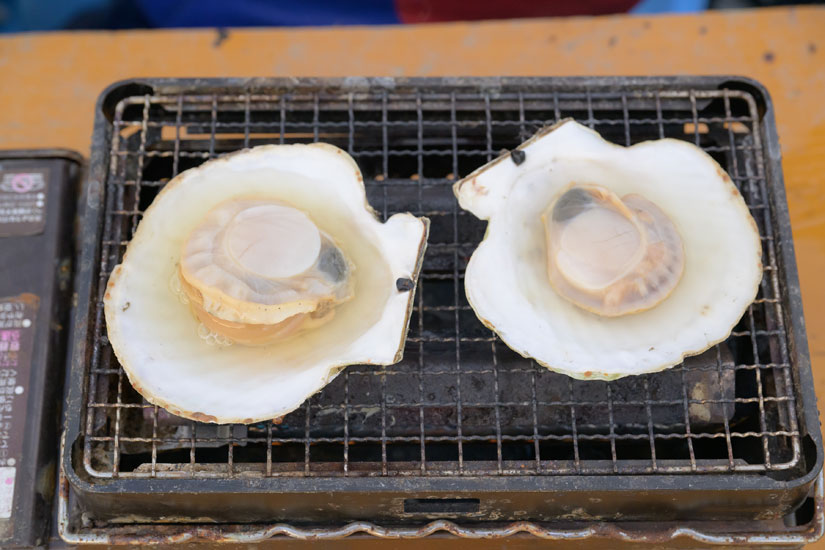
Iwate scallops have long had a good reputation in the central market, and around 1985, they once commanded the highest wholesale price in Japan at the Tsukiji market.
In 2008, Mr. Sasaki founded the Koishihama Youth Club. Until then, Koishihama fishermen had been shipping scallops to the market, but that did not show the name of the beach. So, through the Ayasato Fisheries Cooperative Association, they developed a sales channel for the scallops they grew so that they could ship them directly to ordinary consumers. The scallops were branded as “Koishihama scallops. The name “Koishihama Scallops” is a play on the Japanese pronunciation of “Koishihama. It has a nice sound to it.
The Sanriku Railway runs near the fishing port, and in 2009 the station name was changed to “Koishihama. The station has become a power spot for romance, and the station waiting room is decorated with ema (votive picture tablet) in which wishes are written on scallop shells.
High-quality plankton nurtures scallops.
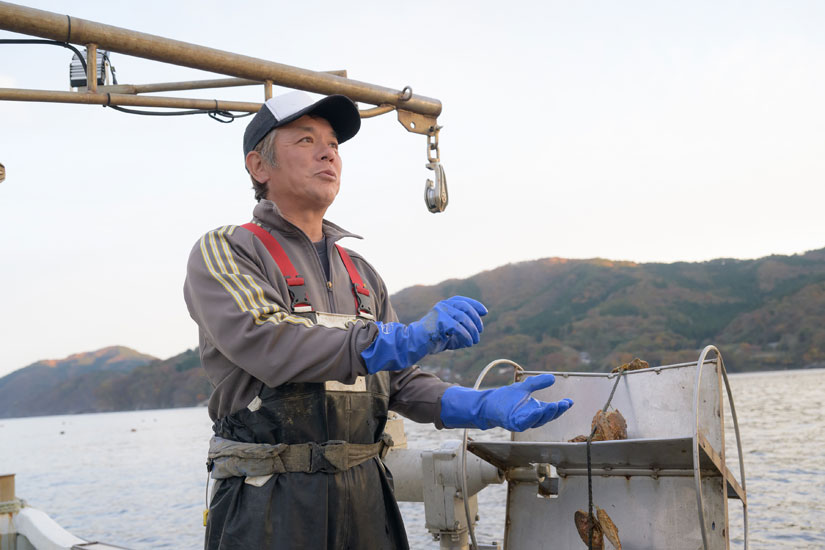
Looking out over the landscape of Koshiki Bay, one can see that there are many broadleaf trees. In autumn, broadleaf trees fall off their leaves and turn to leaf litter. The seawater containing nutrients from this leaf litter provides nourishment for marine life. On the other hand, off the coast of Sanriku, where the Oyashio and Kuroshio currents collide, phytoplankton is born, and zooplankton that feed on the phytoplankton gather there.
Ofunato’s inner bay, which contains plankton from the sea and nutrients from the mountains, is a very good environment for scallops. In Koishihama, only scallops that meet certain standards among those raised with care are sold as “Koishihama scallops.
Ear-suspension type of aquaculture born in Ofunato
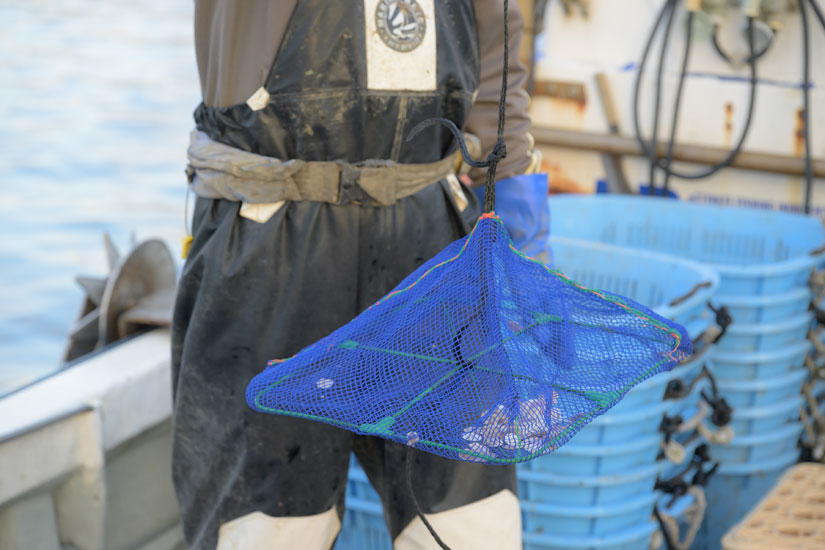
Scallop cultivation begins with the collection of scallop larvae (rahbas) that come in from the northern ocean on the Oyashio tide from April to June. rahbas are collected in May, and by September they are about 1 cm in size. 20 tiers of cages are made, each containing 50 scallop larvae. As the scallops grow, the number of scallops in the cage becomes denser, so the number is reduced to 25 in December, then 10 in February, and so on, until the scallops are 8 cm in diameter, which takes about one year.
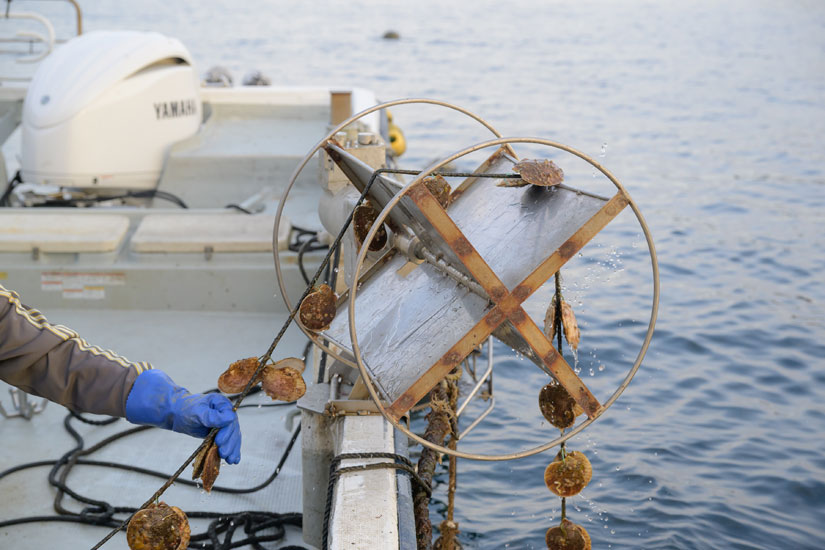
Once the scallops have grown to 8 cm in diameter, holes are made in the shells and the scallops are hung from ropes for aquaculture. This method of cultivation is called the “ear-hanging” method. This method of cultivation is currently practiced from Aomori to Miyagi, but was actually invented in Ofunato.
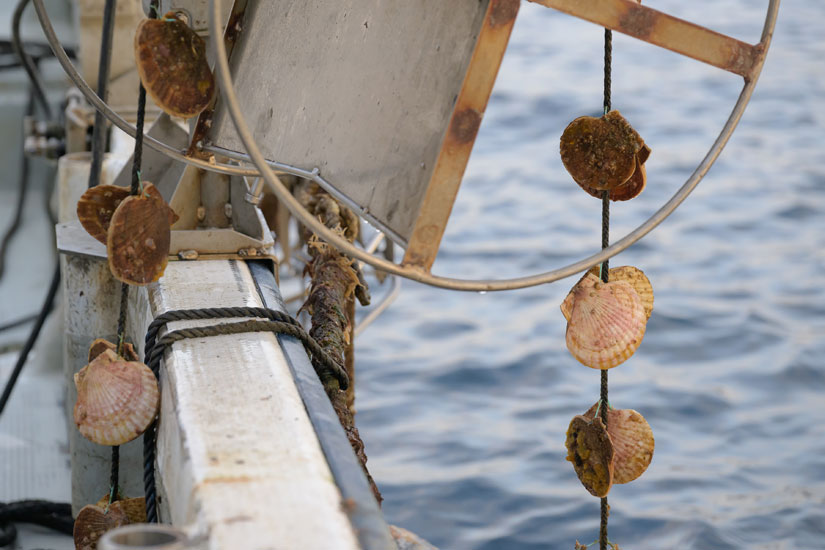
The “ear-suspension” method was established around 1960. It was devised to efficiently raise scallops in Ofunato, where the water is deep and the bays are intricate, and has been used to this day. Ofunato does not have shallow sandy beaches like those in Hokkaido, so it is not possible to harvest a large number of scallops using the “ground sowing” method of cultivation, which grows scallops on the sea bottom. Therefore, the “ground sowing” method of cultivation, in which scallops are hung from ropes suspended in the water, was devised in an attempt to cultivate as many scallops as possible by taking advantage of the depth of the sea. Because the scallops do not stick to the seafloor, sand does not get inside the shells.
Ofunato’s bay is about 40 meters deep, and scallop cultivation has flourished because of this topography.
Sparing no pains to produce high-quality scallops
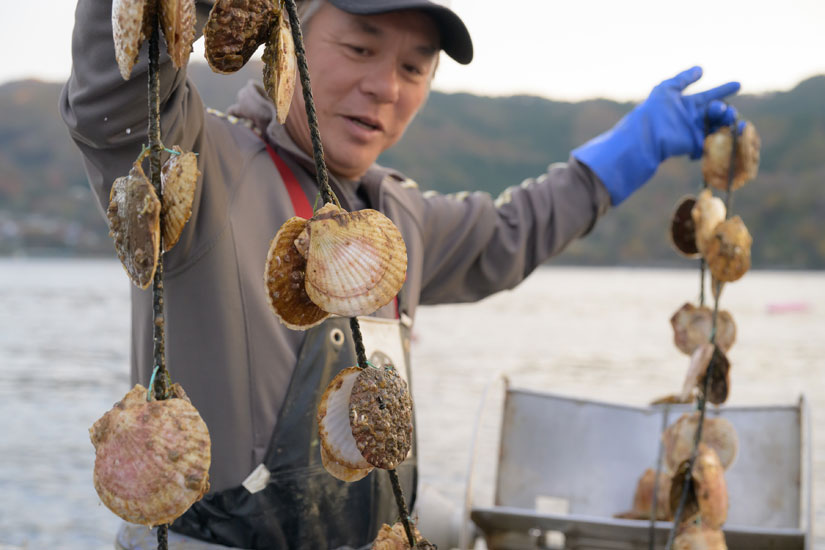
Scallops are hung from ropes and grow to a large size in the bay over a period of about one year. Counting from the larvae, the scallops are shipped after about two years. Koishihama scallops compete on the quality of each scallop, as the fishing grounds are limited.
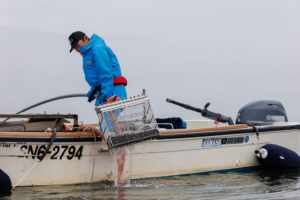
In order to grow high-quality scallops, Mr. Sasaki keeps a gap between shells and cleans the shells at least twice a year. Seaweed and barnacles adhere to the shells. If these are not removed regularly, the seaweed and barnacles will take away the nutrients that the scallops feed on. Not only that, but the rope will become heavier due to the attached materials, causing it to fall.
Even so, the larger the scallops grow, the lower the ropes become. It is the fisherman’s job to adjust the height of the rope. Sasaki says, “The scallops are held together by ropes, so we raise and lower the height of the ropes all year round to keep them suspended at a depth where there is plenty of food.” He raises and lowers the ropes based on his years of experience in checking whether the sun’s rays are reaching the area and whether the tide is running fast enough. Mr. Sasaki is particular about the scallops he grows, cleaning the shells and adjusting the ropes.
Overcoming the Earthquake

Koishihama scallops, sold directly by the Ayasato Fisheries Cooperative, have been successfully branded. The thick scallops, sweet and delicious even when eaten as is, gained a reputation, and the number of orders increased. However, in March 2011, the Great East Japan Earthquake struck. The Great East Japan Earthquake struck. Koishihama was also hit by the tsunami.
I was at sea when the Great East Japan Earthquake hit. When I returned to the beach, I found that the situation was very serious,” said Sasaki. After the earthquake, it was not possible to start fishing immediately. The fishing port had subsided and the cargo handling station had been washed away.
Immediately after the disaster, people he met through Koishihama Scallops offered their support. Some people even rushed to the area to offer their support. In the midst of all this, an overseas volunteer group appeared to offer support for the damaged fishing port, and Mr. Sasaki negotiated with them about the current status of the fishing port and what was needed for its recovery. His natural mobility and sociable personality, which helped him brand the “Koishihama scallops,” made it possible for him to engage in dialogue with foreign dignitaries without fear, which paid off.
Thanks to support from overseas, in 2014, the subsided fishing port was improved and a cargo handling station was completed in Koishihama. The speed of reconstruction was one of the fastest on the coast. Along with the reconstruction of the fishing port and cargo handling station, the scallops that had been cultivated were ready for shipment. In 2014, scallop shells were cleaned and sorted at the cargo handling station, and scallops of good quality were ready for shipment.
He was told by a support group that if they had not known about Koishihama Scallops, they might not have come here. Mr. Sasaki is grateful for the support and human connections he has received, saying, “When we first started (Koishihama Scallops), some people said, ‘What are you trying to do?
Going to the Sea with His Wife Isabelle
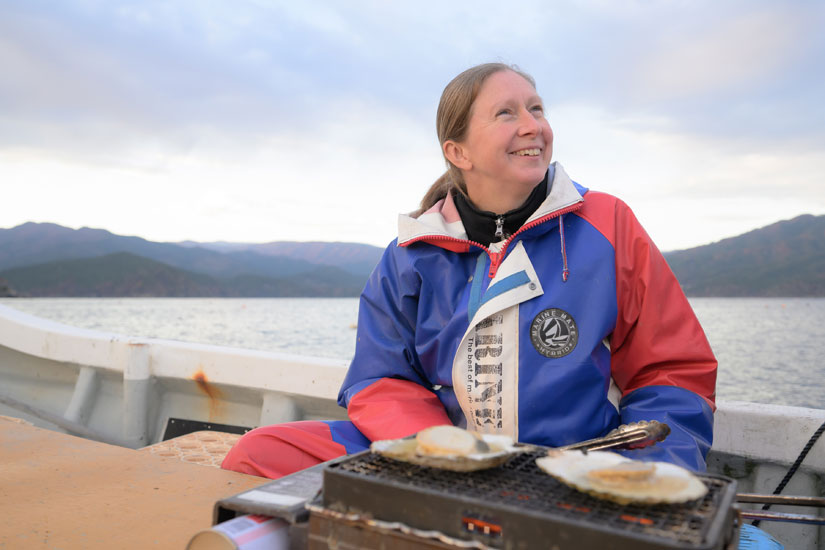
Mr. Sasaki met his wife, Isabelle, after the disaster. Originally from inland France, Isabelle had practiced karate since childhood and grew up interested in Japanese culture. After graduating from a Japanese university and finding a job, Isabelle visited Ofunato many times as a volunteer after the earthquake. Although Isabelle was working in Tokyo at the time, Ofunato became like a second home to her.
In 2020, she married Mr. Sasaki. She now works as a tourist guide and interpreter, and also rows out to sea with Mr. Sasaki to work as a fisherman.
In France, I was not much of a seafood eater, but I did like scallops. But when I ate Koishihama scallops, I was surprised (laughs). I thought,” he laughs cheerfully.
The Sea Connects Ofunato and Europe
In France, scallops are called “Coquilles Saint-Jacques. These are called “European scallops,” and technically speaking, they are a different species from Japanese scallops. However, off the coast of Sanriku in Japan, far away from France, coquille saint-Jacques can sometimes be found in the nursery. These are the shells depicted in Botticelli’s painting “The Birth of Venus,” which have a slightly fluffier shell than Japanese scallops.
In other words, the oceans are connected. In this light, the story of the “Koishihama Scallop” is a romantic tale of a man of the sea.
Delivering Quality Koishihama Scallops in the Future
Global warming is having a tremendous impact on the oceans. The place where the Oyashio (cold current) and the Kuroshio (warm current) collide is moving northward. The warm currents are so strong that the fishing grounds for lobsters, which should normally be caught off the coast of Ibaraki, are also moving northward.
Scallops prefer a cold environment. Scallops hibernate when the water temperature drops below 5°C. After hibernation, they feed on nutrients when the water temperature rises and grow larger. In recent years, due to global warming, water temperatures no longer fall below 5°C. Because the sea water temperature does not drop in winter, scallops lose the opportunity to hibernate. It is as if the next summer will arrive without the scallops having recovered from their summer fatigue. Some of them die without growing large.
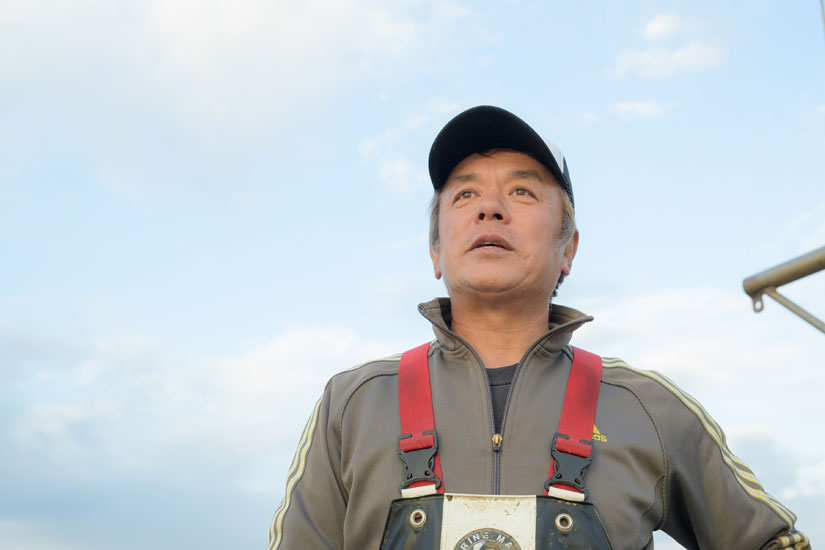
The fisherman’s job is a natural one. They do not know what will happen the next year due to changes in the environment. Even so, Mr. Sasaki says, “We will never give up on scallops. He is determined to maintain the quality of Koishihama scallops. Even if the sea changes, we will live by the sea with the pride of being fishermen. As Mr. Sasaki gazes out to sea with his arms folded, I felt the determination of a man with a mission on his shoulders.