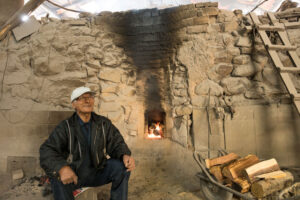


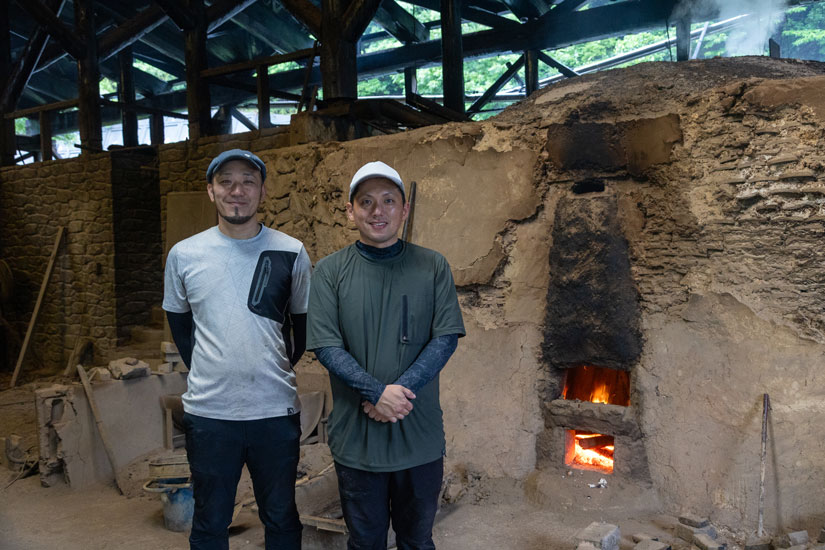
Kishu Binchotan, renowned for its unparalleled quality, enjoys strong support from chefs both in Japan and abroad. The charcoal-making techniques used to produce it, which date back to the Edo period, have been designated as an Intangible Cultural Heritage of Wakayama Prefecture. In Hidakagawa Town—which boasts the highest production volume of Kishu Binchotan in Japan—Akihiro Yugami of “B-STYLE” works as a charcoal maker.
What Is Kishu Binchotan? A Traditional Charcoal with a History Dating Back to the Edo Period
Kishu Bincho-tan is a type of “white charcoal” (shirozumi) made from Ubame oak and oak. Unlike common “black charcoal” (kurozumi), it is characterized by being fired at high temperatures and then rapidly cooled, resulting in a hard, dense charcoal. Its history is long; it is believed that charcoal production was already taking place in Kishu as early as the Heian period. During the Edo period, its high quality gained a reputation and spread throughout the country.
Against this historical backdrop, Hidakagawa Town, located in the center of Wakayama Prefecture, continues to carry on the tradition of charcoal-making and has become a major production center for Kishu Binchotan. The town is a region rich in nature, with the Hidakagawa River—from which the town derives its name—flowing through it and mountains and forests covering most of its area; many broad-leaved trees, including the Ubame oak used as raw material, grow wild here.
“Currently, there are about 30 charcoal burners in the town,” says Akihiro Yugami, who works as a charcoal maker in the town, dedicated to producing Kishu Binchotan. He is the fourth-generation member of a family of charcoal makers whose tradition dates back to the Edo period. After graduating from high school, he worked in various other jobs and spent 10 years as a nurse until the age of 30, when he plunged into the world of charcoal making—the family business. “A rigid work schedule just wasn’t for me,” Mr. Yugami reflects. Now, he laughs, “Being able to set our own schedule while working suits me perfectly.” He has now formed “B-STYLE,” a team of young charcoal makers, with his younger brother Shota—who had already been working as a charcoal maker—and other colleagues. Together, they share responsibilities as they dedicate themselves to crafting Kishu Binchotan. “I’m truly grateful that my father was such a skilled charcoal maker, which allowed me to inherit his techniques directly,” he says. “Crafting is hard work, but it’s just as rewarding.”
The Production of Kishu Binchotan Begins with Grueling Work in the Mountains
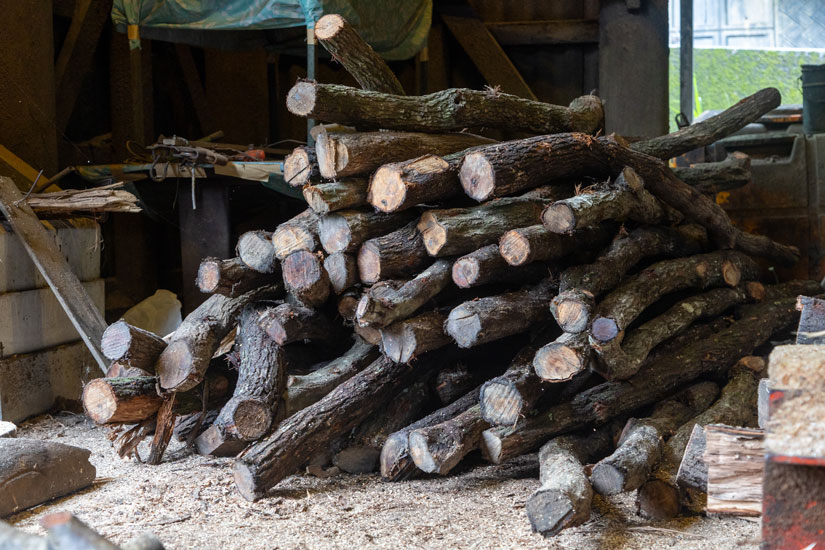
Uba-megashi accounts for more than 90 percent of the raw material used to make Kishu Bincho-tan. Its wood is dense and hard, and when turned into charcoal, it produces high-quality Bincho-tan that is heavy and compact. The process of making Kishu Bincho-tan begins with harvesting this Uba-megashi in the mountains. Uba-megashi trees often grow in clusters on steep slopes from the middle of the mountain to near the summit, making work on these treacherous slopes far more grueling than one might imagine. Furthermore, because a traditional logging method—which preserves the original forest by selectively harvesting only the necessary trees while leaving young ones standing—has been passed down through the generations, it is not possible to clear the area all at once using heavy machinery.
Straight, neatly arranged logs are placed into a high-temperature kiln
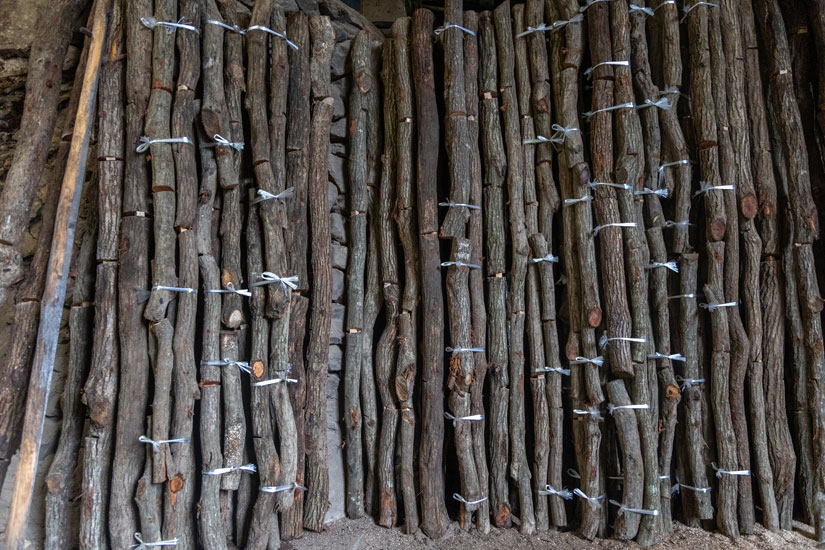
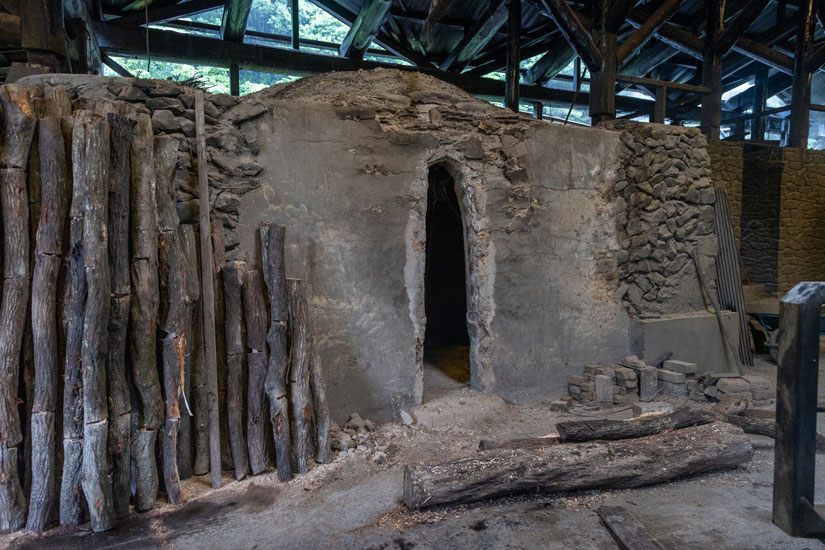
The cut logs are trimmed to uniform lengths, and notches are cut into any crooked logs so that wedges can be driven in, shaping them into the straight, beautiful form characteristic of Kishu Bincho-tan. Then, while the residual heat from the previous firing has not yet completely cooled, new logs are loaded into the kiln. Once the temperature has dropped enough for a person to enter, the worker enters the kiln and, by hand, stands each log upright one by one, packing them tightly together with no gaps. Placing the logs upright is one of the distinctive features of Kishu Binchotan production.
Approximately 5 metric tons of logs are loaded into the kiln at a time. Although the temperature is low enough for people to enter, it is still quite high—the thermometer reads about 100°C. Working inside the kiln takes two to three hours and requires several people. “It’s like hell in the summer,” Mr. Yugami says with a laugh.
The Artisan’s Skill of “Reading” Inside the Invisible Kiln Through Smoke
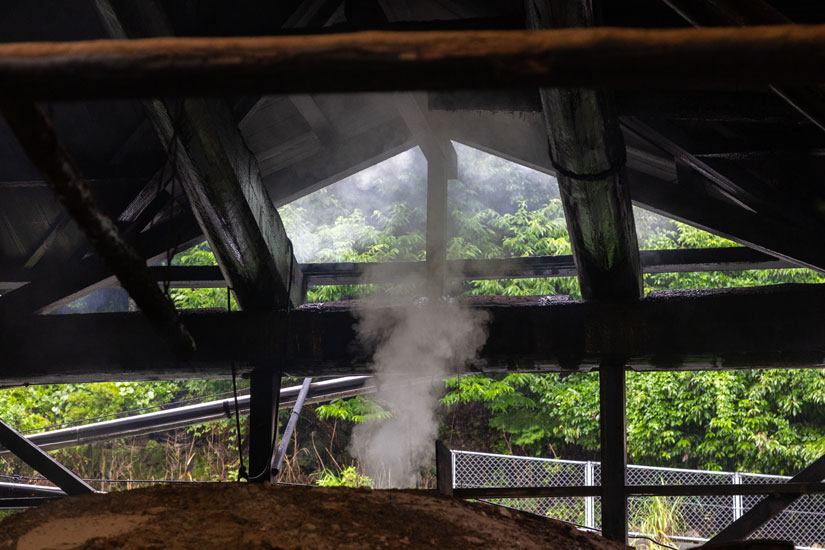
Once the kiln is loaded, the kiln opening is sealed with stones and clay. A fire is lit with the brushwood at the bottom to raise the kiln’s temperature, and the moisture is gradually drawn out of the logs over the course of about a week. Since it’s impossible to see directly inside the kiln, the amount, color, and smell of the smoke serve as clues to gauge the progress of the carbonization process. “At first, white smoke containing moisture comes out, but as carbonization begins, it takes on a bluish tint and a sour odor mixes in,” says Mr. Yugami. Once carbonization begins, the fire opening is closed, leaving only a small air vent open to allow the wood to be steamed.
“Nerashi”: An Important Process for Improving the Purity of Charcoal
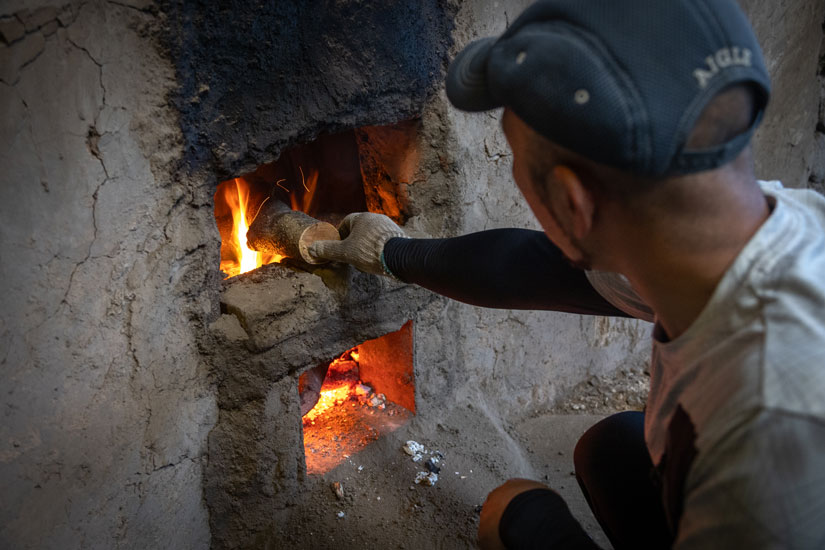
When making binchōtan, you must not apply a fire from firewood directly to the logs. Thoroughly dried logs will spontaneously ignite from the top as the kiln’s temperature rises, and the carbonization process proceeds as the fire spreads gradually. If the heat is too intense, the logs may burn out in a single night; therefore, it is crucial to allow the carbonization to proceed slowly over about a week to ensure that the spontaneously ignited logs do not burst into flames.
Adjusting the airflow and determining the “just right” heat level is where a charcoal maker’s skill truly shines. If a decision is delayed, too much oxygen will enter, causing the heat to become too intense and the charcoal to burn through. The charcoal maker must read even the slightest changes in the smoke to ensure they don’t miss the optimal moment. “Adjusting the heat at the exact moment spontaneous combustion begins is crucial. That moment is a matter of just a few minutes,” says Mr. Yugami.
In the final stage of carbonization, the color of the smoke changes from blue to colorless. This is when the “nerashi” process takes place, which burns off any remaining impurities in the charcoal. The firing opening is gradually widened to let air in, eventually raising the temperature inside the kiln to over 1,000°C. Through this process, the charcoal is refined into a high-purity form.
Once the charcoal is sufficiently fired, it’s time for “kama-dashi” (removing the charcoal from the kiln). The charcoal, glowing a bright orange, is scooped out of the kiln, and “subai” (a mixture of soil and ash) is applied to stop the combustion. The white ash that adheres to the surface at this stage is the origin of the name “shiro-sumi” (white charcoal). This rapid cooling completes the Kishu Binchotan, which becomes tightly compacted and hard.
The Power of Kishu Bincho Charcoal That Captivates Chefs
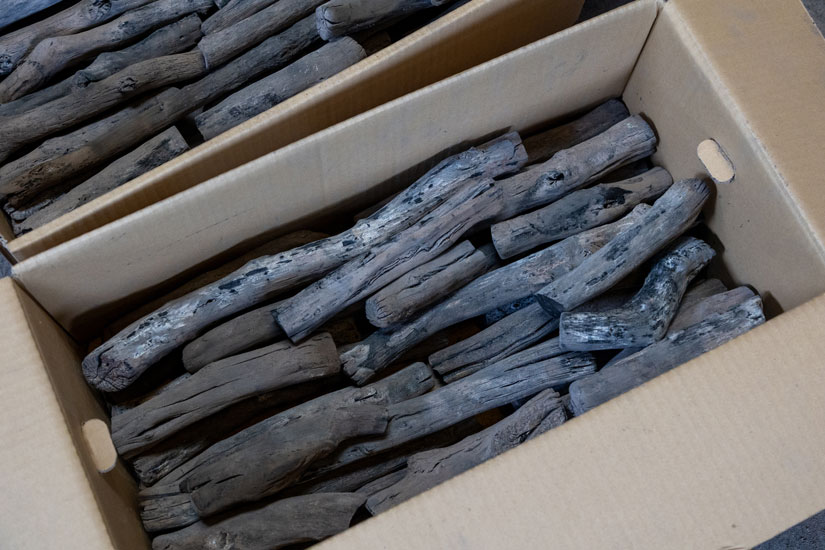
Kishu Bincho-tan is produced through a series of intricate processes and the skill of master craftsmen. Its most notable characteristic is its high carbon content. While ordinary black charcoal has a carbon content of about 70–80 percent, Kishu Bincho-tan contains over 90 percent. Once lit, it maintains a steady heat for a long time; even if the flame briefly weakens as fat or sauce from the food drips onto the charcoal, it quickly regains its intensity. It produces little flame or smoke and imparts minimal unwanted odors.
The Kishu Binchotan produced by Mr. Yugami and his team is shipped to renowned restaurants both within and outside the prefecture, including those listed in the Michelin Guide. It is highly regarded in kitchens where delicate cooking techniques are essential—such as for yakitori, eel, and Japanese cuisine—where preserving the natural flavors of the ingredients is paramount.
Quite a few chefs travel from far away to visit the workshop and witness the charcoal-making process firsthand. Mr. Yugami devotes all his energy to producing high-quality charcoal, leaving it up to the users to decide how to use it. Still, when he sees chefs eagerly learning about charcoal-making, he feels that “they are taking an interest in it and using it with care,” which gives him a deep sense of fulfillment as a craftsman.
Aiming to create charcoal that truly embodies the spirit of “This is Kishu Bincho-tan!”
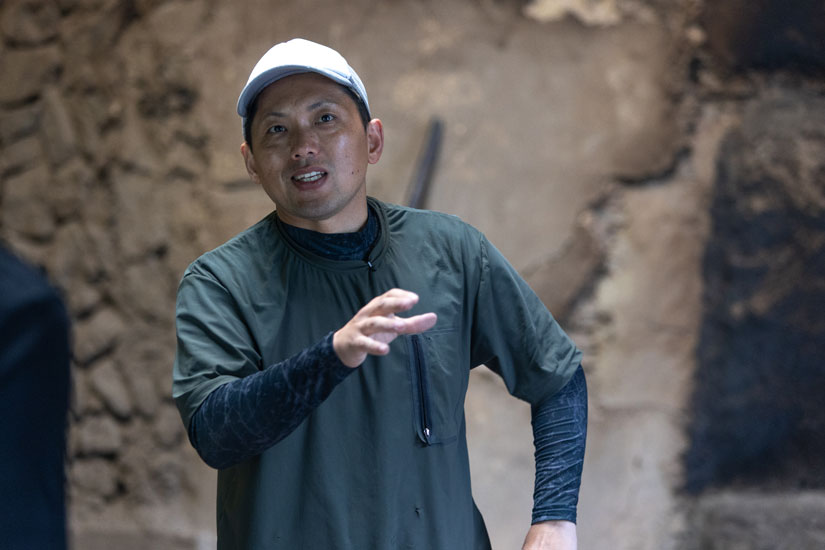
The quality of Kishu Bincho-tan depends entirely on how skillfully it is charcoal-burned. “I think the people of the past who developed this production method were truly amazing. However, even when using the same method, the quality of the charcoal still varies depending on the craftsman,” says Mr. Yugami. For him, his father serves as a major source of inspiration.
“My father was truly a master at making charcoal. If I can produce charcoal like my father did, I won’t be ashamed to show it anywhere. It’s the kind of charcoal that makes you say, ‘This is Kishu Binchotan!’” His goal is to consistently produce high-quality charcoal, just like his father did.
Charcoal production is a craft where the final result varies depending on the season, the condition of the wood, and even the slightest difference in heat control. Mr. Yugami, mindful of the principle of “crafting something of high quality,” confronts the seasonal variations, the quirks of the kiln, and every single change, while also listening to the advice of veteran charcoal burners to gain experience.
“High quality is the fundamental premise of the Kishu Binchotan brand,” says Mr. Yugami. “I want to maintain that quality while carrying on the techniques of our predecessors.”
Hauling logs down from the mountains, reading the color and smell of the smoke, and discerning the slightest adjustments in heat—it is through this steady accumulation of painstaking work that Kishu Binchotan is born, and it will continue to support the skills of chefs and Japanese cuisine for years to come.