

Deep in the Kii Mountains, Masao Horiike of “Sumi Kobo Kishu Shōen” is the sole artisan who continues to produce “pine soot charcoal”—a tradition dating back about 1,000 years—and “pine soot ink,” which has a history of approximately 2,000 years. While preserving the traditional method that involves tending the flame for 100 hours, he pours his heart into each individual ink stick, crafted solely from soot and animal glue.
“Pine Soot” and “Pine Soot Ink”: Carrying On Traditions Deep in the Kii Mountains
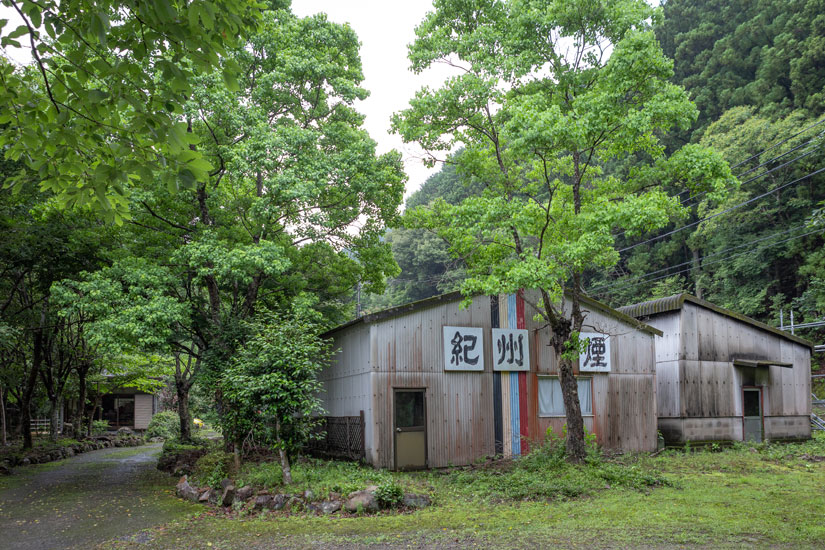
The Kumano Kodo Nakhechi Trail, along which many pilgrims walked during the Heian period on their journeys to Kumano, is a historic pilgrimage route. The workshop of “Sumikobo Kishu Shōen” is located in a remote mountain village in Ayukawa, Tanabe City, which serves as the gateway to this trail. Masuo Horiike, originally from Shizuoka Prefecture, moved to the Kinan region and took over the family business of “matsuen production,” which had been run by his wife’s family. Although he once had his workshop in downtown Tanabe City, he relocated to his current location about 35 years ago due to the nature of his work—which involves handling “smoke”—and has continued to preserve this traditional craft for nearly 40 years.
The only artisan who carries on a production method that dates back to the Edo period
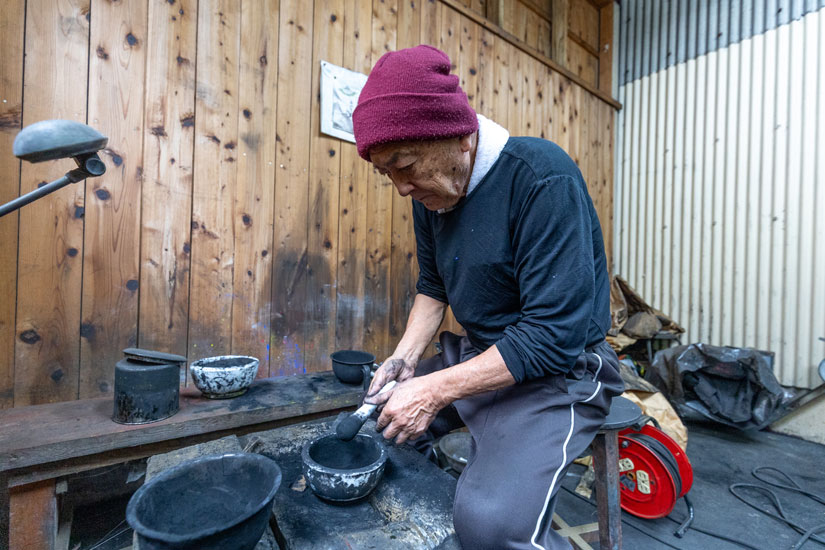
“Pine soot” refers to a carbon-based black pigment made by collecting the soot that adheres to walls and other surfaces when pine trees—rich in “pine resin,” a sticky sap containing oils—are incompletely burned. Mr. Horiike collects this fine-grained soot using the “shōji-daki” method—a traditional technique introduced to Kishū nearly 400 years ago during the Edo period—which involves carefully managing the flame for nearly 100 hours. Today, Mr. Horiike is said to be the only artisan still producing “pine soot” using this technique. Furthermore, he is an ink artisan who uses the “pine soot” he has collected himself to craft “pine soot ink,” a solid ink used in ink wash painting and calligraphy.
Nurtured by the culture of the “Land of Trees” and flourishing under the patronage of the Kishu Tokugawa clan
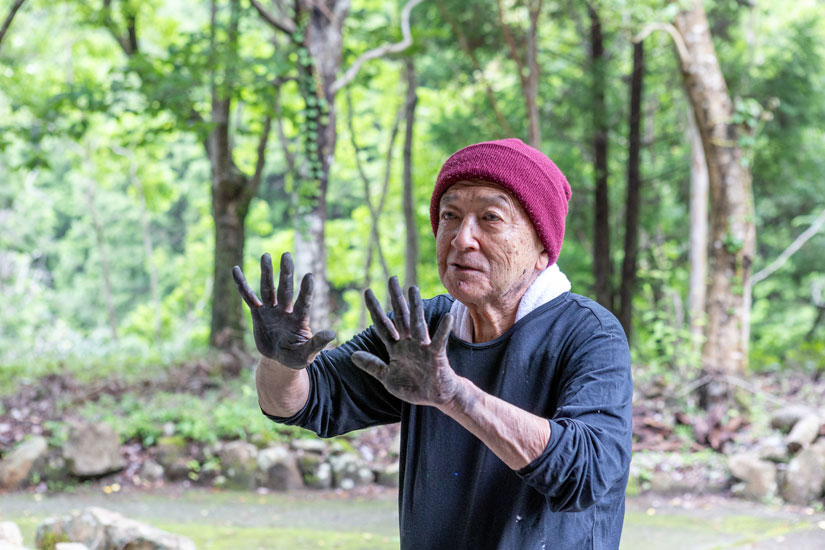
Wakayama Prefecture is known as the “Land of Trees” because forests cover approximately 77 percent of its land area, and since ancient times, people have made a living by utilizing the bounty of the mountains. “In Kishu—surrounded by the sea and mountains, with little flat land—people had to choose between making binchōtan charcoal or harvesting pine soot, or engaging in mountain work or hunting… That’s how everyone made a living back then,” says Mr. Horiike.
In Kishu, pine soot production flourished during the Edo period under the patronage of the Kishu Tokugawa clan. From the Meiji through the Taisho eras, the Tanabe ink master Suzuki Baizen made the craft famous nationwide, and “Baizen Ink” is still highly regarded by calligraphers and enthusiasts today as a masterpiece of traditional ink. However, with the onset of the Showa era and the industrialization that accompanied the postwar period of rapid economic growth, people began leaving the mountains to work in the cities. The number of people engaged in forestry and pine soot production gradually dwindled, and the traditional industries that had flourished in Kishu began a steady decline.
The raw material is red pine, which is rich in pine resin.
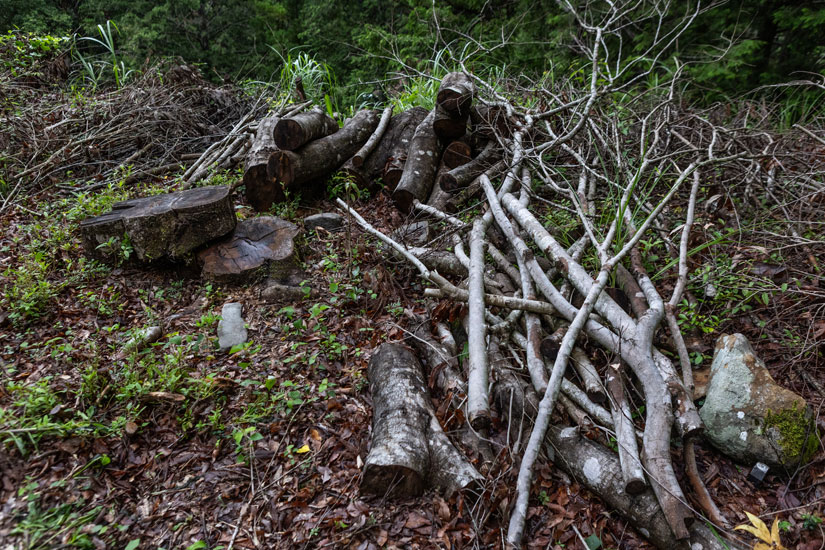
Mr. Horiike uses red pine (Akamatsu) for his pine soot production. “You can use black pine (Kuro-matsu) as well, but black pine grows wild mainly along the coast. White birch, which grows in cool highlands and mountainous areas, also contains a lot of resin and burns well, but it’s rarely found in the warmer climate of Wakayama. In the mountains around here, red pine is the only option,” he explains. However, he says he’s been having a hard time “collecting pine” lately. When the trunk of a red pine is damaged or its bark is stripped, pine resin oozes out. Since the resin accumulates again after about half a year, the process of stripping the bark is repeated. It is said that, in the past, managing 500 to 600 pine trees in the mountains was enough to secure about ten years’ worth of raw material.
Only 10 kg of pine soot can be obtained from 500 kg of Japanese red pine.
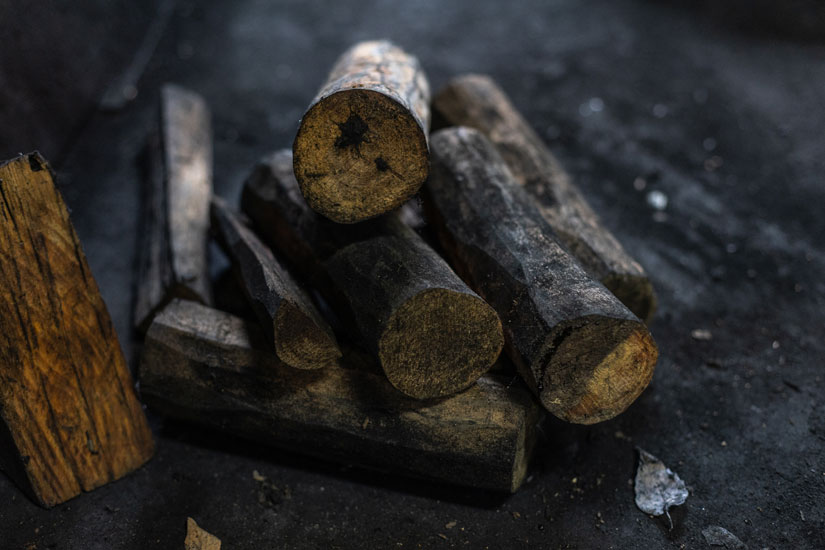
However, the environment surrounding the forests has changed significantly. While we currently ask people working in the mountains to collect red pine logs that have rotted and fallen there, the reality is that even this is becoming increasingly difficult as logging operations shift from manual labor to mechanization. “You can only produce about 10 kg of pine soot from 500 kg of red pine,” he explains. That is precisely why not a single piece can be wasted. The cross-section of the red pine I was shown was rich with amber-colored resin.
A fire that burns continuously for 100 hours
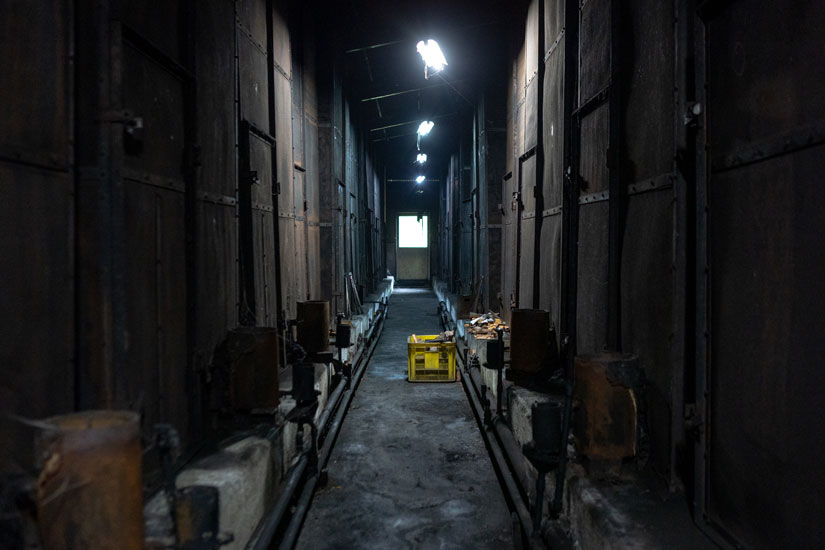
The “Soot Collection Workshop,” where soot is collected, is dimly lit and, of course, pitch black with soot. About 10 small rooms, each roughly the size of two tatami mats, are lined up side by side, separated by fine-mesh wire screens. In the past, they were partitioned by shoji screens, but due to fire hazards, they were redesigned into their current form.
Matsukata is experiencing incomplete combustion
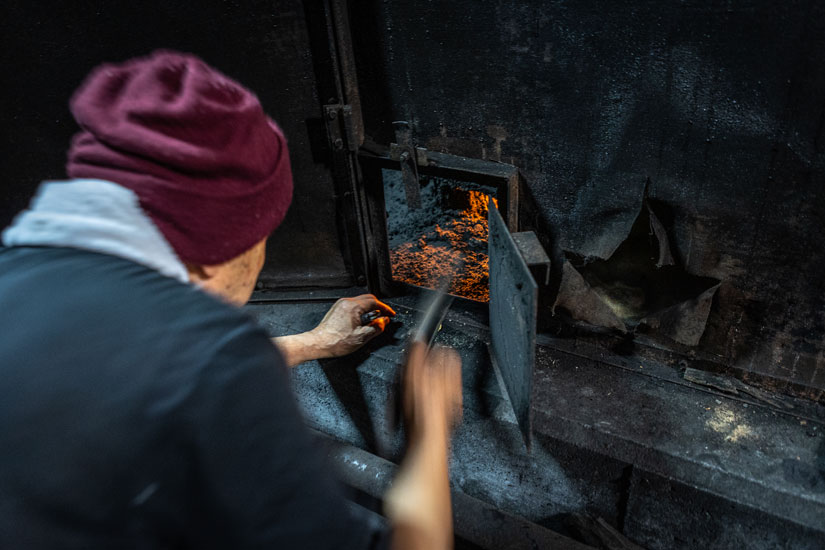
Each small chamber has a small window for inserting kindling, and pine chips are burned in each chamber in turn, allowing them to undergo incomplete combustion. By the time the process has gone through all the chambers once, the first batch of pine chips has just about burned out, so more are added. This process of repeatedly adding fuel while keeping the flame alive and under control lasts a full 100 hours.
Patiently, over low heat, until it breaks down into fine particles
“Since it’s impossible to keep the fire burning continuously for 100 hours, I work for a few hours, then extinguish the fire and resume later,” says Mr. Horiike. “If you burn it patiently over a low flame for a long time, you get fine-grained soot; if you burn it all at once in a large kiln, you get coarse-grained soot. Apparently, in the old days, wholesalers used to grade the soot based on the color differences resulting from the fineness of the particles.”
The “pine soot,” produced by burning pine chips for 100 hours and manually collecting the smoke, is cleaned of debris and passed through a compressor to remove air. It is then transformed into ink at the “Ink Manufacturing Workshop.”
Ink made with the same ingredients and methods as 2,000 years ago
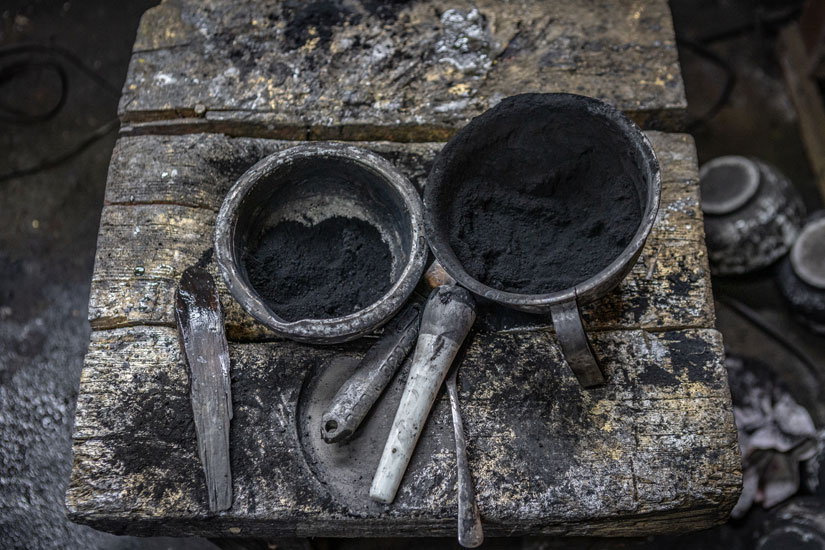
The black pigments used as raw materials for ink include “pine soot,” which is obtained by burning pine resin; “oil soot,” which is obtained by burning vegetable oils such as rapeseed oil or sesame oil; and “carbon black,” which is industrially manufactured from raw materials such as petroleum. These are mixed with “glue”—a natural adhesive made from animal hides, bones, and tendons—and kneaded to form solid ink.
Soot particles determine the properties of ink
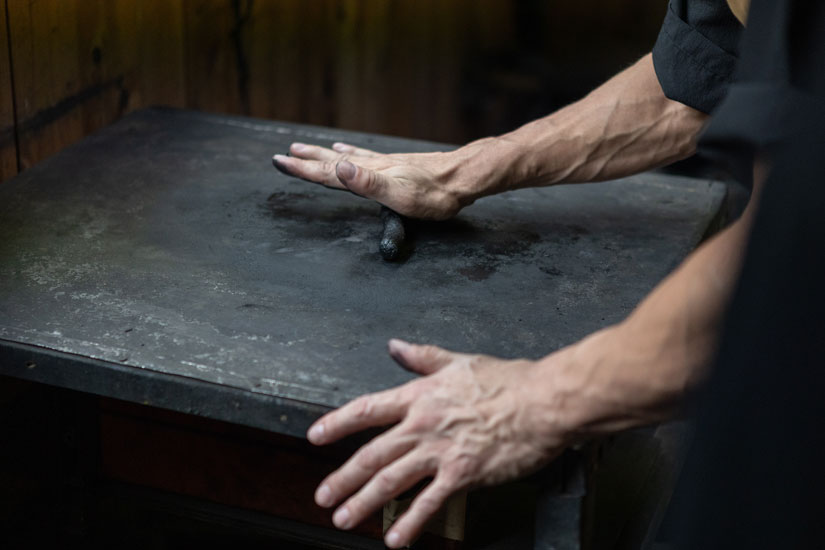
“The ‘pine soot ink’ I make is simply pine soot mixed with animal glue, kneaded, shaped into a block, and dried.” The raw materials and manufacturing process are the same as those used for ink produced in China during the Han Dynasty, roughly 2,000 years ago. “It’s precisely because it’s so simple that it has survived for 2,000 years,” Mr. Horiike adds. Using a mixture of 6 parts soot to 4 parts animal glue, he carefully kneads the mixture by hand into a clay-like consistency—much like making bread dough by adding water to bread flour. Although the mixture is fine-tuned based on temperature and humidity, the 6:4 ratio is the golden ratio derived from the artisan’s intuition and experience. However, Mr. Horiike emphasizes that, more than the mixture itself, “the quality of the soot particles and the animal glue determines the ink’s properties.”
A Carefully Crafted Drying Process
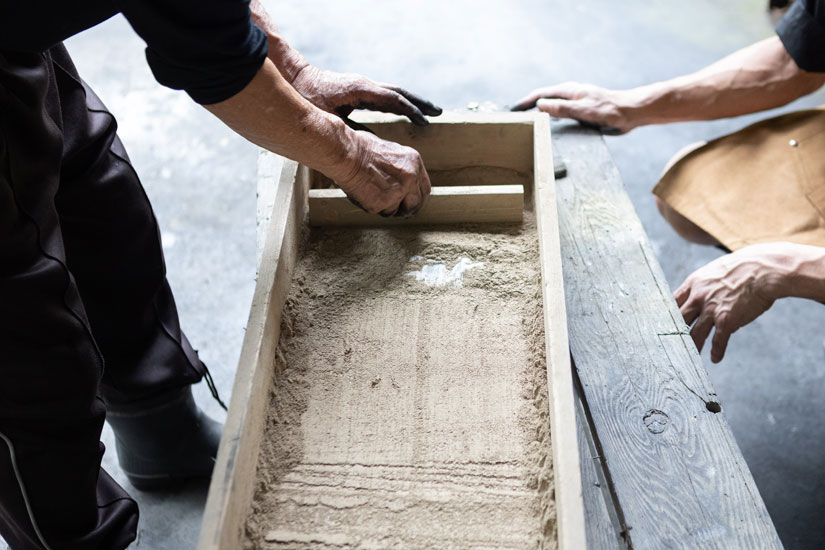
Drying is also a process that requires constant attention. The shaped ink sticks are wrapped in newspaper and buried in the ashes of a wooden box, where they are slowly dried over a period of about one month—or two to three months for larger pieces, depending on the season. During this time, the newspaper is replaced and the sticks are repositioned repeatedly, with the craftsman making countless adjustments by hand to ensure the ink sticks dry straight. Once the ash-drying process is complete, the ink sticks are wrapped in a blanket and left to air-dry. While drying methods vary from workshop to workshop—some hang them from the ceiling, others place them in bamboo baskets—the method of using a blanket to maintain a consistent temperature while slowly drawing moisture out from the inside is a technique Mr. Horiike developed through years of experience. Whether it’s the drying process or the smoke-curing process, which involves keeping a fire burning for 100 hours, ink-making is said to be better suited for winter.
Its most distinctive feature is the fun of “blurring.”
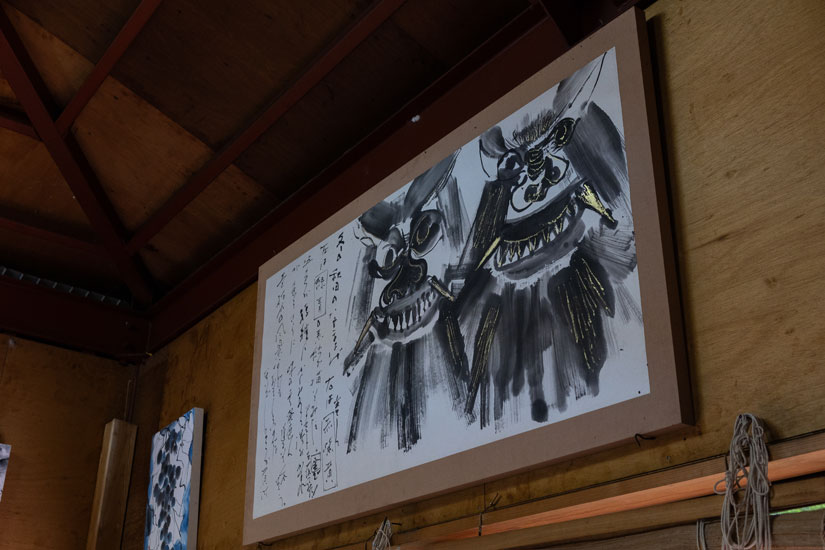
Also on display in the studio is a Namahage painting created by Ms. Kōsa Matsushita, head of Sumi-e GROUP82 and a judge for the “Art of Ink Exhibition” as well as an NHK Gakuen sumi-e instructor, using “Sai-en: Sumi Gōsai.” Ms. Matsushita is one of the sumi-e artists Mr. Horiike admires, but in fact, Mr. Horiike himself also has a side as a sumi-e artist—he uses pine-smoke ink he makes himself to draw gentle, charming characters and pictures, and even holds hands-on sumi-e workshops.
According to Ms. Horiike, the greatest feature of “pine-smoke ink” is the fascination of its “bleeding.” “When you write characters or draw pictures on paper with ink, the lines and dots gradually spread outward from their outlines. That’s the charm of it,” she says—words befitting an artist who has spent many years working with ink.
The Rich Expressiveness Created by Irregular Particles
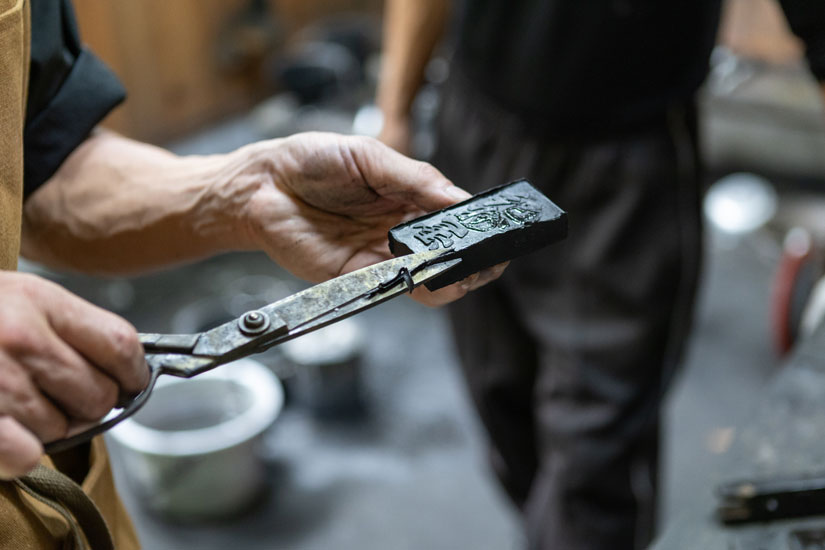
That “blurring” is linked to Mr. Horiike’s oft-stated belief that “soot particles determine the properties of ink.” The “ink solution”—created by grinding ink with water—is not a solution in which the soot is dissolved in water, but rather a state in which the glue enveloping the soot particles is dispersed in water. These particles catch on the fibers of the washi paper; the larger particles remain near the surface, while the smaller ones penetrate deeper and deeper. Of course, “oil-smoke ink” and inks made with carbon black also exhibit “blurring.” However, the difference from “pine-smoke ink” lies in the fact that these inks have uniformly sized particles, resulting in a uniform “blurring.” The “irregular particles, whose sizes vary depending on the intensity and manner of burning,” as Mr. Horiike describes them, create a rich and nuanced “blurring” that imparts a rich gradation of tones and depth to calligraphy and paintings.
“Sai-en-boku”: 40 Colors Born from Tradition
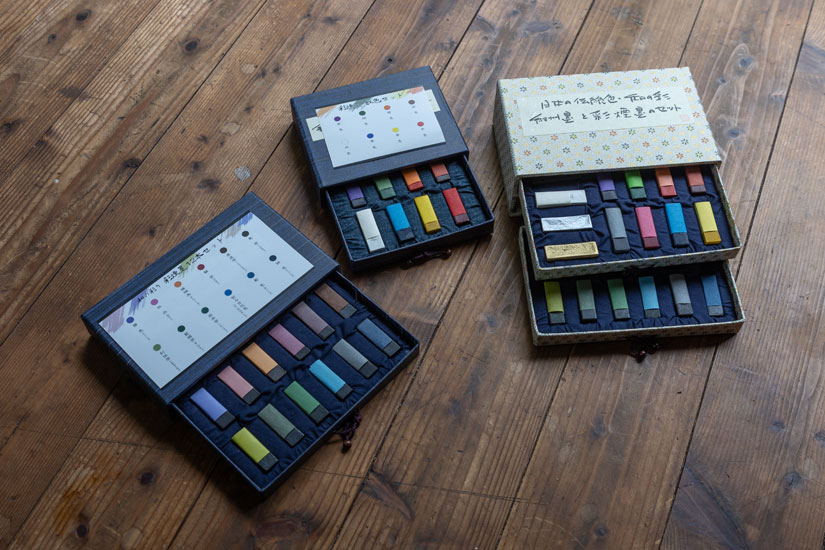
While preserving the tradition of pine-smoke ink, Mr. Horiike has, for about 20 years, been producing colored inks—including gold, silver, and white—in addition to traditional Japanese colors such as wisteria purple, peony red, and Rikyu brown. He has commercialized approximately 40 colors by combining pigments such as “bengara” and “oudo” with animal glue. These colored inks, which he has named “Sai-en-boku,” not only expand the range of artistic expression through color mixing but are also well-suited for “layered painting.” With paint, when a new layer is applied over an existing one, the underlying color tends to bleed. In contrast, once ink dries, it resists bleeding even when water is applied, allowing the overlaid colors to show up beautifully; this makes it possible to layer colored inks over black ink.
The Culture of Ink: To the West
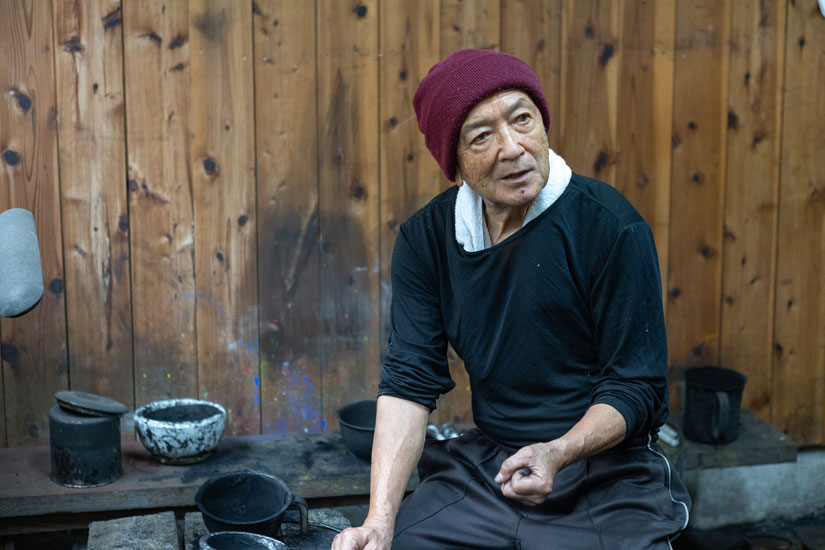
Mr. Horiike, who continues to produce “pine soot charcoal” and “pine soot ink” deep in the mountains of Kishu, has no apprentices. Securing the red pine needed as raw material is becoming more difficult with each passing year, and the workshop that produced “Wakō”—a purely domestically produced product made one by one by hand using traditional Japanese methods—closed its doors about 15 years ago. Furthermore, the artisans who craft the wooden molds used to shape the ink are also growing older. Nevertheless, he continues to visit events at department stores and elsewhere to convey the passion he pours into every single piece of ink.
“Foreigners show a tremendous amount of interest. If I were 20 years younger, I would definitely have gone global,”
says Mr. Horiike with a laugh, his eyes fixed on the potential for global expansion. In Japan, the use of pre-made ink is becoming more common even in calligraphy classes, and the culture of grinding one’s own ink is gradually fading away. On the other hand, overseas—against the backdrop of growing interest in Japanese culture—some people are drawn to ink, and in fact, there are those who use Sai-en ink for “calligraphy,” also known as Western calligraphy.
“In Japan, we have a culture that embraces ‘blurring’ as a form of beauty. In contrast, in the West, the mainstream style emphasizes drawing precise lines. That’s precisely why, if ink spreads further, it might be used in different ways, and a new culture could emerge.”
“Pine soot charcoal,” passed down for over 1,000 years, and “pine soot ink,” with a history of approximately 2,000 years. With these techniques and forms of expression close to his heart, he quietly burns with determination to reach the world from his small workshop in Wakayama.