

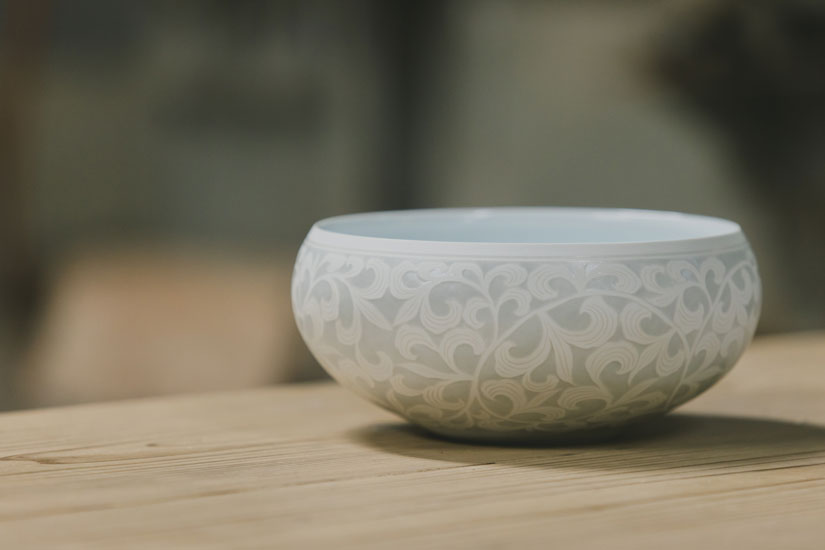
A transparency reminiscent of glass. “Hakuji Yuzogan” (white porcelain inlay), one of ceramic artist Shin Egami’s series, is striking for its translucent appearance—despite being a ceramic piece. Born into a kiln that traces its roots to “Takada-yaki,” a traditional craft representative of Kumamoto, Egami is exploring new possibilities while preserving tradition and pursuing his own unique form of expression.
He took over the kiln his father had established and became a potter.
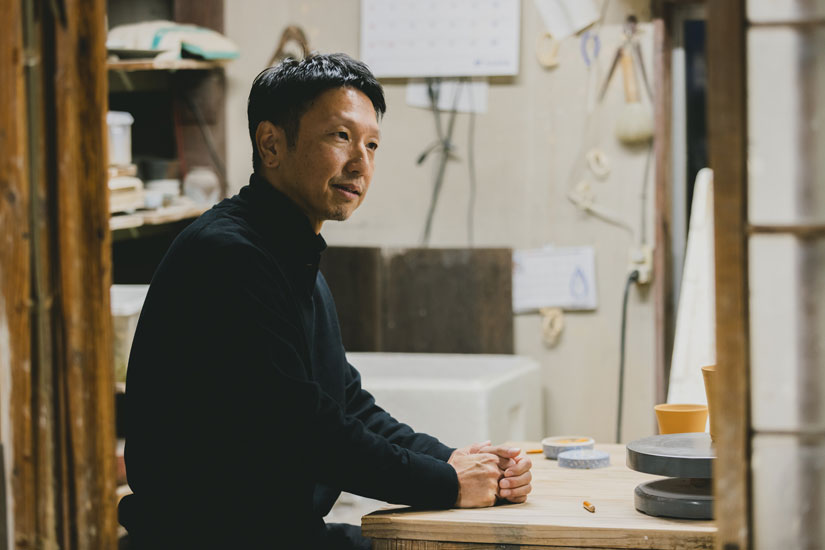
“Koda-yaki Ryugen Kiln” is located on the banks of a spring-fed pond in the Yatsushiro Plain. Mr. Egami is the second-generation head of “Koda-yaki Ryugen Kiln.” He has won awards at exhibitions such as the Kumamoto Prefectural Art Association Exhibition, the Western Japan Traditional Crafts Exhibition, and the Japan Traditional Crafts Exhibition.
Mr. Egami graduated from a local high school and went on to attend a university in Kumamoto City. His father, Gen, who opened “Kodayaki Ryugen Kiln” in 1987, never once asked him to take over the kiln, and because their home and workshop were located far apart, he rarely saw Gen at work making pottery. As a result, he says he never even considered becoming a potter. The turning point for Mr. Shin came during his job search.
“When I thought about what kind of work I wanted to do, memories of my grandfather, who was a Western-style painter, came flooding back,” says Mr. Egami. Recalling how he had been moved by the beauty of the oil paintings and sculptures he saw in the studio he visited as a child, he realized that, deep down, he had always harbored a longing and interest in creating things. It was then that he first recognized he was in the ideal environment to pursue ceramics.
After graduating from college, she studied the basics of ceramics at the Saga Prefectural Arita Ceramic College and returned to her hometown at the age of 26. There, she began devoting her days to creating pottery alongside her father at “Takada-yaki Ryugen Kiln.”
“Ryugen Kiln,” which carries on the legacy of the “Higo Imperial Kiln”
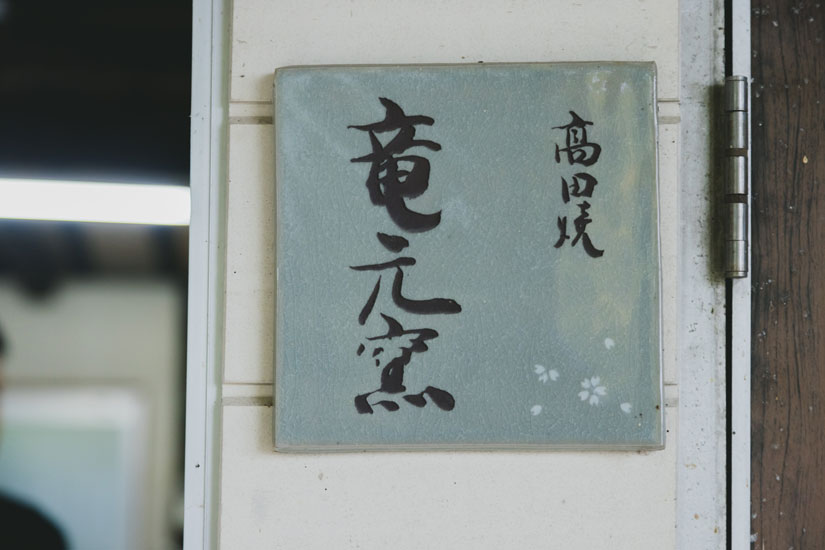
“Takada-yaki Ryugen Kiln” traces its roots to Takada-yaki, a traditional craft that represents Kumamoto. Takada-yaki has a long history; it is said that in 1632, during the early Edo period, Sonkai established a kiln in what is now Yatsushiro City. Sonkai was a Korean potter who was taken into the service of Hosokawa Tadaoki, lord of the Buzen Kokura Domain, in 1602. Although he initially built a kiln in Ueno (present-day Fukuchi Town, Tagawa District), which Tadaoki governed, he moved to Yatsushiro following the Hosokawa family’s transfer of their domain. Takada-yaki, also known as “Yatsushiro-yaki,” was protected as the official kiln of the Higo Domain but lost that patronage after the Meiji Restoration. The three surviving Takada-yaki kilns are the “Ueno Kiln” (the head family), the “Den-shichi Kiln,” and the “Ryugen Kiln.” Mr. Egami’s father, Motosan, trained at the “Den-shichi Kiln” before opening the “Ryugen Kiln.”
An attempt to reinterpret tradition and create something new
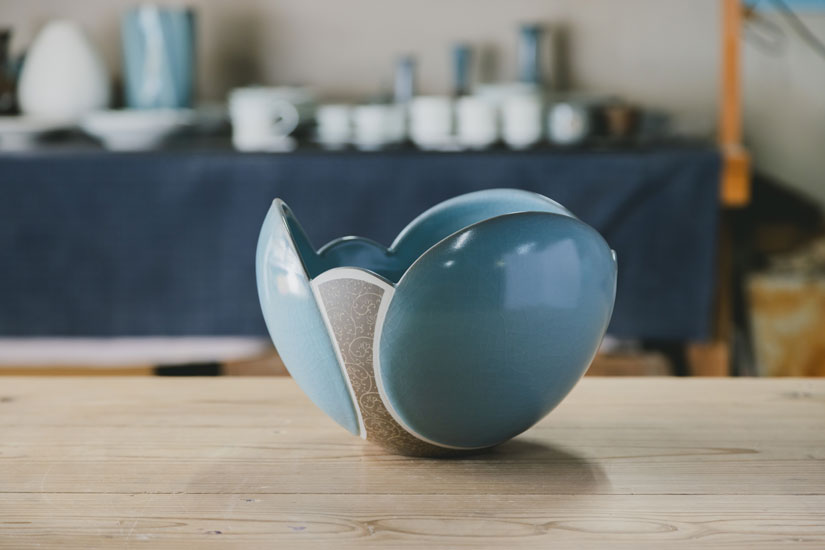
Mr. Egami’s father, Moto, sought to create Takada-yaki that broke free from conventional molds while preserving ancient traditional techniques. Mr. Egami, too, is exploring new possibilities for Takada-yaki and pursuing his own unique style, all while carrying on the tradition.
“I believe that by preserving and simultaneously reconstructing the three elements that define Takada-yaki—‘clay, glaze, and inlay’—I can present a vision of ‘Takada-yaki for today,’” says Ms. Egami. These three elements are the essential core of Takada-yaki and serve as the starting point for her creative process.
Among these, clay preparation is one of her greatest passions. While many contemporary potters use commercially available clay, Egami goes into the mountains himself to dig up raw clay. He transports the raw clay to his studio, mixes it with water, and sifts it through a fine-mesh sieve to remove impurities. This process is both time-consuming and labor-intensive, but by selecting the clay with his own eyes and refining it with his own hands, he produces clay with a finer texture than commercially available varieties. This clay is then transformed into works free of imperfections such as spots.
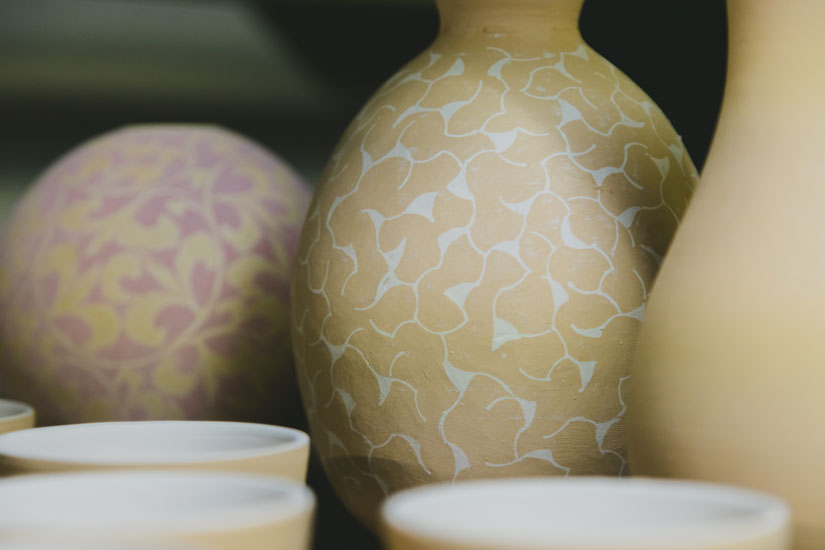
Egami’s philosophy is reflected in his body of work. His pieces can be broadly divided into three categories: “Celadon Inlay,” “Yakisime Inlay,” and “White Porcelain Glaze Inlay.” “Celadon Inlay,” which accounts for the majority of his award-winning works, is characterized by the striking contrast between the brown clay he produces himself and a uniquely formulated celadon glaze that brings out its beauty. “Unglazed Inlay” is created by applying inlay to the base material and firing it in a pit kiln without glaze, resulting in a texture that conveys warmth and strength. Finally, “White Porcelain Glazed Inlay”—mentioned at the beginning—involves pouring glaze into indentations made in white porcelain; the glass-like transparency and the shadows cast within the indentations create a beauty of subtle mystery.
Tradition is not something to be preserved, but something to be created.
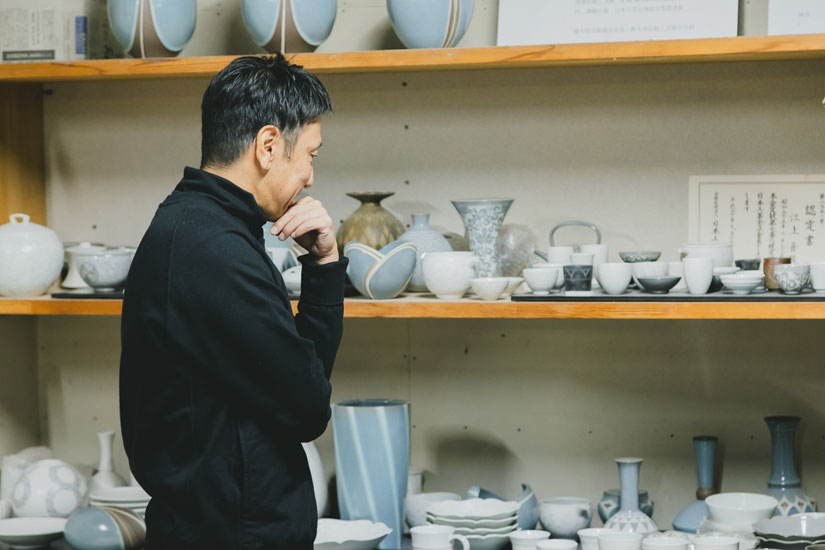
In 2018, Mr. Egami was certified as a “Full Member of the Japan Crafts Association”—a status granted only to artists who have been selected for the Japan Traditional Crafts Exhibition four or more times. The Japan Crafts Association is an organization composed primarily of Holders of Important Intangible Cultural Properties, commonly known as “Living National Treasures,” and full membership is highly selective, with only about 1,300 members nationwide. The Japan Traditional Crafts Exhibition is considered the nation’s premier open-call craft exhibition, and being selected for it four or more times signifies not merely a fleeting recognition but a sustained and public acknowledgment of one’s skill. Yet Ms. Egami is not content to rest on her laurels; she continues to explore new forms of expression to this day.
“Within the framework of Takada-yaki, I want to pursue ‘ceramics unlike anything seen before.’ I believe tradition is not something to be preserved, but something to be created,” says Egami. These words have been forged amid the tension inherent in a craft deeply rooted in the local community. While unveiling new works at department stores in the Tokyo metropolitan area, he also holds solo exhibitions every year without fail in his hometown of Yatsushiro City. There, he faces the watchful “eyes” of the local community, which has watched over Takada-yaki for some 390 years. “In Yatsushiro, there are people who take pride in Takada-yaki as a local treasure. They are well-acquainted with my father’s work and have been observing Takada-yaki for even longer than I have.” Although her new artistic style sometimes draws harsh criticism, Ms. Egami does not dismiss it; instead, she accepts it as a learning experience for her next step.
In the world of traditional crafts, change is not always welcomed. That is precisely why her attitude—challenging herself to find new forms of expression while discerning what must be preserved—serves as a guiding principle for the artisans who will follow in her footsteps. As Ms. Egami speaks, gazing at both her father’s works and her own, her eyes show respect for the past while firmly looking toward the future. The challenge faced by this single kiln, rooted in the local community, overlaps with a universal question confronting the craft world as a whole: how to pass on a tradition spanning approximately 390 years to the next generation.