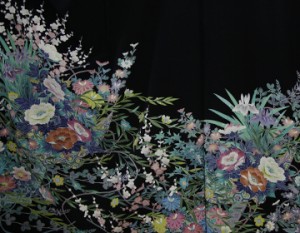

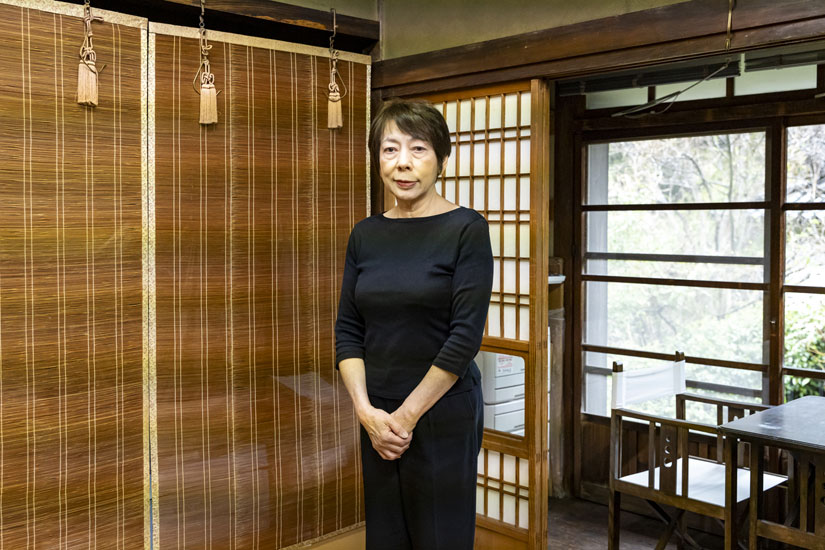
Located in Yahata Higashi Ward, northern Fukuoka Prefecture, the Yū Dyeing and Weaving Studio is a workshop dedicated to Kokura-ori, a traditional craft of which Kitakyushu is proud. Studio founder Noriko Tsuki continues to create vibrant Kokura-ori textiles, dyeing threads with plants and weaving them by hand. What is the source of this creativity that captivates people both in Japan and abroad?
Thick and durable. Captivating with beautiful vertical stripes.
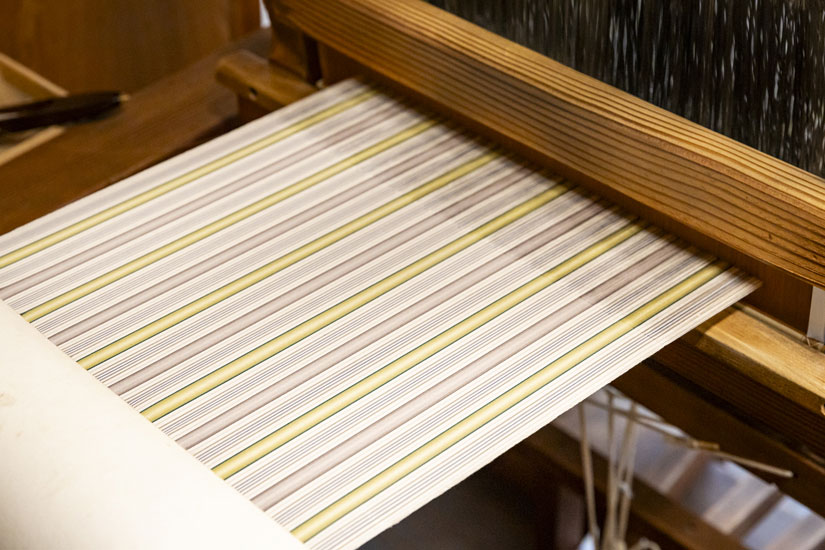
Kokura-ori is a simple weave created by crossing warp and weft threads one by one. Its distinctive feature, however, is the high density of warp threads—used in greater quantity, approximately three times that of the weft. This makes the weft threads less visible, allowing the vertical stripes to appear sharply defined and radiate a captivating beauty.It is a unique fabric with a smooth texture, creating a three-dimensional effect through the gradations of thread color.
During the Edo period, it was used for hakama and obi. In the Meiji era, it circulated as student uniforms.
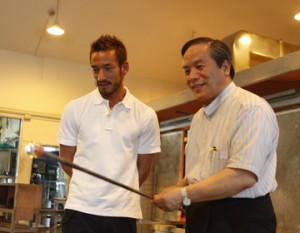
Originating in the Edo period in the Buzen Kokura domain (present-day Kitakyushu City), Kokura-ori emerged. As this region was a cotton-producing area, samurai women began weaving textiles using cotton yarn.Its thick, durable fabric gradually led to its use for samurai hakama and obi, spreading nationwide. It gained fame when Tokugawa Ieyasu wore it as a haori during falconry, earning the praise “Kokura-ori that even a spear cannot pierce” and becoming highly valued.
During the Meiji era, the gray fabric “Shimofuri Kokura,” made by twisting black and white threads, became popular nationwide as the summer uniform for male students. However, as cheap machine-woven imitations began appearing in various regions, production in Kokura waned, overwhelmed by this trend.Furthermore, Kokura flourished as an “iron town” with its steelworks, and by the early Showa period, the last Kokura-ori factory closed, leading to the discontinuation of the fabric.
A Fateful Encounter with a Scrap of Kokura-ori at an Antique Shop
Nestled in the quiet foothills of Yahata Higashi Ward, Kitakyushu City, lies the Yusei Dyeing and Weaving Studio. Its director, textile artist Noriko Tsukiji, is the person who revived Kokura-ori. Born and raised in Kitakyushu, Tsukiji, who loved literature, became captivated by the beauty of Noh costumes while studying classical performing arts like Noh and Joruri at university.
While visiting a Nishijin-ori weaving workshop in Kyoto, Tsukiji was moved by the mastery of the artisans. Yet she realized that what she truly wanted to express was not patterns, but “color.” She boldly dropped out of university and threw herself into the world of dyeing and weaving.After mastering the fundamentals of yarn dyeing and weaving at a textile research institute in Kitakyushu, he traveled to Kumejima Island in Okinawa. There, he learned tsumugi weaving by assisting elderly women at a workshop producing Kumejima Tsumugi, a fabric passed down since the Ryukyu Kingdom era.Kumejima is considered the birthplace of tsumugi, the weave that spread nationwide from there. Kumejima tsumugi is also designated as an Important Intangible Cultural Property of Japan, making it an essential place to learn dyeing and weaving techniques. However, he struggled to create a piece he felt truly satisfied with.
One day, a shocking encounter came to Tsukiji. At an antique shop she happened to visit, she found a scrap of Kokura-ori fabric. This small piece, about 10 centimeters, showed only vertical stripes despite being woven. When the shopkeeper told the astonished Tsukiji, “This is Edo-period Kokura-ori,” she only associated Kokura-ori with the gray student uniforms of her youth.The beautiful gradient of the vertical stripes, the substantial yet silk-like texture, appeared to Tsukishiro as something incredibly fresh, hard to believe it was from about 150 years ago. “To discover that the very fabric I aspired to weave existed right in the land where I was born and raised! It was such a happy encounter,” Tsukishiro says, his eyes narrowing with satisfaction.
Reviving and Regenerating Kokura Ori
At the time, no one around him knew about Edo-period Kokura-ori. Tsukishiro had the scraps sent to the Industrial Research Institute for weave analysis. There, he learned that while most textiles have a 1:1 warp-to-weft ratio, Kokura-ori had a 2:1 ratio, meaning it had more warp threads.She immediately tried weaving with that ratio, but couldn’t achieve the smoothness of the old scrap. Further investigation revealed that the smooth texture came from years of use.
Tsukishiro sought to create fabric with a smooth texture from the start, not through aging. By using finer threads, increasing the number of threads, and raising the density, he achieved a lustrous sheen reminiscent of silk, despite the fabric being cotton. This can be seen as Tsukishiro’s “recreation” and evolution of the historic Kokura-ori. Thus, in 1984, Kokura-ori was revived. Tsukishiro began presenting his work as Kokura-ori, paying homage to his predecessors.It was precisely the instantly recognizable, vibrant striped patterns that made it widely accepted. His first work was selected for the Japan Traditional Crafts Exhibition.
However, even after successfully restoring the technique, it took three years to fully master the design of the satisfying Kokura stripes. Driven by a desire to use color more freely, unbound by traditional color schemes, he wove the pale pink obi “Plum Blossom Season,” which won the Asahi Shimbun Award at the Western Japan Traditional Crafts Exhibition in 1991.To date, she has produced over 600 pieces. Today, Kitakyushu is recognized as a center for Kokura-ori weaving, and several new artisans have emerged.
Borrowing the power of plants to express translucent colors
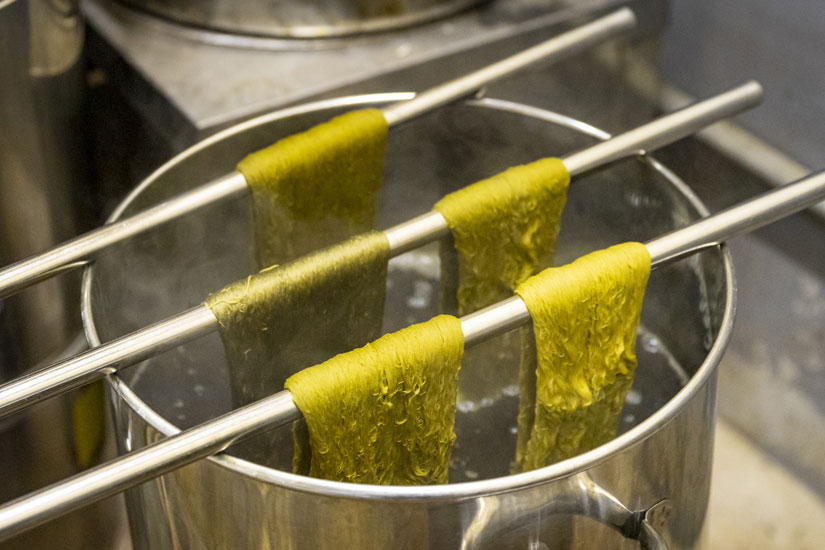
Tsuki dyes cotton threads using natural materials like plants found around her workshop. “Dyeing with plants is incredibly fascinating. For example, rosemary dyes a yellowish color before the flowers bloom, but once they bloom, it dyes a stronger olive hue. Even the same plant changes color depending on the season.”
Unlike chemical dyes, plant-based dyeing takes time and doesn’t happen instantly, making it ideal for creating gradations. You can add more thread later to achieve lighter shades, and it easily reflects whims or moods, perfectly aligning with human rhythms. “Above all,” Tsukiji says, “the soft, naturally derived colors have a translucent quality.”
Preparing thousands of warp threads before weaving
Due to its characteristic of raised vertical stripes, Kokura-ori fabric has many constraints—it cannot form check or horizontal stripe patterns. “But that also means Kokura-ori’s distinctive character remains consistent. Since only the warp thread colors show, the thread’s color is directly reflected—that’s its strength. So the key is how many ‘paints’ you possess, which is why we constantly dye threads.”
Preparing these threads in advance according to the design, known as “warping,” is also a crucial process. The warp threads are arranged on the warping machine, rotated, and combined into the necessary colors while considering factors like length and tension before being wound onto the beam. Preparing around 2,300 warp threads for a single obi involves this painstaking, mind-numbing work. It is precisely this effort that produces the delicate colors.
Textiles suited to the climate and character of Kitakyushu
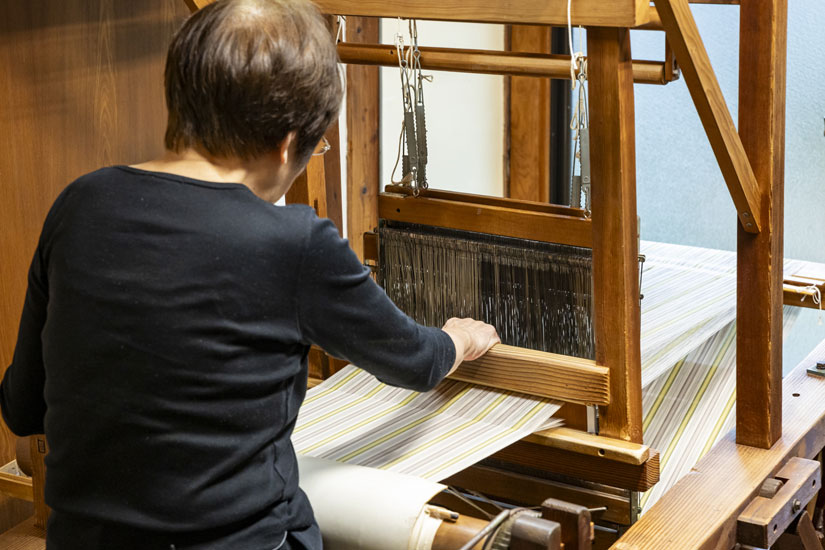
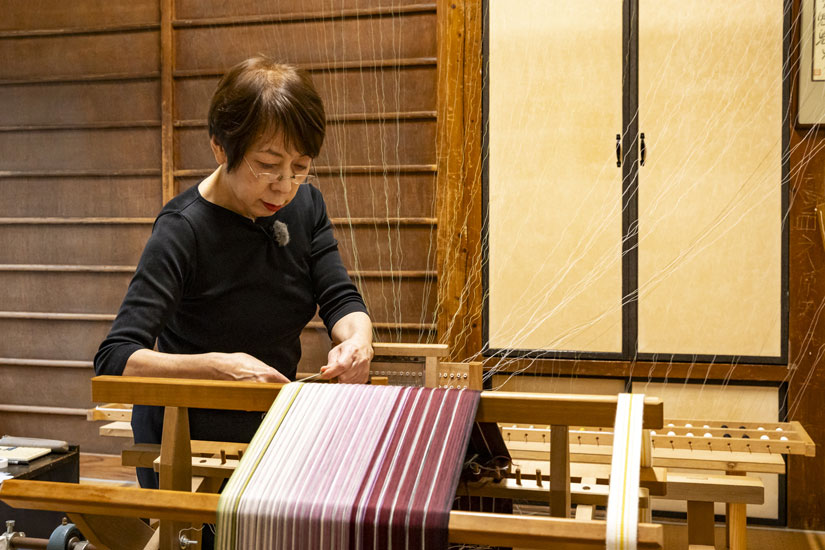
When Tsukiji weaves Kokura-ori on her loom, it’s not a light “tick-tock” sound that resonates, but a loud “thud-thud!”It’s a surprisingly intense sound, hard to imagine coming from such a delicately beautiful fabric. “I weave with strong force to increase the thread density. If I weave gently, the fabric becomes fluffy and lacks firmness. If I slack off, irregularities in the weave become noticeable. So once I start weaving, I just focus intently and keep going.”
“It’s a very stubborn fabric,” Tsukiji-san says with a smile. “This region, even after the tradition once faded, has stubbornly woven this difficult fabric for 400 years. It’s inflexible and clumsy—a fabric that’s quintessentially Kitakyushu.”
Modern, refined textiles captivate the world
Hand-weaving yields limited production, so to introduce Kokura-ori to more people, Tsukiji launched the machine-woven brand “Kokura Shima Shima” in 2007, which she oversees. This allows for the creation of wider fabrics impossible with hand-weaving, enabling larger-scale works like furniture, interiors, and art.Collaborations with global creators like architect Kengo Kuma and Kunihiko Morinaga of the fashion brand ANREALAGE consistently draw the attention of highly discerning individuals.
However, Tsukiji’s core focus remains hand-weaving in the workshop. “No matter how many colors overlap, I aim for a world where colors respect each other, playing a symphony,” Tsukiji states. While he has expressed abstract worlds through Kokura weaving until now, over the past two or three years, he has been challenging himself to incorporate concreteness within them. For example, within vertical stripes, a single diagonal line like rain falling…”Inorganic vertical stripes and organic natural elements seem incompatible, but I want to bring that into the world of vertical stripes. I’m still in the prototyping phase, but I hope to complete it someday.”
Tsukiji-san restores and revives Kokura-ori while seeking new forms of expression. The world eagerly awaits what new beauty will emerge from Tsukiji-san’s meticulous, refined Kokura-ori, woven with such expansive sensibility.