
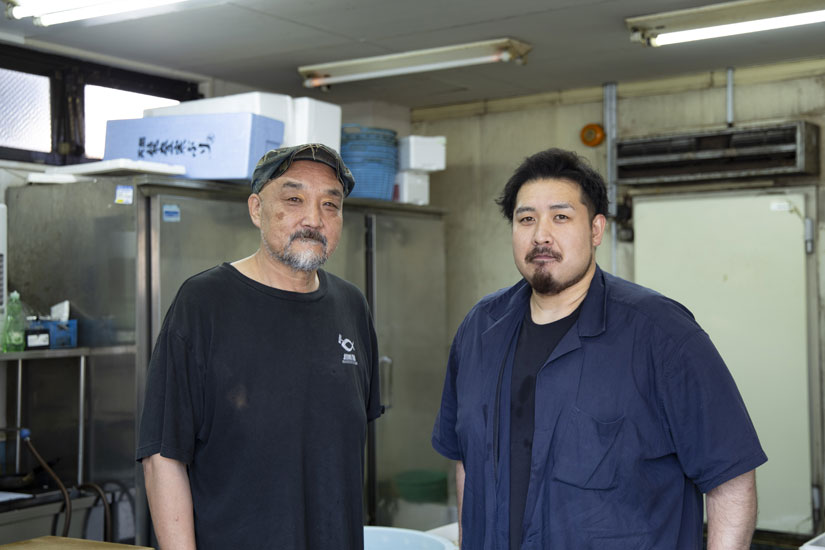
Aomori Prefecture boasts four fishing grounds: the Sea of Japan, the Pacific Ocean, the Tsugaru Strait, and Mutsu Bay. In Aomori City, located at its center, Takashi Shioya, the fifth-generation owner of the fresh fish wholesale and retail shop “Shioya Fish Shop,” and his son Naoki use advanced techniques like nerve-pinching to deliver fish tailored to the specific requests of each chef, both within and outside the prefecture.Underlying their work is a strong desire to halt the decline of the fishing industry and repay the fishermen for their contributions.
Delivering Aomori’s prized fish at the highest quality
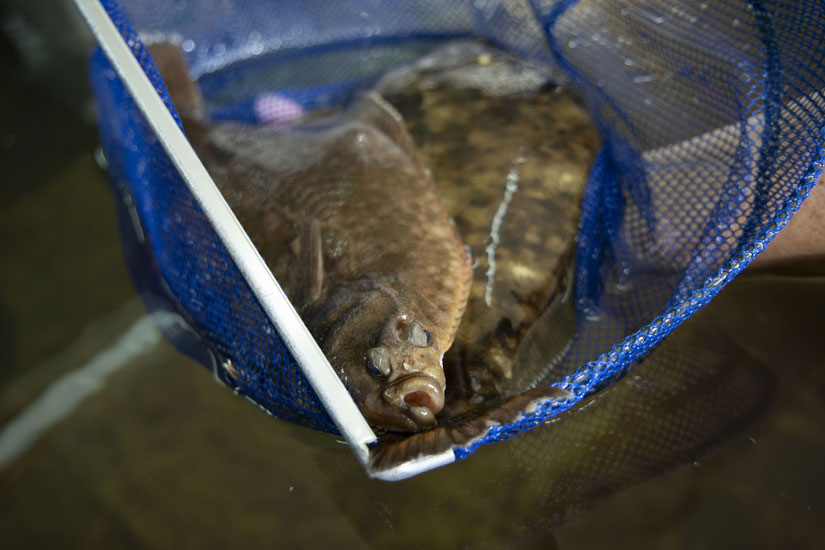
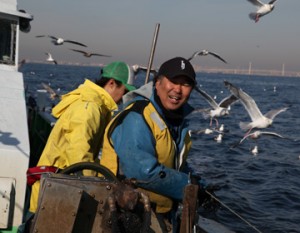
Surrounded by sea on three sides, Aomori Prefecture is a treasure trove of seafood, boasting four distinct fishing grounds: the Sea of Japan coast, the Tsugaru Strait, the Pacific coast, and the inland Mutsu Bay. Off the Sea of Japan coast, the Tsushima Warm Current flows northward; part of it enters the Tsugaru Strait, becoming the Tsugaru Warm Current, and then flows out toward the Pacific.The Tsugaru Warm Current collides with the Oyashio Current from the north and the Kuroshio Current from the south off the coast of Hachinohe. Diverse fishing methods are employed across Aomori’s various fishing grounds, where fishermen, facing the sea, use techniques passed down through generations to land high-quality seafood.
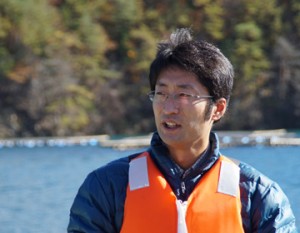
It is Aomori City’s fish wholesaler and retailer, Shioya Fish Shop, that transforms these bountiful gifts from Aomori’s sea into the highest quality products for chefs and consumers, using extensive knowledge, advanced techniques, and above all, a passionate dedication.Takashi Shiotani, the fifth-generation owner running the shop, also serves as the representative of the “Hama no Shigoto-nin: Northern Japan Nerve-Stopping Association.” This association, founded by Takashi, is an organization formed by fisheries professionals engaged in nerve-stopping techniques across Aomori, Hokkaido, Iwate, Miyagi, and other prefectures. Nerve-stopping is a technique that delays rigor mortis in fish after death to preserve freshness. This allows high-freshness fish to be delivered even to distant locations.
Transforming frustration into strength: The journey to nerve-pinning
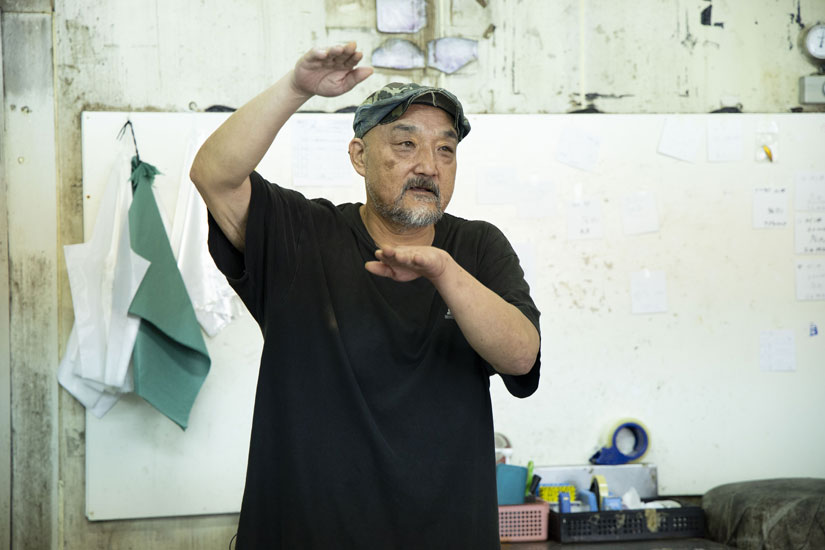
Takashi’s motivation to pursue nerve-pinning began when he heard people in western Japan, far from Aomori, say, “Fish from Aomori are poor in freshness and not tasty.”Shioya Fish Shop, started in 1933 (Showa 8) by four fishmongers, primarily served local restaurants and hotels when Takashi joined. Wanting “people outside the prefecture to taste delicious Aomori fish,” Takashi challenged nationwide distribution in his mid-40s. However, long-distance transport took time, leading him to hear those words again.
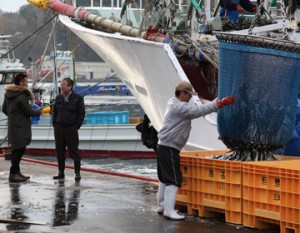
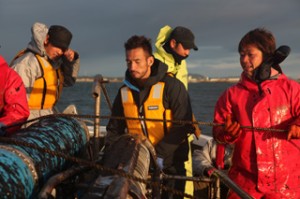
“Is there no way to deliver Aomori fish nationwide while keeping it fresh?” Fueled by frustration, he studied and researched relentlessly, eventually arriving at nerve-pinching. Furthermore, alongside his son Naoki, he visited fishermen in coastal villages like Sai Village and Fukaura Town within the prefecture, dedicating effort to sharing knowledge and techniques directly at the fishing sites.Since the condition of the fish at the moment of killing directly impacts its flavor, it became crucial for fishermen to catch fish in optimal condition and perform proper processing. To unite stakeholders in pursuing excellence, they established the “Hama no Shigoto-nin: Northern Japan Nerve-Striking Association” to create opportunities for information exchange and skill improvement. At its founding, nerve-striking professionals from places like Ehime and Kanagawa came to provide lectures.Many fishermen, moved by the passion of the Shioya father and son, have united their efforts with them.
Crafting Custom-Made Fish as One Team
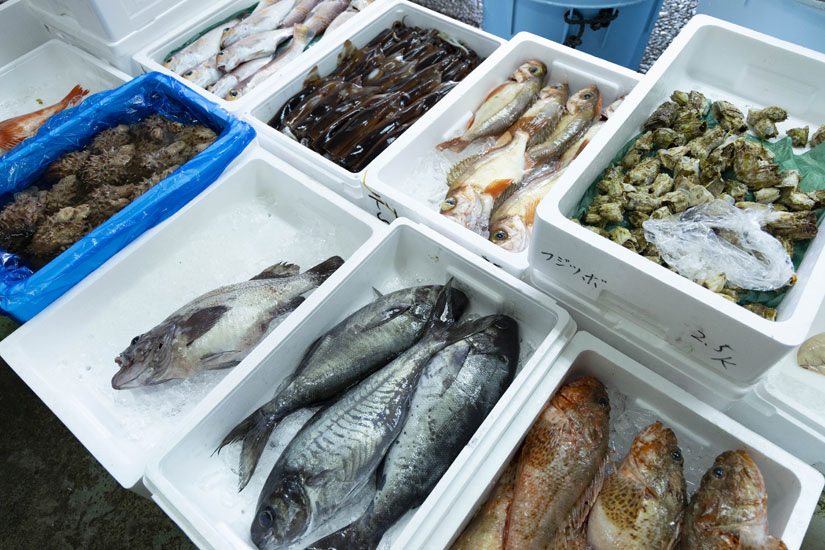
Utilizing techniques evolved into a unique style, the fish crafted by Aomori fishermen and Shioya Fish Shop as one team now attracts attention from renowned chefs nationwide.Because the fish delivered meet or exceed expectations. When an order comes in, Shiotani Fish Shop explains to trusted fishermen: “We want fish like this.” The fishermen then determine the best approach for each request—whether to kill the fish onboard, send them live, or prepare the fish tanks optimally.The fish delivered this way undergoes meticulous management at Shioya Fish Shop. They consider everything down to what the fish ate, selecting the appropriate processing method, such as nerve-pinning. This collaboration between two professional teams enables Shioya Fish Shop to create what they value most: “custom-made fish tailored to each individual customer.”
“We want customers to feel satisfaction beyond the price, just like wearing a perfectly tailored suit,” says Takashi. “Each chef prioritizes different elements—whether texture or aroma. We deeply understand each fish’s individuality, calculating even the optimal cooking timing to meet their requests. Creating fish that tastes absolutely delicious the moment it hits the palate—that’s what making custom-made fish means. Nerve-pinching is just one of the methods to achieve that.”
Shioya’s Nerve-Cutting: Adapting the Process Based on Species, Condition, and Requests
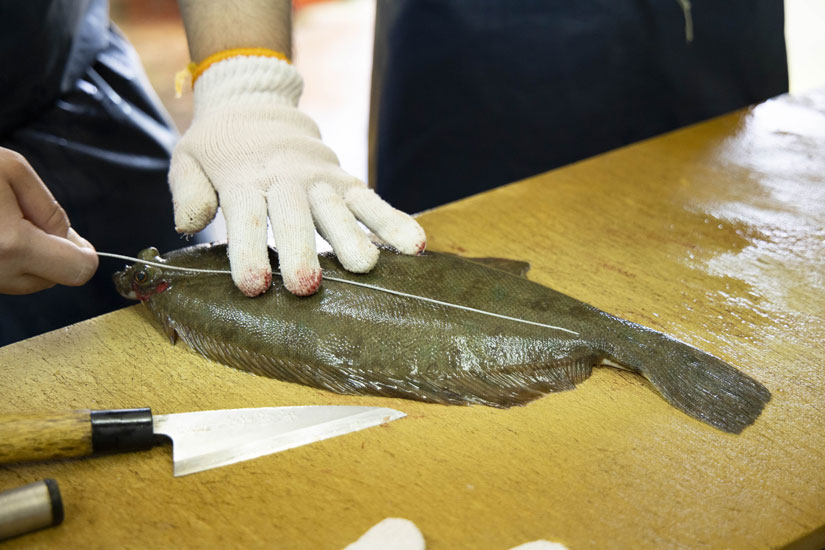
Nerve-pinning involves destroying the spinal cord. Typically, it combines two processes: destroying the brain (known as brain destruction) and bleeding out the fish. Takashi excels by determining whether to prioritize brain destruction or bleeding based on the type and condition of the delivered fish and the customer’s request, thereby adjusting the flavor and freshness. “With brain destruction priority, we destroy the brain and perform nerve-pinning before bleeding, leaving some blood in the fish.”Leaving some blood actually enhances the aroma and umami. So for customers who plan to use the fish immediately upon delivery, we prioritize brain destruction. On the other hand, bloodletting-priority is a technique focused specifically on draining blood. Since residual blood accelerates deterioration of the flesh, we use this method for customers who won’t cook it right away, like those who want to age it,” explains Naoki. He demonstrates brain destruction, a craftsmanship skill passed down directly from Takashi.
Nerve pinning involves severing the spinal cord nerves with a wire. Since nerve locations vary by fish species, it relies on experience and intuition—a true artisan skill. “The wire is coiled, so it wraps around the nerves,” Naoki explains. Removing the nerves causes the color to drain instantly in fresh fish. This also serves as an indicator of the fish’s quality.
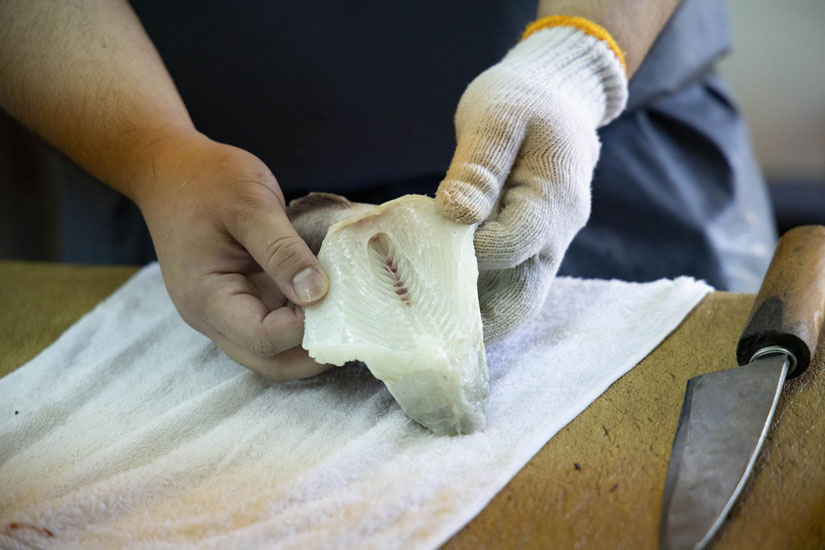
While bleeding methods vary, Mr. Shiotani’s approach relies solely on the fish’s own heartbeat. Here too, the fish’s vitality is crucial. With a lively fish, thorough internal chilling allows nearly all blood to drain within about 10 minutes, resulting in a translucent finish.
Regardless of the processing method, the fish must be in excellent condition as a prerequisite. “We get to work with fish that fishermen meticulously manage, allowing us to pursue even higher standards. Our work exists because of the fishermen,” both Takashi and Naoki express their gratitude.
Raising fish prices to halt the decline of fisheries and preserve culinary culture
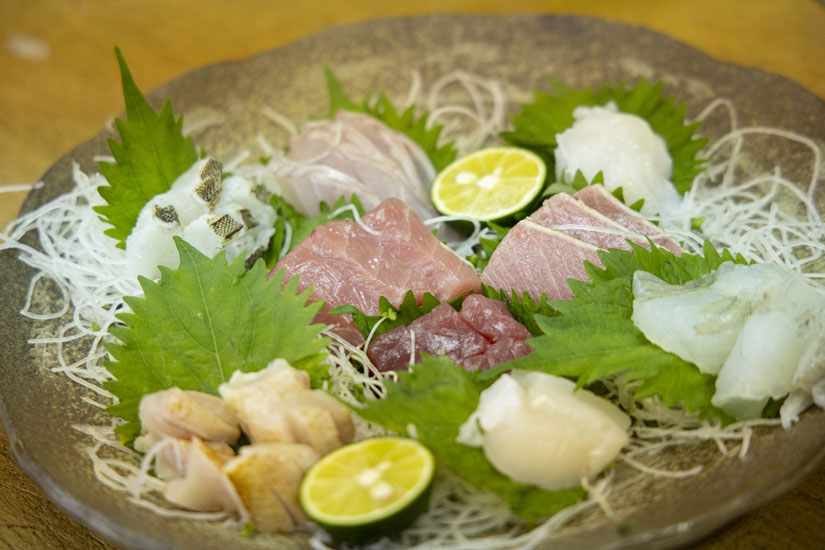
“We want to produce fish that can compete nationwide. Fish worthy of recognition by chefs featured in the Michelin Guide.” While Takashi initially held such dreams, his desire to “repay the fishermen” gradually grew stronger.”I learned so much from the fishermen, and the work I do now is only possible because of the fishermen who walk alongside me. It’s my turn to repay the debt,” says Takashi. He feels the dwindling fish stocks firsthand and shares a sense of crisis.
“When I go to the beach, I often hear sad stories about sons wanting to take over the family business, but their parents can’t afford to feed them if there’s no catch, so they have to give up. I’ll say it again: our livelihood depends entirely on the local fishermen.We’re sustained by them. Plus, the local fish-eating culture could vanish. So what can we do? We have to raise fish prices. We especially need to lift the rock-bottom prices,” Takashi believes. “To achieve that, I want to spread the knowledge and techniques I’ve gained throughout the entire prefecture, raising the value of fish county-wide.”
If fishermen can continue their work under good conditions for generations, Naoki’s generation will also be able to carry on this profession. Furthermore, they can preserve the food culture passed down from their predecessors. This is the future Takashi envisions. “Ultimately, it’s about people enjoying delicious Aomori fish. I want to keep delivering fish that people will crave again and again to as many people as possible.”