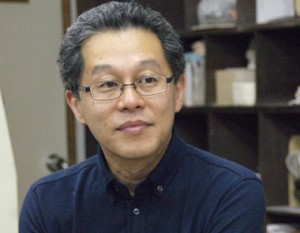


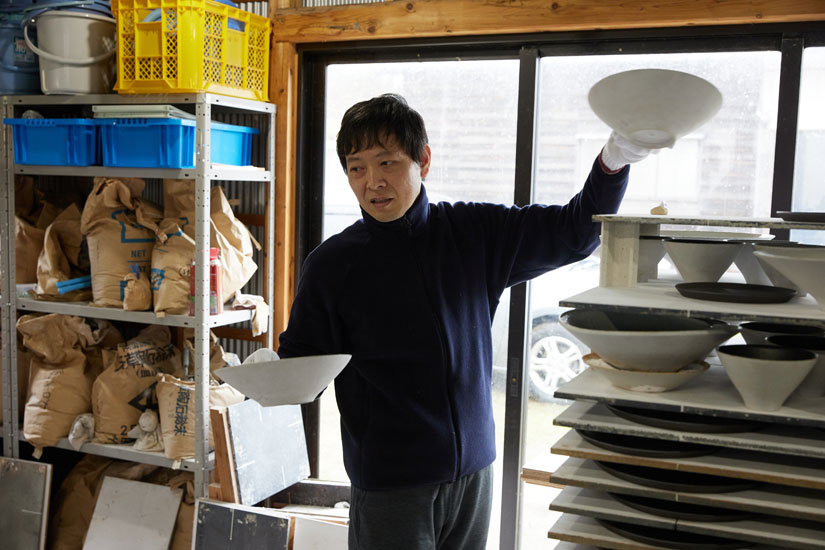
Mashiko Town, Haga County, Tochigi Prefecture, is a town where the original landscape of satoyama still remains. Mr. Toshifumi Tashiro is a potter who works hard in this town. Using a variety of unique techniques, he produces simple yet distinctive vessels with a unique texture and depth.
Guided by fate, he began his career as a potter.
Mashiko Town is located in southeastern Tochigi Prefecture. The town is famous for its Mashiko pottery, and the pottery market held in spring and fall attracts not only general customers seeking pottery, but also many artists who are involved in pottery and other forms of “monozukuri” (craftsmanship).
Mr. Tashiro has had his studio in Mashiko since 2007. Mr. Tashiro, who says he was born in Miyazaki Prefecture, became a potter in Mashiko through a series of coincidences.
The trigger was an invitation to join a club that was on the verge of being discontinued.
Mr. Tashiro was born in Miyazaki Prefecture, but because his father was a transferee, he spent time in Okinawa, Hakodate, Osaka, and other places in Japan before entering university.
His first encounter with ceramics was in high school. While attending high school in Osaka at the time, a friend invited him to join the pottery club, which was on the verge of being discontinued due to a lack of members.
I was dexterous with my hands, so I wondered if I was suited for it,” he recalls. He was attracted to ceramics and decided to attend the Nara College of Art and Design.
After graduation, he considered working at a pottery, but at the time, around 2002, it was the “ice age” of employment, and finding a job at a pottery was difficult, and he was not confident that he could suddenly start his own business. I was wondering if I should consider becoming an apprentice, when my father said to me, “Try as hard as you can. and a casual remark from a classmate, “I think you’re right for it. He decided to become an apprentice under Mashiko potter Seiichi Imanari.
Mashiko’s welcoming atmosphere for people from outside
I chose Mashiko because it has a relatively short history among Japanese pottery, and I thought it would have a climate that would make it easy for people from outside the prefecture to be accepted,” Tashiro said.
The history of Mashiko pottery, which is said to have started when Otsuka Keizaburo opened a kiln at the end of the Edo period (1603-1867), is only about 170 years old, which is certainly short compared to regions with centuries of history such as Bizen, Mino, and Arita. It is also an area with easy access to the Tokyo metropolitan area, yet rich in nature, making it an easy area to move to. In addition to potters, there are also bakeries and cafes run by people who have moved here from Tokyo and other cities, and many of these people cite “a climate that naturally accepts people from outside” when talking about the good qualities of Mashiko.
In addition, his mentor, Mr. Imanari’s idea of “polishing one’s sensitivity” had much in common with the policy of his teacher at the university and, above all, with what Mr. Tashiro himself wanted to do.
He worked as a live-in worker for about five years, and it was during that time that he learned how to handle a potter’s wheel and how to fire a kiln in particular. It was also a period during which he learned about the work of a “potter,” such as where to obtain clay and where to distribute his works.
A time-consuming and labor-intensive process, but necessary to produce the pottery he wanted.
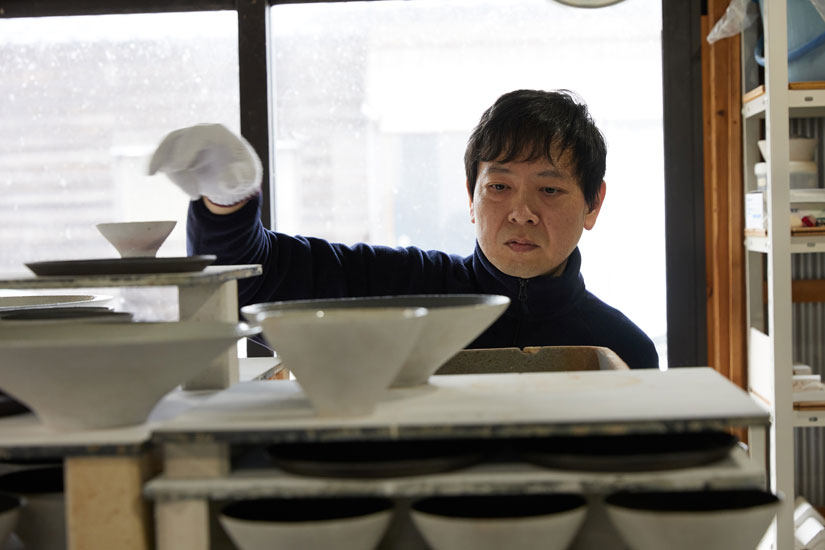
In 2007, Tashiro began to think about becoming an independent potter, and was considering returning to the Kansai region when he happened to find his current studio.
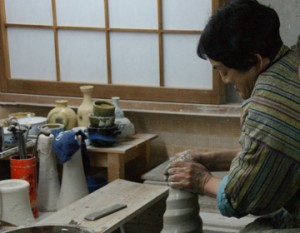
Tashiro uses an electric potter’s wheel for shaping and a manual potter’s wheel for finishing. Since the speed of the electric wheel can be adjusted, many potters use the electric wheel from start to finish, using high or medium speed at first and then using low speed for the finishing process. However, Mr. Tashiro is particular about using a hand wheel for the finishing process.
With an electric potter’s wheel, even if you turn it slowly, it will be regular, and the shape of the vessel you are making will inevitably give a cold impression. With a hand wheel, it takes more time, but the rotation is a little more irregular, so it gives a warmer impression.”
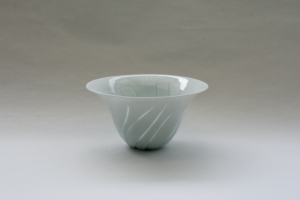
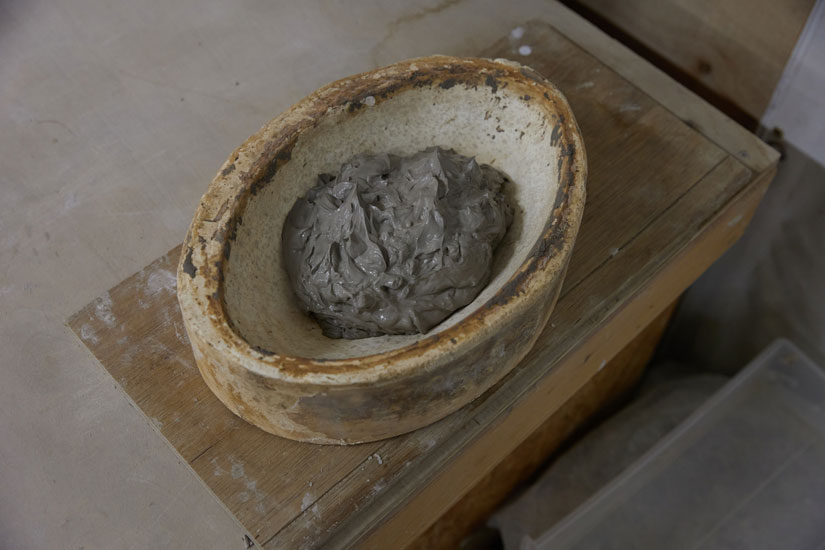
Tashiro’s vessels are mainly thinly made with delicate forms. However, Mashiko clay has a tendency to be sandy, less viscous, and easily cracked, which is why most “Mashiko-yaki” has a thick appearance. Therefore, Tashiro mixes Mashiko clay with clay from other regions to create clay suitable for his own works.
I try to make simple yet expressive vessels with an emphasis on texture,” he says. However, I believe that the vessel is only a tool, and the food is the star, so I put emphasis on how the food looks when it is served in the vessel. The vessel itself should not make a strong statement. Ease of storage. As a result, I think the dishes will last for a long time and never grow tired of being used. says Tashiro.
Nama-kake,” a process of glazing without firing.
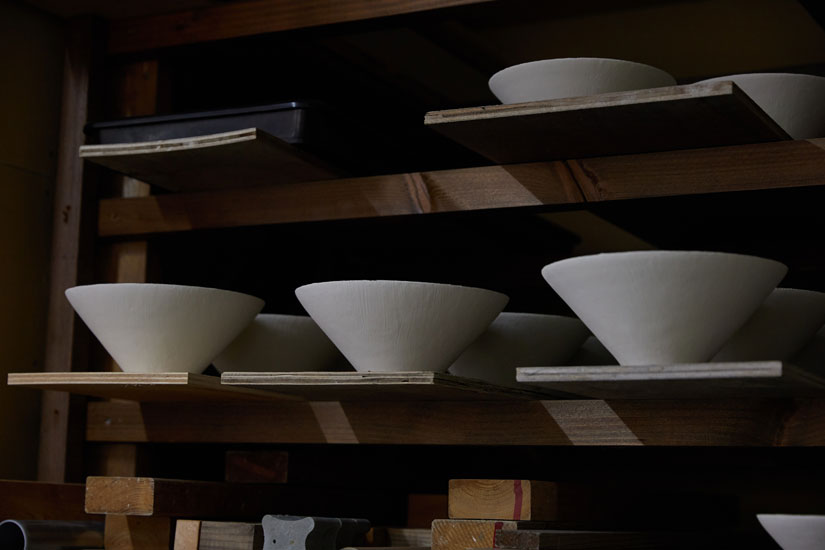
Mr. Tashiro is particular about the firing method, saying, “I want to create expressive and soft textures.
In general, pottery is made by forming a vessel from clay, drying it, and firing it at a low temperature. This is called “unglazing,” and after unglazing, glaze is applied, followed by “honyaki” to add color (there is also a technique called underglaze glazing, in which color is added after unglazing). Unglazing increases the strength and water absorbency of the vessel, so the vessel does not collapse when liquid glaze is applied, and the glaze can adhere to the fabric.
However, Mr. Tashiro does not use this unglazing method, but instead uses a method called “nama-kake,” in which the glaze is applied while the vessel is still half-dry, and then the vessel is fired.
However, the strength of vessels made of thin, half-dried clay is low. It is only natural that liquid glaze would cause the vessels to lose their shape. Even if glaze is applied without destroying the shape, problems are likely to occur later. The clay of the vessel itself contains water, which evaporates and shrinks during drying and firing. However, the glaze does not shrink as much at that point, making it easier to peel off from the fabric. If the vessel were unglazed, the liquid (glaze) would be applied to the water-absorbent state (dry clay vessel), so it would absorb water and shrink at about the same rate, increasing the adhesion between the vessel and the glaze, but Mr. Tashiro dares not do this.
However, Mr. Tashiro dared not to do so. “Because I was doing something special, things did not go well at all for about three years after I started my own business…. It was much harder than the time I spent as a live-in trainee,” says Tashiro.
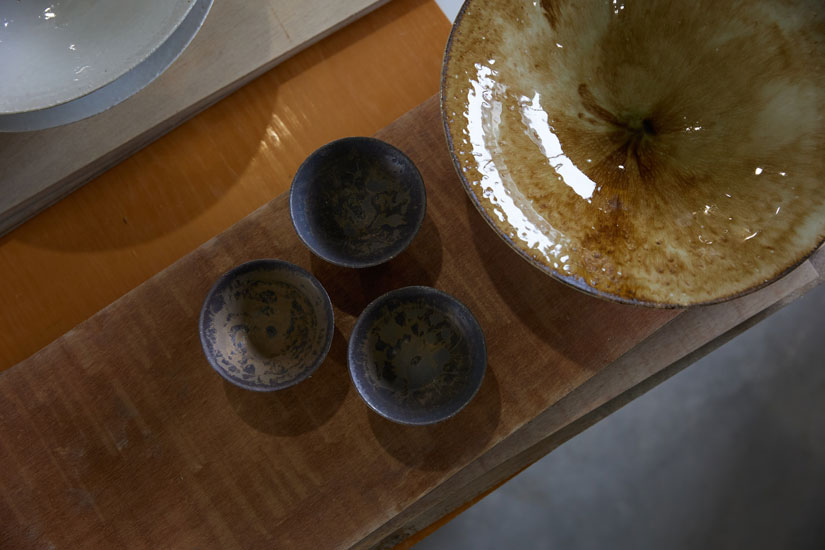
Why did he choose such a difficult method?
The reason lies in Mr. Imanari, under whom Mr. Tashiro studied. Mr. Imanari’s roots as a potter originally come from Bizen Pottery in Okayama Prefecture. Bizen ware is characterized by long hours of firing at high temperatures without unglazing or glazing. In the process, he also paid attention to the “Nama-kake” technique that his master sometimes used. He wanted to create his own unique style that was different from others, and he thought it would broaden the range of his original expression, so he began to actively use “nama-kake” in addition to yakijime, and that was the beginning of his difficulties.
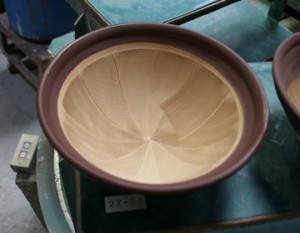
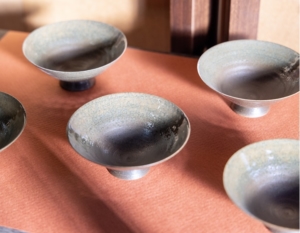
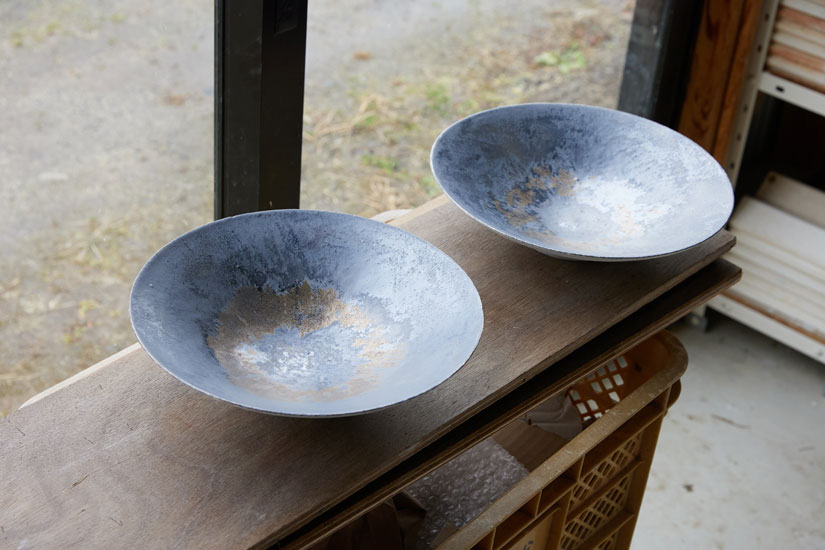
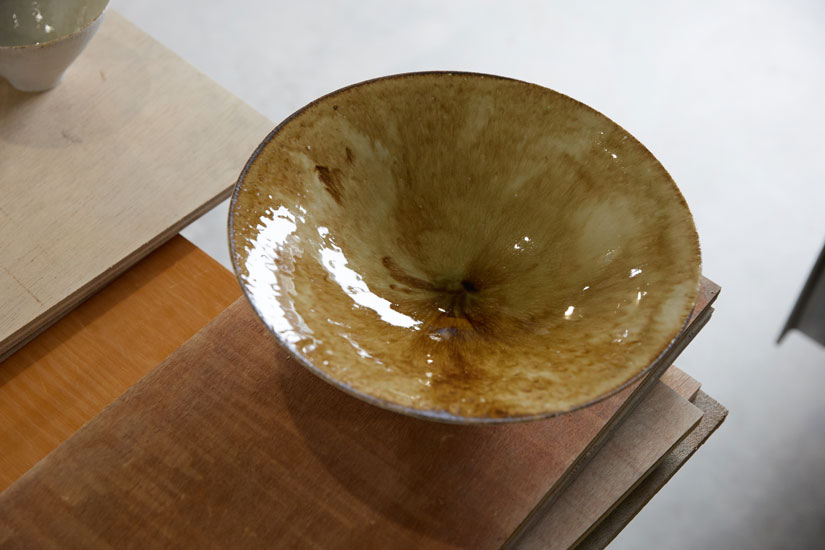
Trial and error was used to determine the clay mixture, the type of glaze, its density and thickness, and each combination, with repeated failures. Based on the method of applying glaze only to the inside of the vessel, Tashiro pursued his ideal form and texture of the vessel. By glazing only the inside of the vessel, the shape is maintained, while the outside has a soft clay texture. Through repeated fine-tuning, Tashiro now applies clay to the outside with a brush and adds glaze to the inside with a compressor to create the “expressive texture” that he envisions.
Painting with a brush or spraying with a compressor takes time and effort. Thinning also entails the risk of distortion. Nevertheless, Tashiro enjoys the change in texture and feel of the finished product after overcoming this time-consuming process, and he continues to go through a process of trial and error every day in order to give shape to the vessels he aims to produce.
When asked if the technique has a name, he replied, “I haven’t decided on a name. It’s like a one-shot firing…,” he smiles.
The delicate form and simple texture of the clay. The shading and flow of the glaze, which cannot be found in homogenized products. At first glance, the pieces look simple, but one cannot help but feel the skill and thought that went into every detail.
Creating products with value, with an eye toward new challenges
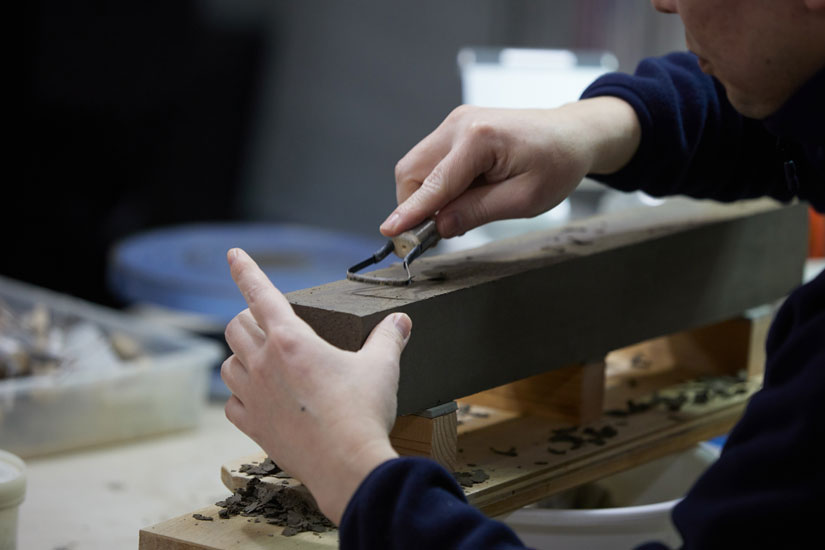
Mr. Tashiro continues to steadily increase the number of fans of his vessels through his many activities such as solo exhibitions and special exhibitions, and he never misses the “Mashiko Pottery Market” held every spring and fall.
When asked about his future outlook, he replied, “I am facing some difficulties due to the recent rise in prices of materials. However, I hope to continue to express myself with my unique sensibilities and techniques and create products that people can feel the value of. I hope I can continue to express my unique sensibility and technique and create products that people can feel the value of.
His wife, Hiromi Suzuki, also works as a potter at his current studio. They hope to continue their activities in Mashiko, a place they both love.
In 2022, his vessels and vases (oysters) were collected by the “Ceramic Museum of Ibaraki. Some French and Western restaurants in and outside of the prefecture have asked to use Tashiro’s vessels.
This has led to an increase in business with French and Western restaurants in Utsunomiya City. It makes me very happy to have my tableware used in a “special place to eat,” says Tashiro. The inspiration and inspiration he receives from the restaurants he meets with and delivers to are also utilized in his current production concept, and after much trial and error, the tableware he has arrived at has become something that is sure to captivate.
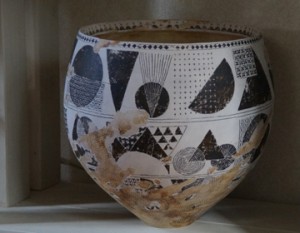
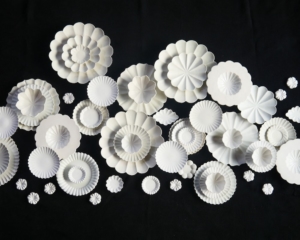
In the future, Tashiro hopes to broaden her horizons by creating not only vessels, but also objects, which she studied as a university student, and other figurative works such as interior decorations. Expectations for new developments are high.