
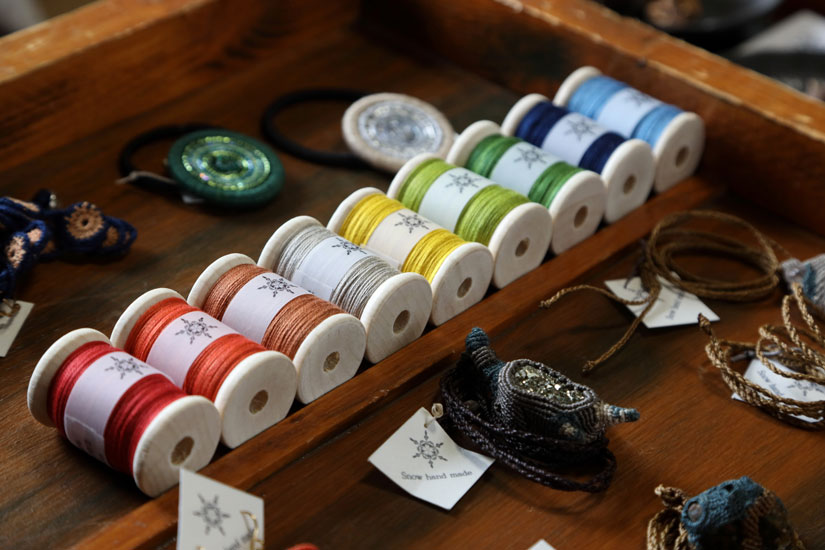
Ryosuke and Yuki Sasaki, whose lives were transformed in Okinawa, create nothing but highly stylish designs that incorporate traditional techniques. Behind their works—which bring an involuntary smile to anyone who holds them—lies the couple’s characteristic, down-to-earth way of life.
The Creative Spirit and Way of Life Inspired by Life on Hateruma Island
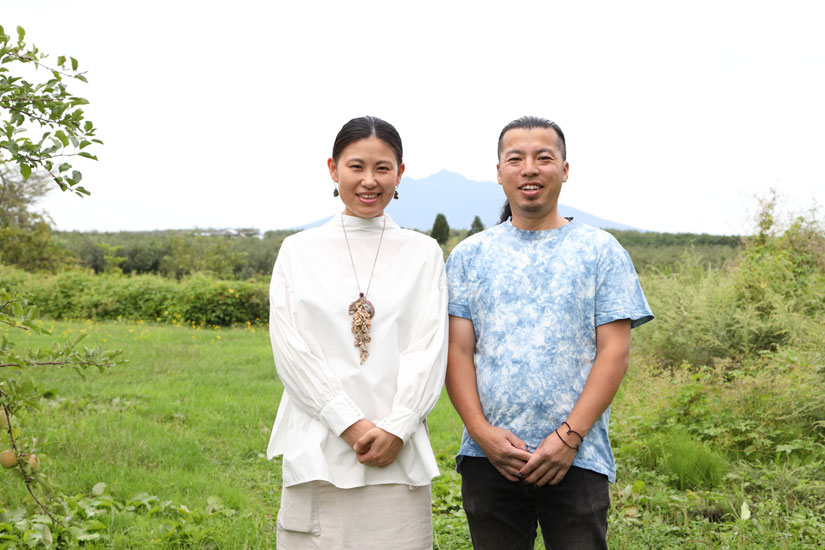
Hirosaki City in Aomori Prefecture, where the townscape and culture still bear traces of its history as a castle town, is a place where traditional crafts such as Tsugaru lacquerware and Kogin embroidery remain deeply rooted to this day. “Snow hand made,” a studio based in Hirosaki, is run by the husband-and-wife team of Ryosuke and Yuki, who specialize in dyeing and weaving, dividing their work between them.
Ryosuke dyes fabrics and threads using indigo and safflower as dyes, while Yuki creates woven textiles and crocheted accessories. Their work has gained popularity for its intricate, delicate designs and vibrant colors—which are so refined that one would hardly believe they are hand-woven—and many people reportedly purchase their pieces every time a new collection is released.
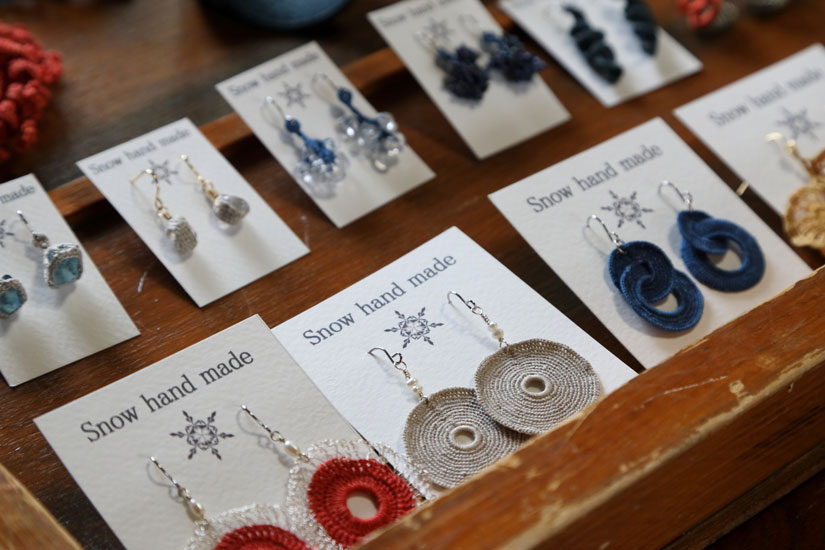
The dyes are made from ingredients such as bamboo and cherry blossom branches sourced from their own garden and nearby mountains. They pair well with nature-inspired accessories and offer a charm distinct from trendy designs. The couple says their creative concept is to make items that will be cherished for a long time.
“She creates based on her intuition. That intuition is amazing,” “Even if you understand the principles of dyeing, sometimes you can’t achieve the desired color. But he figures it out and manages to get close to that color,” the two say, praising each other. It is precisely because they recognize and trust each other’s skills that such high-quality works are born.
An Encounter in Okinawa That Felt as If I Had Been Led There
Ryosuke, who is from Kanagawa Prefecture, and Yuki, who is from Hirosaki City, met on Hateruma Island in Okinawa Prefecture—Japan’s southernmost inhabited island. Ryosuke had visited Hateruma Island during his student days and, captivated by the people and the island’s atmosphere, decided to move there. It was around that same time that he met Yuki, who had come to visit a friend.
“I wanted to learn dyeing and pottery techniques. “On my first visit, I wondered if there was any way to preserve Okinawa’s vibrant natural colors, so I tried dyeing thread with flowers I found by the roadside. I was deeply moved when it turned a pale purple. I thought, ‘So you really can preserve the colors of nature,’” says Ryosuke.
Yuki, who was also looking to acquire a craft, was introduced through an acquaintance to Akiko Ishigaki, a dyeing and weaving artist working on the neighboring island of Iriomote. Ms. Ishigaki studied under Fukumi Shimura, a Living National Treasure known for “tsumugi-ori”—silk textiles woven using tsumugi yarn—and has been working for over 40 years to revive the dyeing and weaving culture of Iriomote Island.
However, she felt it would be difficult to instruct two people with absolutely no prior knowledge, so she introduced us to someone on Hateruma Island who knew how to use a “genshibata” loom. A genshibata is a loom that can be considered the foundation of weaving; one end of the warp threads is attached to a “waist strap” around the weaver’s waist, and the tension of the warp threads is adjusted using the strength of the weaver’s hips.
It was these two—who would later co-found a workshop with her—who provided her with instruction. She learned the gen-shibata technique from them, continued weaving at home to ensure she didn’t forget what she’d learned, and even brought her finished pieces to Professor Ishigaki’s workshop. From there, she was given assignments, and the four of them lived and studied together at the professor’s workshop, clinging to the opportunity with all their might.
Among them, Yuki’s weaving skills stood out in particular, and she reportedly demonstrated exceptional talent.
“I’ve loved knitting and drawing since I was a child. I think that played a part, but coming to Okinawa was a major turning point. In Okinawa, everyone took an interest in the things I made and recognized my work—that probably helped build my confidence.” Yuki explains that her creative work stems from discovering her own way of life in Okinawa and gradually building upon it over time, leading her to where she is today.
Furthermore, from her teacher, Ishigaki, she learned something that could be called the very essence of craftsmanship—that “dyeing and weaving are not merely crafts”—a lesson that goes beyond simply honing her technical skills. She explains that her teacher personally dyes the thread and weaves the fabric to make hand towels, and places great importance on the idea that these practices are an integral part of daily life. While preserving these works as crafts is certainly a necessary endeavor, Yuki says this was a crucial period for her to learn that these creations are “born from everyday life.”
From launching their studio to striking out on their own: Creating works that reflect their unique style in Hirosaki
With Professor Ishigaki’s support, the four of them launched a dyeing and weaving studio in 2008. The space also served as a restaurant, but as their carefully selected ingredients and elaborate catered meals gained popularity, it became difficult to balance that work with their dyeing and weaving. After discussing it with their colleagues, Ryosuke and Yuki decided to branch out on their own from the studio so they could devote themselves more fully to their work as dyeing and weaving artists. That’s when they chose Hirosaki City.
“It was my wife’s hometown, so we were already familiar with the area, and the fact that it’s a region rich in traditional crafts was also a deciding factor. To be honest, there might not have been any other option besides Hirosaki,” the couple laughs.
They chose not to fly but instead drove north from Kagoshima to Hirosaki. Hoping to refine their sensibilities while visiting acquaintances along the way, they stopped at World Heritage sites and other places to experience the distinct characteristics of each region. As the landscape changed, so did the climate and local culture. One of Professor Ishigaki’s teachings was that craftsmanship involves incorporating elements that suit both the land and oneself.
Taking those words to heart, they headed to Hirosaki with the desire to create works that were true to themselves and unique to that region—and thus, Snow Handmade was born.
Techniques that spare no effort and bring out the best in the ingredients
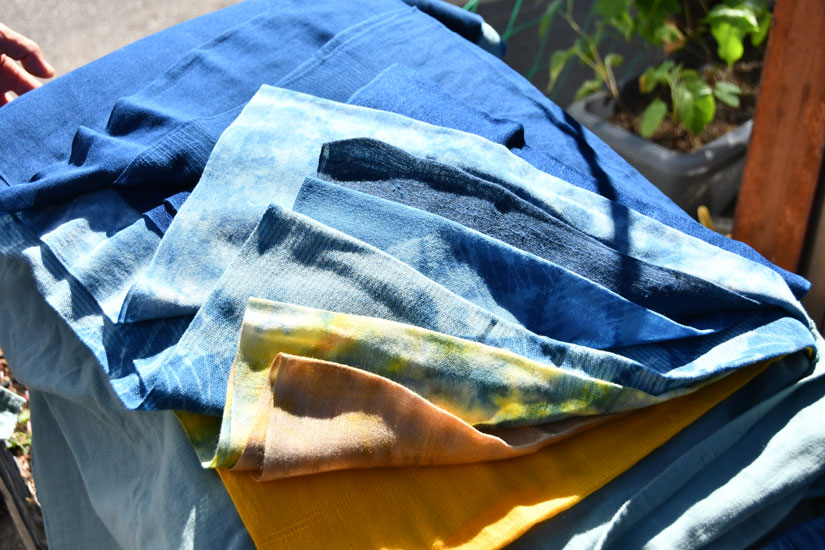
“Many people think indigo dyeing is prone to fading and color bleeding, but that’s not actually the case. After exploring this further, I settled on the traditional method.”
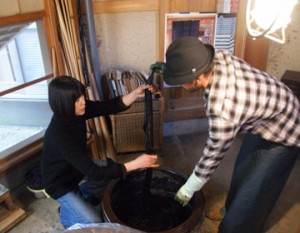
Snow Handmade’s indigo dyeing uses techniques established during the Muromachi period: “Jigoku-zuke” and “Sho-ai-zome.” After drying indigo leaves, they are fermented over two to three months while being periodically moistened with water. Through repeated turning, the mixture is transformed into a compost-like substance, which is then sun-dried to produce “sukumo,” the raw material for indigo dyeing. The finished sukumo is thoroughly kneaded with lye made from apple tree ash. This wood ash comes from branches pruned or cut down in nearby apple orchards; they are burned in a wood-burning stove during the winter to produce ash, which is then stored. The lye is made by adding boiling water to the ash and stirring, then skimming off only the clear liquid on top. Since the remaining wood ash can also be used as glaze, he says he gives it to a potter he knows.
“This is the kind of cycle I wanted to create. There’s absolutely no waste,” Ryosuke says with a smile.
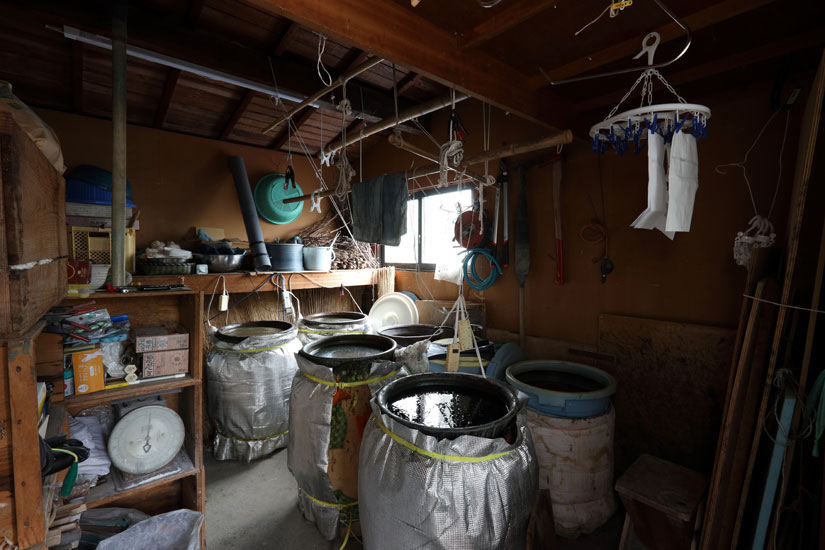
One of the most important steps in indigo dyeing is the process of preparing the dye bath, known as “aitate.” Indigo leaves and lye are placed in an indigo vat, and the mixture is allowed to ferment over about 10 days, gradually increasing in volume to create the dye bath. However, this process requires a large amount of water, and if the water and indigo do not mix well, the dye may not set properly. For this reason, when searching for a property in Hirosaki, the ability to use well water was the top priority. The current location has an abundant supply of spring water, which works well with the indigo, and it seems we’ve been blessed with good fortune regarding the land itself.
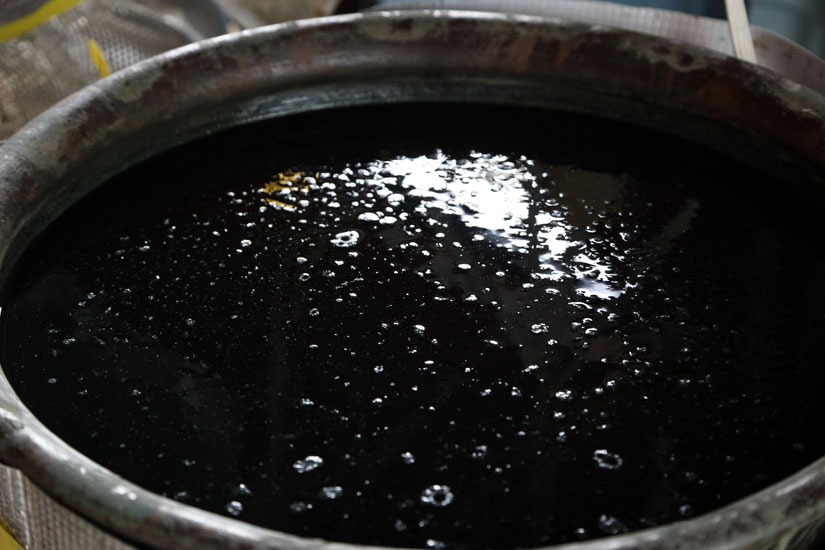
Once the dye bath is ready, the indigo dyeing process finally begins. The fabric, which has been soaked in lye, is gently lowered into the indigo vat, taking care to prevent air from entering. The dyed fabric is rinsed with water, sun-dried, and rinsed again. This constitutes one cycle, which is repeated until the desired color is achieved. Finally, the fabric is thoroughly sun-dried to remove any off-flavors from the lye, and the process is complete.
Since they grow their own indigo, the entire process—from sowing the seeds to harvesting and sun-drying—takes over a year. Currently, they blend in Tokushima’s “Awa-ai” indigo, which boasts one of the highest production volumes in Japan, but their dream is to dye exclusively with Hirosaki indigo in the future. Since they work as a team of just two, expanding their operations isn’t easy, but they’re currently experimenting and refining their methods in hopes of making this a reality someday.
The reason they go to such lengths is their desire to maximize the benefits of indigo. Traditional indigo dyeing is resistant to fading and color loss, and offers strong deodorizing and antibacterial effects. Although it takes time, they believe this is the best technique for bringing out the true qualities of indigo.
Nature is the inspiration for the design
The dyed yarn is shaped by Yuki’s hands. In addition to crocheting, she uses a loom called a “gen-shibata” to weave straps and cords. She has been using this loom since her time on Hateruma Island; it is a primitive-style loom in which one end of the yarn is tied to the weaver’s waist, and the tension of the yarn is adjusted using the strength of the weaver’s hips as she weaves.
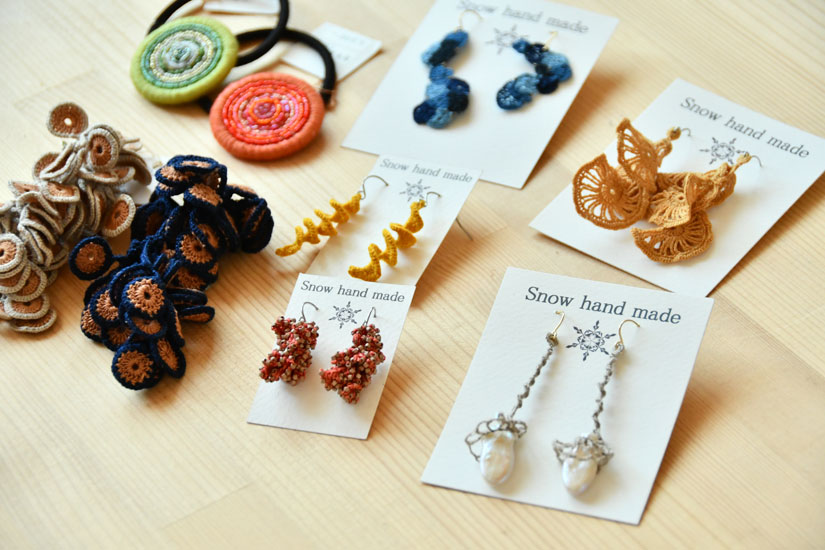
Her inspiration comes from nature. She says she was deeply impressed by the islanders in Okinawa, who wore accessories made from local materials as talismans, and that this experience has greatly influenced her own work. She incorporates into her pieces a worldview inspired by the microcosm seen under a microscope and the universe—where naturally formed elements are arranged in orderly patterns or create a sense of beauty. That is precisely why Yuki’s designs possess a meticulous beauty that defies belief that they are handmade.
Both the dyeing and weaving are created entirely from materials found in her immediate surroundings. This can be said to be the very foundation of Snow Handmade’s creative process.
Staying true to ourselves while incorporating the best ideas
Although the two create their works using traditional techniques, they aren’t limited to just those of the past. They also incorporate dyeing methods that utilize modern technology, applying them to bring their artistic visions to life.
“It feels like we’re taking the best of both worlds,” says Ryosuke. “The best approach is to make the most of each method’s strengths and bring out the inherent qualities of the plants.” Whether it comes to techniques or materials, they aren’t bound by preconceived notions and incorporate whatever they believe will work best. Perhaps staying true to themselves is what matters most to the two of them.
“One of our goals for the future is to dye using only the indigo harvested here. We’re currently thinking about what kind of system to set up to create one-of-a-kind pieces using the soil, water, and air of this place,” says Ryosuke. “I’d also like to work on pieces that aren’t for sale. We once rented a large space to exhibit big works, and it was so much fun to create exactly what we wanted to express. It helped us reconnect with our original passion, so we’d like to hold exhibitions like that again,” says Yuki with a smile. Without feeling pressured by traditional techniques, the two approach their creative work as a natural part of their daily lives. The works of Snow Handmade reflect their very way of life.