

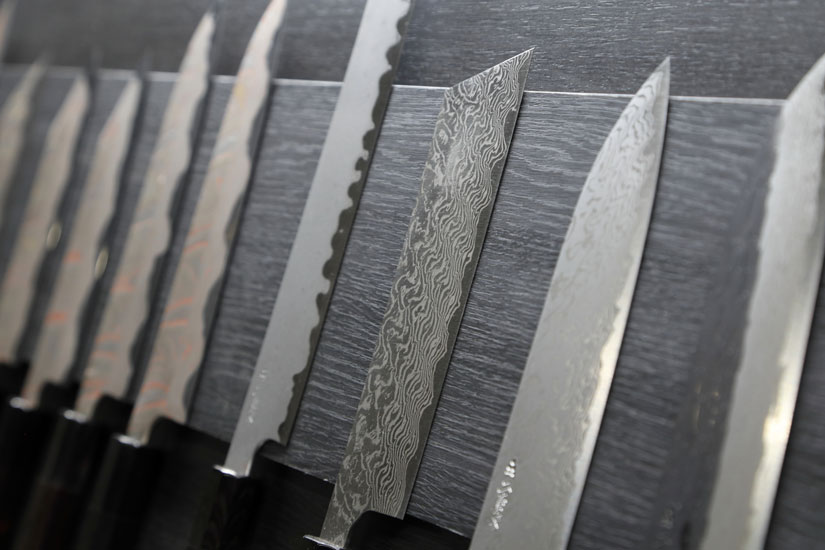
In Hirosaki City—where it is said there were over 100 blacksmith shops during the feudal era—the Nigara family is known as a “prestigious” blacksmithing lineage that has carried on a 350-year tradition since first being commissioned by the Hirosaki Domain to forge swords. The Nigara family’s philosophy, embodied in the motto “Fine craftsmanship speaks for itself,” continues to guide their blade-making to this day.
From Sword Smithing to Farming and Fishing Tools, and On to Kitchen Knives
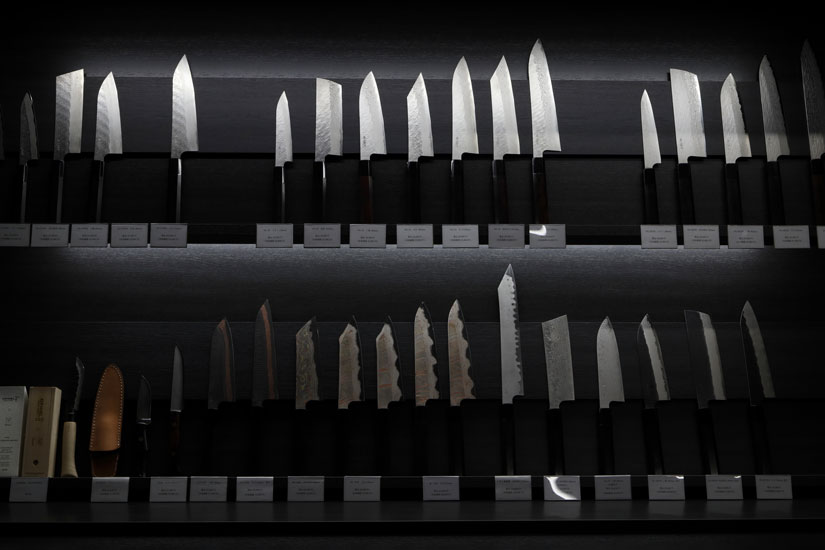
Japanese swords are primarily made of tamahagane, a type of steel with a higher purity than ordinary iron. While Western swords “cut by striking,” Japanese swords “slice through”—this is the key difference. Japanese kitchen knives have inherited this sword-making technique.
The Nigara Blade Forge was originally located near Hirosaki Castle. In 1949, the fifth-generation master blacksmith, Mr. Nigara Kunitoshi, transformed the family blacksmith shop into a limited liability company and moved it to its current location. At that time, in addition to farming tools such as sickles and hatchets, the forge also produced blades used on fishing vessels for Pacific salmon and trout; however, as demand for these products declined, the company began manufacturing kitchen knives around 1965.
Meanwhile, Mr. Kunitoshi is known nationwide as a swordsmith and has been designated as a Prefectural Intangible Cultural Property. Sword-making reportedly continued until the sixth-generation head, Mr. Shun Nigara.
The 6th-generation owner who laid the foundation for the “Nigara” brand
To create high-quality kitchen knives, Mr. Shun established his techniques not only through a craftsman’s intuition but also by grounding them in academic research. He studied metallurgical engineering and various theories, leaving behind a legacy of modernized knife-making techniques. When he began producing and releasing the Japanese kitchen knife brand “Yoshihisa,” infused with the techniques and spirit he had cultivated over the years, its popularity soared. He laid the foundation for the “Nigara” brand. This was born from the spirit of the Nigara family, whose motto was “Quality speaks for itself.”
Furthermore, in 1974, he established a steel division specializing in construction materials and incorporated the business as a corporation, which led to the refinement of welding techniques.
Since Shun had no heir, his nephew, Toshihisa Yoshizawa, succeeded him as the seventh-generation head of the family. “The Shun I remember was a man of few words. During the ‘Uchi-hajime’ Shinto ritual held on the second day of the New Year, he would forge knives alongside my father,” says Tsuyoshi Yoshizawa, the current president and eighth-generation head of the family.
“The act of creating things and the craft of making blades are a culture. This craft is born from tradition—it was created by our ancestors—and we cannot let it die out.”
Mr. Yoshizawa has expanded the company’s product range to include custom-made kitchen knives tailored to individual users and outdoor knives. He is also the driving force behind preserving the Nigara brand and its spirit to this day.
Judging the browning while navigating through 24 steps
“Knives are made by combining two materials: jigane and tamahagane,” says Mr. Yoshizawa. This is done to compensate for the weaknesses of each material, but he explains that it takes as many as 24 steps to complete the process.
The process begins at the First Factory, where a special powder is applied to bond the two materials together, and the blade is then placed in a 1,200-degree furnace for about 2 to 3 minutes. Once the iron turns orange, it is removed with tongs; Mr. Yoshizawa explains that judging the color of the heat at this stage is the most difficult and crucial step.
The iron is removed from the furnace and gradually shaped into a knife by hammering and stretching it with a mechanical hammer. Subtle adjustments are then made by hammering it further, followed by heating it to a high temperature and quenching it in water. To create a knife with both hardness and toughness, it is then tempered again at a high temperature.
Once this stage is complete, the next step is sharpening. “I’m not particularly dexterous, so it took me more than twice the effort of others, but it takes at least a year—though it varies by person—to get to the point where I can shape a knife to a certain degree. But it’s very rewarding,” Mr. Yoshizawa says firmly.
Light Edging to Improve Sharpness
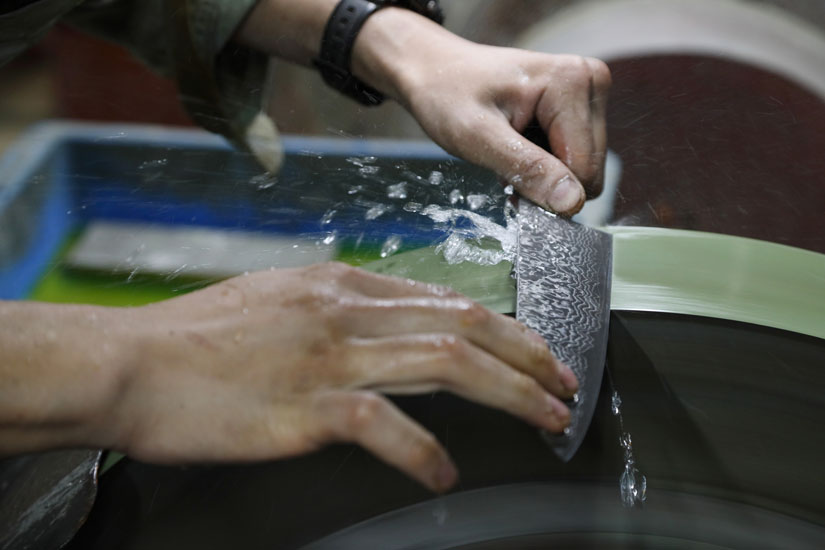
Once the knives have taken their final shape, they move on to the sharpening process at Plant No. 2. The grinding machines used here were reportedly manufactured by the welding department of the Steel Structures Division.
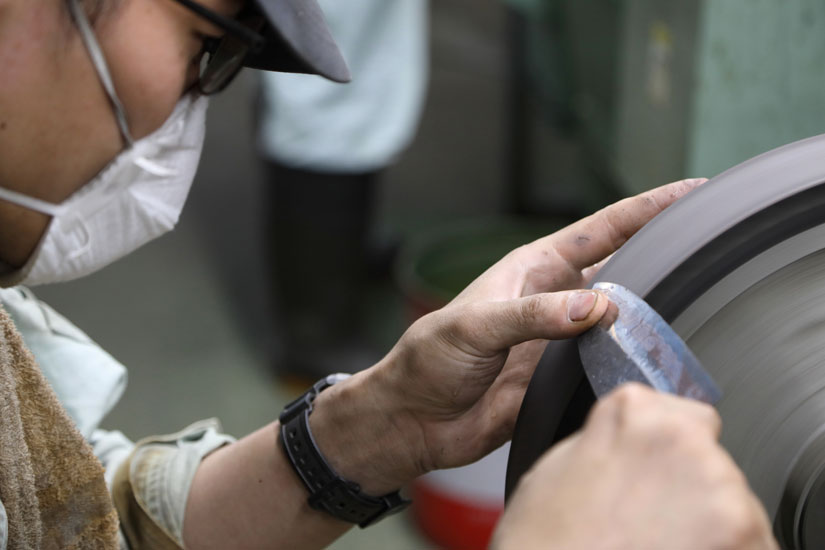
First, hold the knife with your finger against the grinding wheel, starting from the end known as the “chin” and working toward the tip. While doing so, tilt the knife at an angle of about 25 degrees and sharpen it by sliding it sideways in small increments, taking care not to apply excessive force. Once both sides have been sharpened, the process moves on to “koba-zuke.” “Koba-zuke” involves sharpening the tip thinly on both sides to create a double-beveled edge, which improves the knife’s sharpness—an entire process that requires master craftsmanship. The finished knife features a pattern that stands out, resulting in a gleaming finish.
“Currently, we have a total of 30 employees across the Steel Structures Division and the Cutlery Division. While their levels of skill vary, we generally have each craftsman take sole responsibility for finishing a single knife. Of course, a senior craftsman performs the final inspection.”
A major characteristic of Nigara Cutlery Forge is that each craftsman is free to experiment with designs and other creative aspects. This freedom serves as the foundation for the “Nigara Brand.” Another defining feature of their in-house brand is the consistent quality of their products.
A facility dedicated to crafting specialized knives for cakes and pies, as well as preserving and passing on the skills of master craftsmen
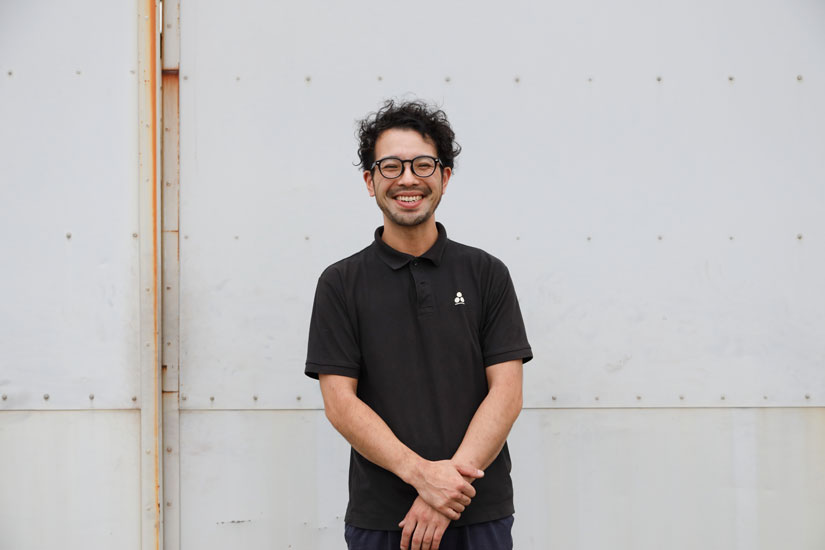
“Fortunately, overseas demand from Asia, Europe, and the United States has been growing in recent years, and about 95% of our production is exported,” says Mr. Yoshizawa. “Most of these exports are thin, lightweight stainless steel knives that are known for their sharpness.”
Stainless steel knives are also made by combining two types of materials, but they are difficult to process and require nearly twice as much time to craft as iron knives. However, their main features are that they are lightweight and resistant to rust.
Furthermore, another major project has come their way: a collaboration with the French outdoor brand Opinel. This appears to be a first in Japan; the handle is designed by Opinel, while the blade is crafted by “Nigara Brand,” and the knives are part of a limited edition of just 2,500 pieces worldwide.
“Going forward, I’d like to take on the challenge of creating knives that can slice through cakes and pies cleanly,” says Yoshizawa, his dreams expanding. “Also, in the future, I hope to establish a facility dedicated to passing down the craftsmanship of master artisans, a tradition that is gradually being lost.”