
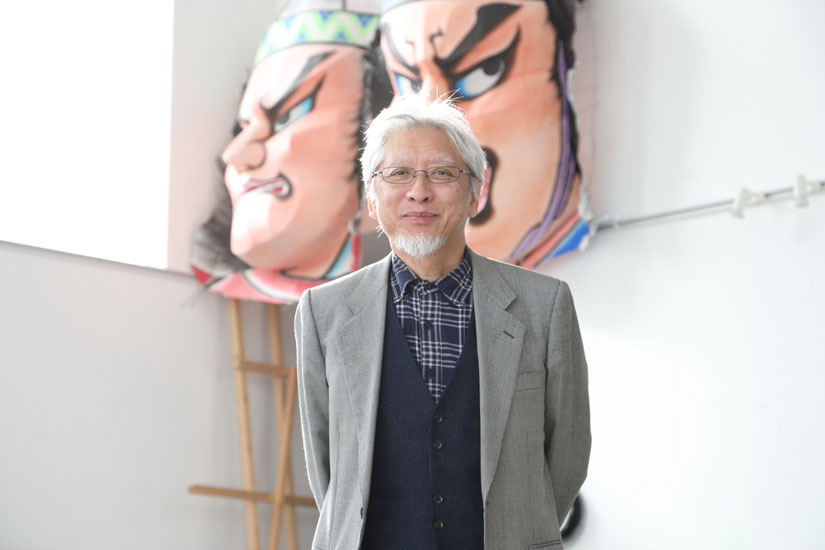
The creators of large-scale Nebuta floats, known as “Nebuta masters,” are the artisans who shape the face of the Aomori Nebuta Festival. Among them, Hiroo Takenami is one of only seven people ever to have been awarded the title of “Nebuta Master”—a distinction granted to creators who have contributed to the Aomori Nebuta Festival through their exceptional skills over many years. While preserving the centuries-old tradition of Nebuta as a folk festival, he is also an artist who pushes the boundaries of Nebuta as a sculptural art form.
One of Japan’s premier fire festivals, a source of pride for Aomori City
The Aomori Nebuta Festival is a summer festival held annually in Aomori City, Aomori Prefecture, from August 2 to 7. More than 20 large Nebuta floats parade through the city streets, accompanied by dancers known as “Haneto” who perform wild dances to the chant of “Rassera,” as well as musicians playing flutes and drums. During the festival, the city attracts more than 1 million visitors.
From a Local Folk Event to a Major Festival
Although it is now one of Japan’s most iconic festivals, its origins lie in a folk tradition. Throughout Aomori Prefecture—excluding the Nanbu region—various local festivals known as “Nebuta” or “Neputa” are held. While the names and forms vary by region, they share the same roots and are believed to have evolved from Tanabata customs. While there are various theories, one suggests the influence of “nemuri-nagashi” (a ritual to dispel drowsiness that hinders farm work), and that the name evolved from “neputē” (meaning “sleepy” in the Tsugaru dialect) to “Nebuta” or “Neputa.”
As for records of the Nebuta in Aomori City, an ancient document remains indicating that Nebuta floats were paraded in Ohama (present-day Aburakawa, Aomori City) in 1730 (the 15th year of the Kyōhō era). While this is considered the first recorded appearance of “Aomori Nebuta,” it is believed that the festival had actually been held as an annual event long before that, even if it was not formally documented.
“The Nebuta festivals throughout the prefecture, including Aomori City, have been passed down for hundreds of years solely through the dedication of the townspeople. I believe it is a truly rare and precious festival,” says Mr. Takenami. Over the long course of time, even as social conditions and the shape of the town have changed, Nebuta has been passed down and has continued to evolve. Behind this must surely lie the passionate dedication of the people of this land.
In modern times, while each neighborhood created and paraded its own Nebuta floats, the trend toward commercialization led to increasingly larger floats. Although the traditions of local Nebuta remained, the focus of the festival shifted to the “Aomori Nebuta Festival,” which is organized by corporations. Regarding the float builders, while the floats were originally crafted by skilled, Nebuta-loving locals, the larger floats came to be created by specialized builders—known as Nebuta-shi—who had honed their technical skills.
“Nebuta masters,” the creators of large-scale Nebuta floats
In the past, Nebuta and Neputa floats were made of washi paper and bamboo, with candles lit inside. They came in both doll-shaped and fan-shaped varieties, with the Aomori Nebuta primarily featuring the doll-shaped design. After World War II, as national highways were widened, the floats gradually evolved into their current wide, horizontal shape, and the materials used also advanced. Today, washi paper is attached to a wire frame, and LED lights are used for illumination.
As of 2025, there are about a dozen “Nebuta masters” who create these floats, and Mr. Takenami is one of them. Mr. Takenami says he begins thinking about the theme for the following year even before the current festival ends. The themes are primarily drawn from Kabuki, history, and legends. He coordinates the theme with the sponsoring company, researches literature and historical materials, develops a concept, and then draws the original artwork. Mr. Takenami describes this process of creating the original artwork as “the most important part of a Nebuta master’s work.” “Even with the same subject or scene, the expression varies depending on the creator’s individuality. It requires sensitivity in turning a captured scene into a painting, as well as a sense of color,” he explains. He completes the pencil sketch of the original artwork by around New Year’s and prepares the details, such as the face and limbs, in advance. In May, he moves to the “Rasseland,” a workshop dedicated to Nebuta. They build a framework using square timber pillars as a base, install lighting, apply Japanese paper, and proceed to the “kakigiri” stage, where they draw the faces and outlines in ink. The kakigiri stage is also a crucial part of the process; Takemura says that drawing the facial expressions, which determine the character’s look, “makes me nervous no matter how many times I do it.” Once this is finished, they apply patterns with wax and then use a mixture of paints and dyes to color the float using brushes, paintbrushes, and spray cans to complete it.
The Nebuta master does not perform all the work alone; carpentry, paper application, and lighting installation are handled by specialists and staff, with the Nebuta master serving as the on-site supervisor during these phases. The moment when the Nebuta, completed through the efforts of so many people, is loaded onto a cart—known as “taage”—is said to be exceptionally moving. From conception to completion, it takes a full year to create a Nebuta. While Mr. Takenami is one such example, there are also masters who handle multiple floats, and being a Nebuta master demands that level of skill.
“I was born to make Nebuta floats.” A life captivated by Nebuta
Mr. Takenami is originally from the former town of Kizukuri (now Tsugaru City). That town also had its own small, community-based Nebuta Festival, and the neighborhood association where Mr. Takenami was born and raised would send a float every year. He was captivated by those Nebuta floats from a young age. “I think it started when I was three. Apparently, I was a child who talked about nothing but Nebuta, Nebuta. Eventually, my family took me to see the big Nebuta floats in Aomori. And that’s when I became completely obsessed.”
At the age of 19, he began visiting the nebutah workshop of Chiba Sakuryu (the fifth-generation master) and started helping out. “Among the many creators, Mr. Chiba’s nebutah floats looked very stylish and fresh. So, I wanted to try assisting him. When I knocked on his door, he accepted me.” From then on, he devoted himself entirely to the craft, making his debut with a large-scale Nebuta float in 1989 at the age of 30. Since then, in addition to creating floats for the Aomori Nebuta Festival every year, he has played a central role in the industry, including working on Nebuta floats for tours to Budapest in 1996, the Tokyo Dome in 1998, and Los Angeles in 2007. In 2010, he established the “Nebuta Research Institute” to facilitate year-round activities. In 2023, at the age of 63, he was certified as the seventh-generation Nebuta Master.
“The things that were as precious to me as toys when I was a child remain just as precious to me even as an adult,” says Takenami with a smile. “Perhaps my values haven’t changed since I was three or four years old.” He adds, “Now, I believe I was born to make Nebuta floats.”
The three-dimensionality and colors breathe life into the Nebuta floats
Mr. Takenami says he doesn’t particularly like to depict battle scenes. “Most of my work features guardian deities that ward off evil and drive away demons, such as Kongo Rikishi and Nio statues,” he explains. Even when he depicts figures holding swords, he says they are often held not so much as weapons but to ward off evil. This is Mr. Takenami’s unique style and artistic expression. “It’s really hard to decide on a theme every year,” as Takenami says. Since approximately 23 Nebuta floats are produced for the Aomori Nebuta Festival each year—amounting to about 230 over a decade—it’s inevitable that themes will overlap with past floats, and scenes may repeat. “In the world of creation, where everyone has idols and ideals, the challenge lies in how to express my own unique voice,” he confides.
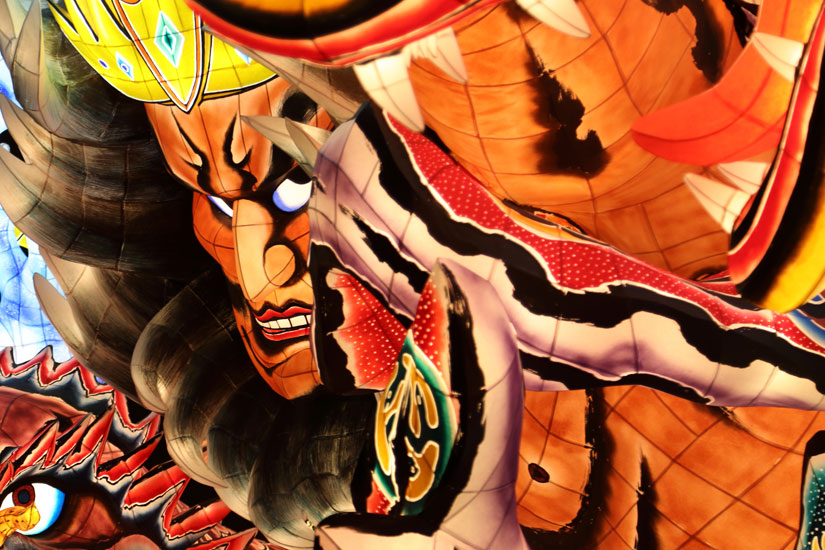
Amidst this, Takenami’s “sense of self” lies in creating a sense of depth and three-dimensionality in the Nebuta floats. “How do I arrange and fit the characters’ body parts within a cube measuring 9 meters wide, 7 meters deep, and 5 meters high? The way they’re placed completely changes how they look, so I’m particularly meticulous about that aspect,” he explains. Furthermore, he notes that the arrangement of colors is crucial. Takenami explains that he uses a single primary color—such as his favorite red—as a core, then arranges other hues around it as if scattering them out from that point. He uses color to convey a sense of power so that, during the actual festival, the Nebuta floats appear vigorous as they sway slowly toward the spectators lining the streets from afar. “I also make a conscious effort to draw ink lines that have a strong presence,” he adds. While painting the colors is often a collaborative effort with my staff, I draw every single ink line myself. That’s because the ink lines are what give the design its distinctive character.” It can be said that the heroic grandeur of the approaching Nebuta floats is brought to life through the ingenuity and hard work of the Nebuta masters.
It’s better not to lose to yourself than to lose to others
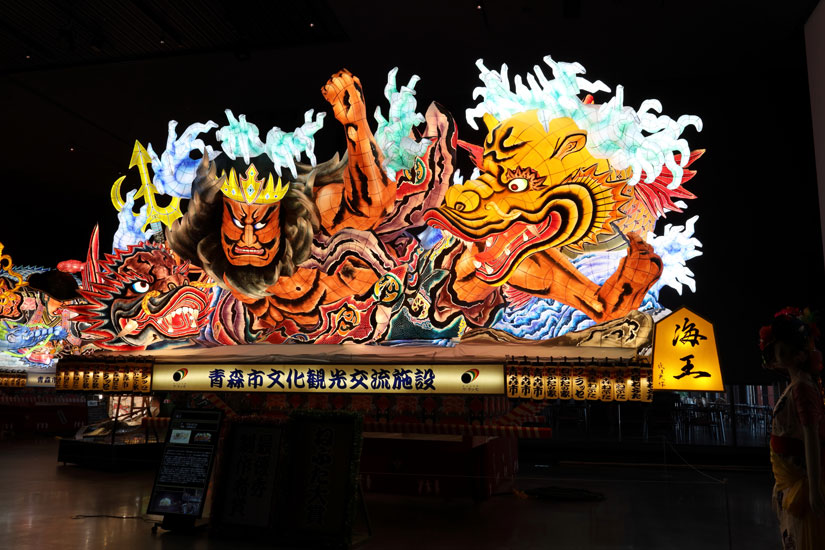
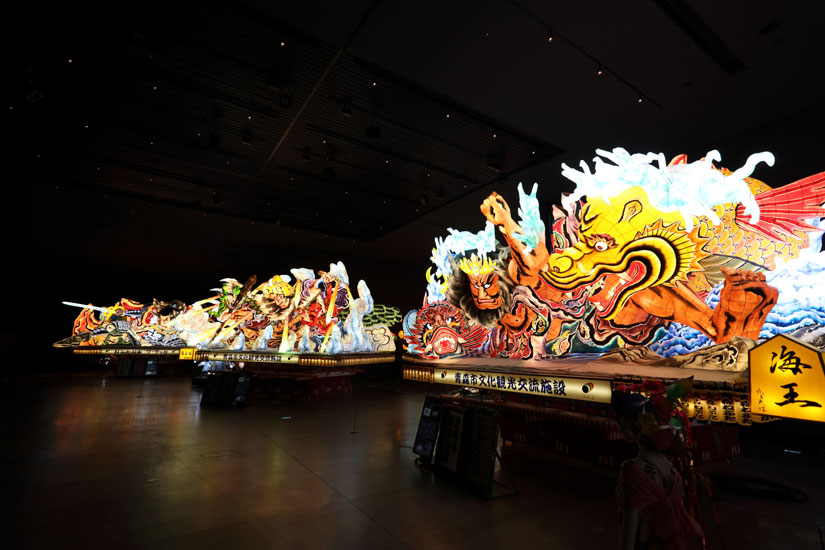
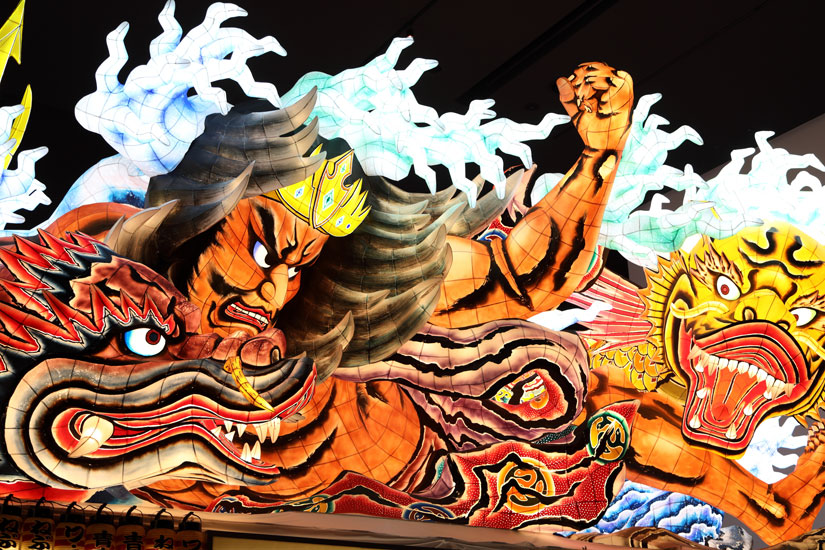
At the 2025 Aomori Nebuta Festival, Mr. Takenami won the Nebuta Grand Prize and the Best Creator Award for the Aomori Ryoyukai’s float, “Kaiō.” “Kaiō” will be on display at the Aomori City Culture, Tourism, and Exchange Facility, Nebuta no Ie Wa-Rasse, until August 9, 2026, when it will be replaced by the next award-winning float.
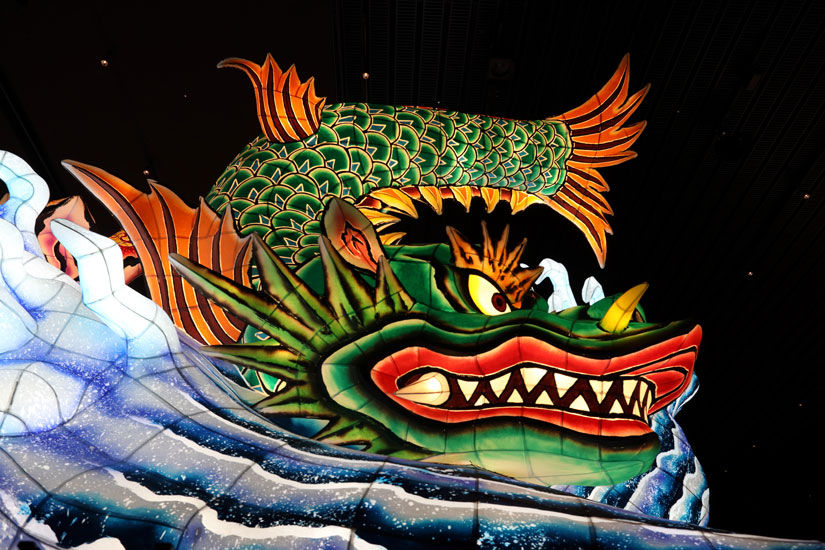
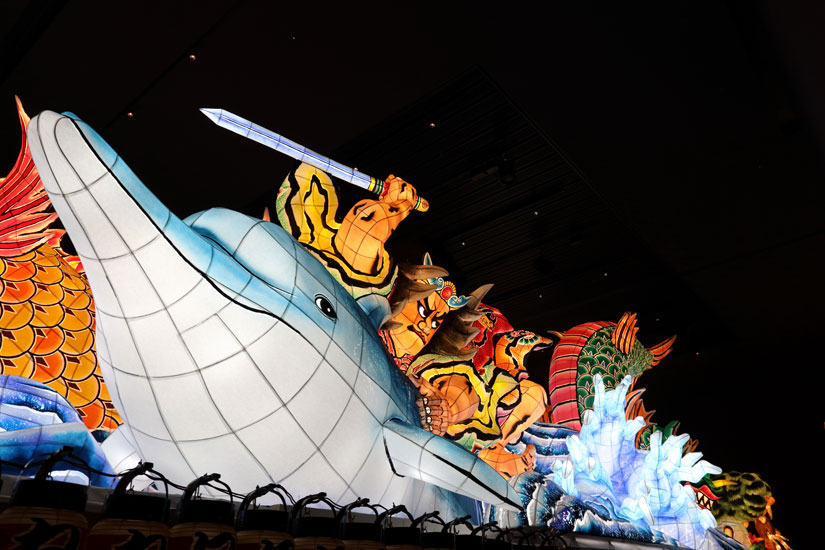
The year 2025 marked the 400th anniversary of the opening of Aomori Port. With this theme in mind, the float depicted the majestic figure of Poseidon, the guardian deity of the sea, rendered in a traditional Japanese style, as a way to reflect on Aomori City’s history—a history shaped by the sea—and to express hopes for its continued prosperity. Surrounding Poseidon, dressed as a Japanese warrior, are shachi (mythical creatures with the body of a fish and the head of a tiger) and fish-bodied dragons. At the rear, dolphins—which inhabit the waters off Aomori—were placed to emphasize that the setting is the Sea of Aomori. “The contrast between the color of the waves and the yellow tones of the shachi creates a strong visual impact,” said Takenami. “Additionally, for the ink-wash sections, I deliberately drew the lines representing Poseidon’s arms and ribs to be strong and rough,” said Takenami. Upon receiving the award, he commented, “I was able to express something truly powerful and impactful—this is what Nebuta is all about.” The award was a testament to Takenami’s unique artistic vision.
The Grand Prize-winning Nebuta float is placed in the most prominent spot in Wa-Rasse’s “Nebuta Hall.” Standing in front of “Kaiō,” Mr. Takenami said, “Every time I come here, it motivates me to return to this spot again next year. I create a Nebuta float every year, and I really struggle with it every time, but that struggle is also part of the fun. It’s not like a sport where you get clear, numerical results, so rather than aiming to beat others, I set a goal for myself: not to lose to myself. I refuse to compromise on anything when it comes to what my intuition tells me I want to create. I don’t tell anyone this, but I hold that principle—not losing to myself—in high regard.”
Thinking of the future, we’re giving Nebuta a new look
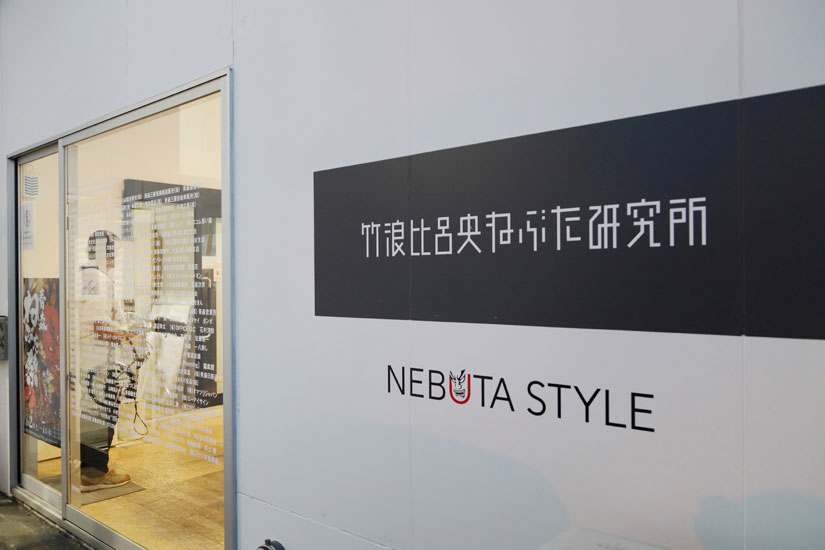
When Mr. Takenami first entered this field, being a Nebuta artist was not yet established as a profession. Even if he spent a year on a single piece, he couldn’t make a living from it. However, Nebuta has continued to grow and has become something we can be proud of on the world stage. People even come to Mr. Takenami, willing to relocate just to make Nebuta. “The people who come to us are the ones who will support the future of Nebuta. To ensure Nebuta’s legacy lives on, we must establish it as a profession so that these people can make a living as Nebuta artisans. By recognizing Nebuta’s value not just as a festival prop but as a work of art, can’t we expand its possibilities?” It was this conviction that led him to establish the research institute.
However, he says the institute faced strong opposition when it was first established. Many argued, “Nebuta is not art; it is, after all, just a festival.”
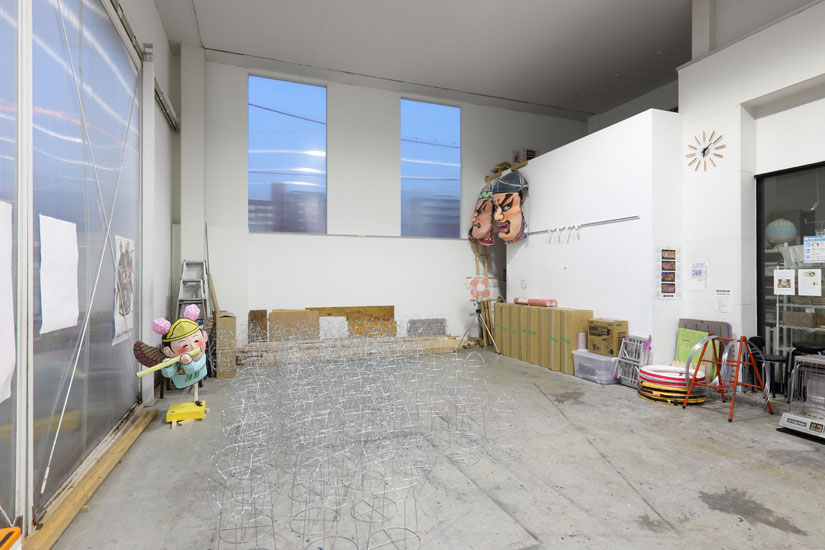
Nevertheless, Mr. Takenami continued to explore new possibilities for Nebuta based on the concept of “sculptures of paper and light.” He launched “NEBUTA STYLE,” a brand featuring interior goods and apparel made using Nebuta techniques, and created decorative objects for restaurants and hotels. By embracing this role as a sculptor, he built a sustainable livelihood. Moreover, these new products help spread the appeal of Nebuta. Mr. Takenami feels that as his dreams gradually come true, the attitudes of those around him have also begun to change.
Mr. Takenami’s goal for the future is to promote Nebuta more widely around the world as a form of Japanese culture and as a work of art crafted from washi paper. “When I’ve taken Nebuta to places like the United States and Budapest, the crowd gasped in awe the moment the lanterns were lit. Everyone was truly amazed and delighted. I’d like to take it to other countries, such as Europe, where people aren’t yet familiar with Nebuta.” As he spoke, Mr. Takenami’s eyes shone brightly, as if the eyes of the young boy who had always admired Nebuta were still there.