

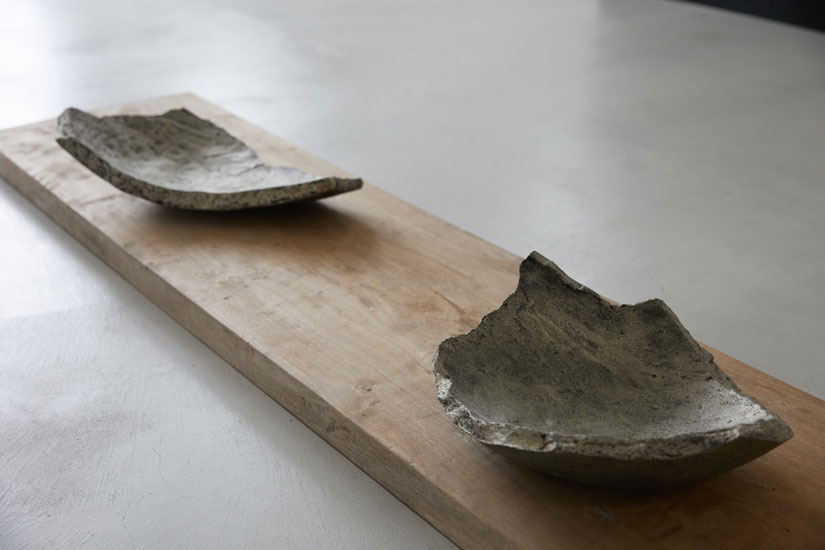
When people hear “lacquerware,” they often imagine lacquer applied to wooden objects. However, there is a technique called “tōtai shikki” (lacquerware on ceramic bodies) where lacquer is applied to pottery or porcelain. The workshop of ceramic artist Koichi Onozawa, who creates pottery using this now-rare technique, is located in the pottery town of Mashiko.
Mashiko: A Ceramic Town Preserving the Original Landscape of Satoyama
Mashiko Town, Haga District, Tochigi Prefecture, is home to Mr. Onozawa’s studio. Located in the southeastern part of Tochigi Prefecture, this town rich in nature is famous as a renowned production area for “Mashiko ware.” Mashiko ware began in the late Edo period when Keizaburo Otsuka, who trained in Kasama, discovered high-quality clay in this area and established a kiln.
Today, Mashiko Town is home to about 160 kilns of various sizes and 50 pottery shops. During the “Mashiko Pottery Fair,” held every May and November, not only local artists but also ceramic kilns from across Japan, along with craftspeople, artisans, accessory makers, and food vendors, set up stalls.While the town usually offers a quiet, nostalgic satoyama landscape, during the pottery fair period, it bustles with cars and people from within and outside the prefecture.
Mr. and Mrs. Onozawa moved to this pottery town of Mashiko in 2021.
Finding the Roots of His Style in Tochigi Prefecture, Where Fate Led Him to Relocate
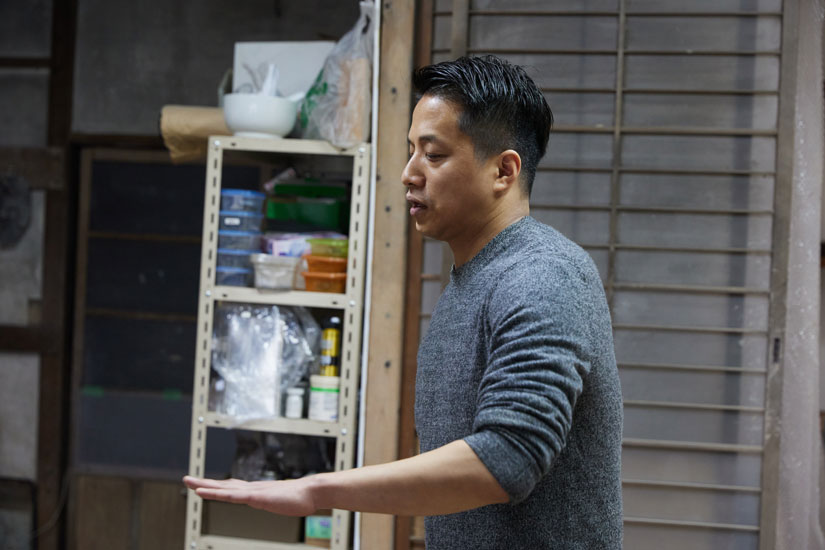
Mr. Onozawa was born in Tokyo. His father collected pottery, so he was exposed to ceramic art from a young age. He also enjoyed playing with clay and drawing as a child, and tried pottery-making during his student years.
He says he always had the profession of “potter” in mind. Upon entering university and beginning to seriously consider his future career, his desire to “become a potter” grew stronger. Resolving that “if I’m going to work, I should strive at something I love,” he studied ceramic techniques and knowledge at the Tajimi City Ceramic Design Institute in Gifu Prefecture after graduating.
After graduation, he continued making pottery while working part-time for about two years. Then, introduced by an acquaintance, he moved and opened his kiln in the Bato district of Nakagawa Town, located about an hour’s drive north of Mashiko.
Mr. Onozawa’s work is not “Mashiko ware” to begin with. At the time, he was looking for “a place within the Kanto region with low rent,” and it just so happened that a property in the Bato area became available.
However, living in this land became the catalyst for his current artistic style.
Tout ai Shikki (Lacquerware on a Ceramic Base)
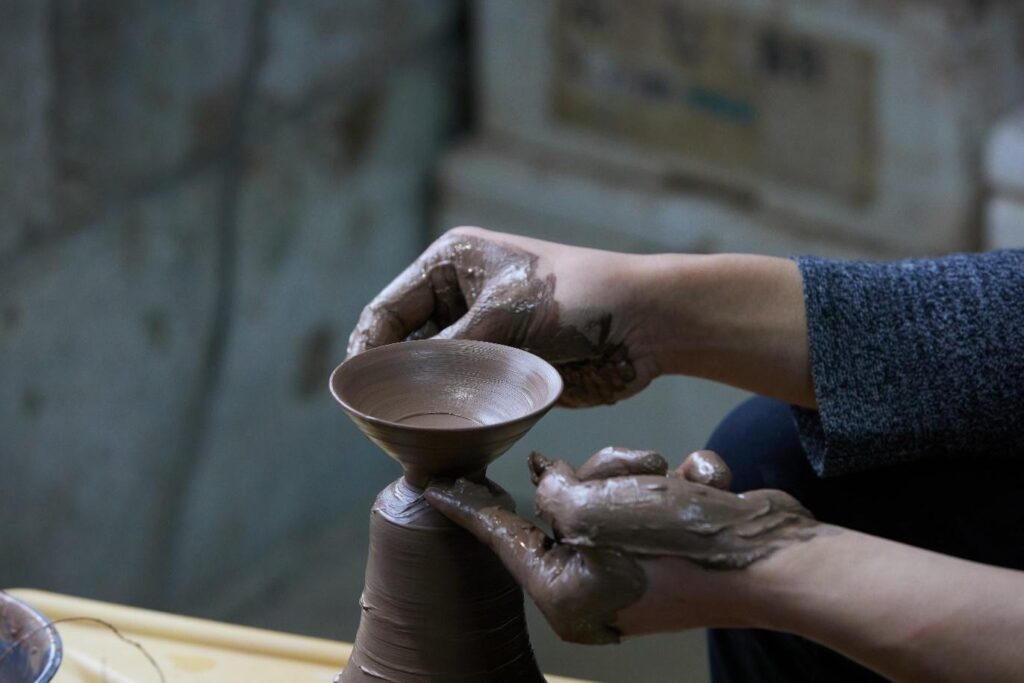
Initially, Mr. Onozawa’s work centered on “yakishime” (high-temperature firing without glaze). Now, he primarily creates pieces using the “tōtai shikki” technique, where lacquer is applied after the yakishime firing.
Adjacent to Nakagawa Town, where he lived at the time, was Daigo Town in Ibaraki Prefecture. Daigo Town is a renowned production area for lacquer known as “Daigo Urushi.” Ibaraki Prefecture is Japan’s second-largest producer of domestic lacquer after Iwate Prefecture. Most of the lacquer produced in Ibaraki comes from Daigo Town and is used in high-end lacquerware like Wajima-nuri.
By chance, Mr. Onozawa found himself surrounded by lacquer. His interest piqued, he researched and learned that the technique of applying lacquer to pottery existed since the Jomon period. This led him to try it himself, which became the root of his current style.
In 2020, he found an empty workshop in Mashiko, more accessible to Tokyo, and the couple moved there in 2021. There, alongside his wife Noriko, a Japanese-style painter, they each pursue their creative work.
Drawn to History and Antiquity
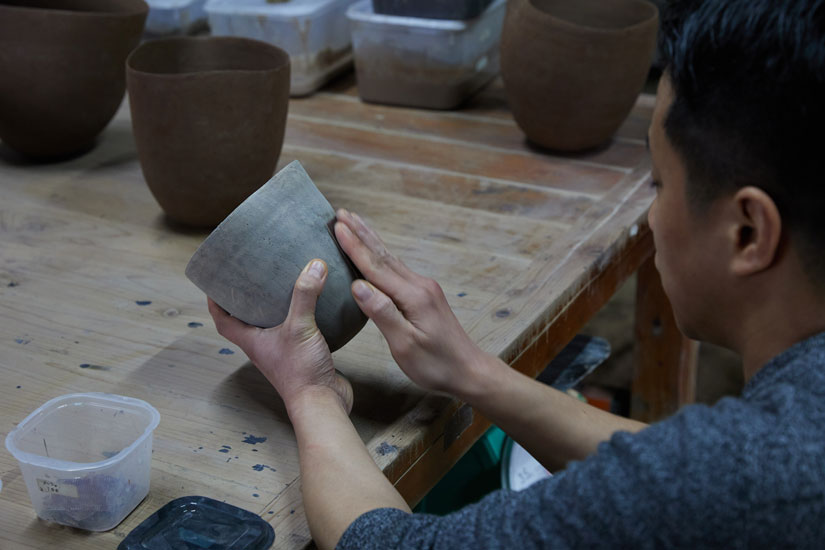
Mr. Onozawa’s work involves not only lacquer but also pieces where lacquer is applied together with tin powder. “It’s easier to understand if I call it ‘ceramic-based lacquerware,’ so I use that term, but I’m not particularly fixated on that classification.”
Mr. Onozawa says he loves history and is drawn to old things. He particularly likes “Yayoi pottery.” The shapes created by ancient people through scraping and polishing feel both soft and sharp, and he wants to incorporate this into his own work. “I’m moved when I see the fingerprints of the people who made it back then. With old things, I feel like I can hear the breath of the people from that time.”
Aiming for a Fusion of Primitive and Modern
His work begins at the potter’s wheel. He rarely sketches beforehand, preferring to think as he creates. His goal is to fuse the “modern sharpness” achieved on the wheel with the “primitive, freehand softness” reminiscent of earthenware.
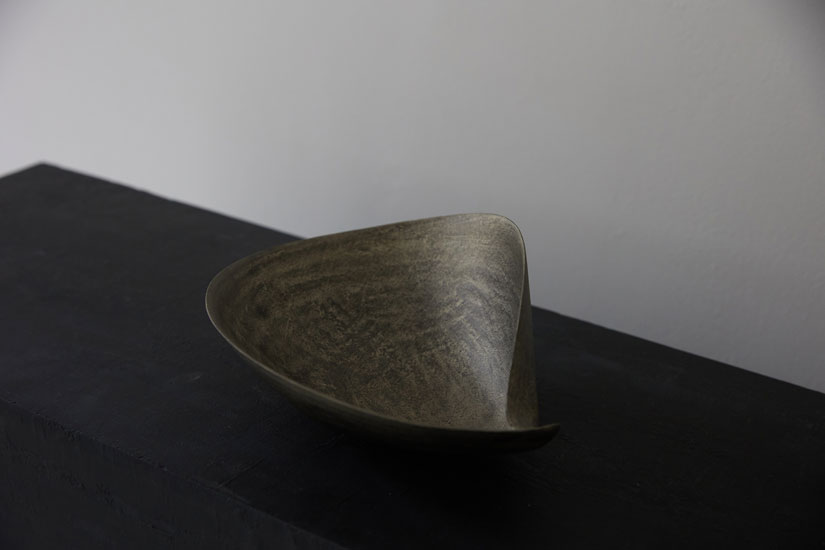
Even when throwing on the wheel, he avoids perfect symmetry. While tableware is typically symmetrical and “distortion-free,” Onozawa deliberately introduces distortion. He also ensures no two vessels have identical distortions, consciously creating unique pieces.Furthermore, he applies ancient techniques to the surface, such as “brush adjustment”—where joints made with wooden boards or sticks during Yayoi pottery production are smoothed or subtly reshaped—and “smoothing adjustment”—erasing the lines created by brush adjustment. This results in a matte finish retaining the handcrafted character of brush marks and color variations.From there, four types of clay in five layers are applied and dried repeatedly, followed by lacquer coating. Finally, the surface is polished with a file to express even greater gradations and diverse textures.
Though an extremely labor-intensive and time-consuming process, it is precisely this layering of techniques—adding the unique texture achievable only by human hands to the “modern sharpness” of forms created using a machine lathe—that is essential for realizing the fusion of “modernity and primitivism” envisioned by Mr. Onozawa.
Mr. Onozawa describes his creative process as “working with a sense of encapsulating the passage of time.”
Indeed, numerous techniques exist to replicate aged objects. Theme parks, familiar to many, often feature artificially created ruins, artifacts, and weathered rock surfaces to evoke their world. While these modern, technologically advanced creations are impressive, they remain imitations that merely mimic the real thing.
“To simply achieve the texture of aged pottery, there are techniques like layering glaze to create mottled effects or revealing the base clay,” says Mr. Onozawa. Yet for him, the result is merely “superficial antiquity.”Instead, what is expressed “now” through Mr. Onizawa’s world is born from a deep respect for time-honored ceramics and techniques. The resulting texture feels as if it has truly weathered the years, yet it retains a modern beauty, free from mere antiquity. This unique expression, achievable only by Mr. Onizawa, is truly one of a kind.
Encounters with the history of people and places. The footsteps of predecessors become his “master.”
Mr. Onozawa has walked his own path, never formally apprenticed to any specific person.
“When I was in Gifu, I felt the depth of Mino’s history. When I was in Bato, I encountered Koisa-yaki pottery, older than Mashiko ware, and the people who work with it. I don’t have a specific ‘master,’ but I’ve learned to feel what the predecessors did by seeing, hearing, and experiencing these things firsthand.”
Mr. Onozawa speaks of his love for history and pottery. His words convey not just a simple “liking,” but a profound respect for the paths of those who came before and for history itself.
“Actually living in Mashiko allowed me to learn history even locals didn’t know. I love discovering that this land was shaped by diverse histories, and that affection fuels my motivation to create works here.”
“I want to discover the essential nature felt through the potter’s wheel.”
Expanding his activities from solo exhibitions and workshops in Japan to overseas, Mr. Onozawa says, “Now that I’m 40, while I still have the physical strength, I’d like to try making large pieces by hand-building.”
He also enjoys contemplating the background stories behind sculptures like Rodin’s human figures, stating, “I want to do work that involves observing subjects.” Onozawa explains, “Electric pottery wheels have a certain regularity, and there’s beauty within that. I want to create works by hand while observing the objects made on that wheel.”
One can’t help but wonder if this isn’t redundant work, but that is precisely the “work that involves observing the subject” Onozawa wants to do.”By thoroughly ‘observing’ the object first made on the wheel, and then engaging with it to sense something within myself, I believe I can uncover the essential beauty inherent in the wheel,” he says. While highly intuitive, one cannot help but feel that this delicate, beautiful sensibility and thought process is the very source of his style, which bridges the present and the past.
Everything he has seen with his own eyes and felt—every new learning and discovery—has been sublimated into his work. Undoubtedly, he will continue to evolve relentlessly, much like the history of humankind.