

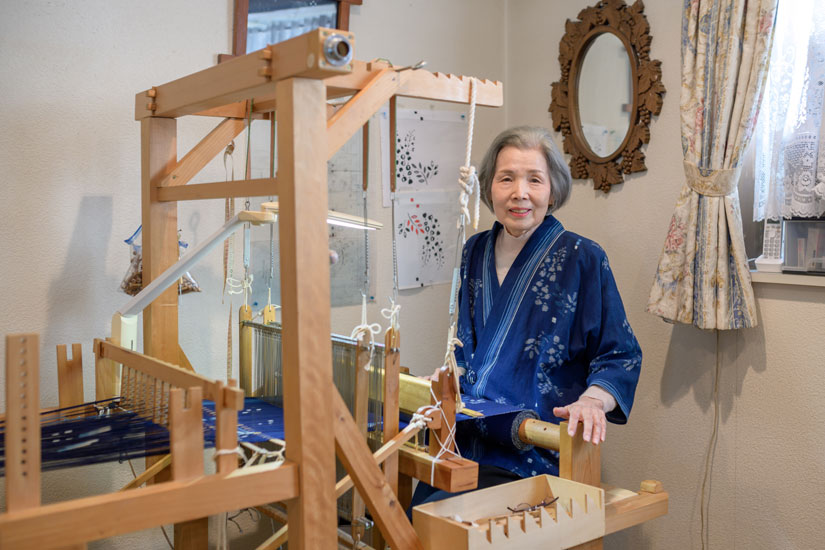
Iyogassuri, one of Japan’s three great kasuri weaves and a traditional craft of Ehime. Kuniko Murakami, an Iyogassuri artist who began weaving around age 54. Her challenge to participate in traditional craft exhibitions and her approach to Iyogassuri truly embody the philosophy that “to live is to weave.”
Weaving and Iyogassuri: A Meeting in Her 50s
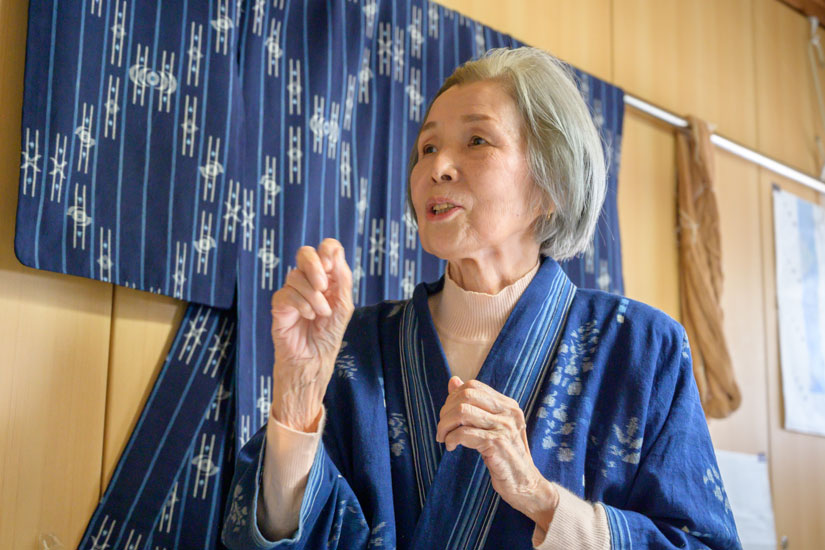
Born in 1948, Ms. Murakami works as an Iyo Gasuri artist. Surprisingly, she only began weaving after turning 50. She had long worked as an art flower instructor, but wrist injuries made creating pieces difficult, leading her to leave that path. She then distanced herself from “teaching others” and began searching for a new form of expression she could genuinely enjoy herself.
While trying new crafts like pottery and woodcarving, weaving captivated her most. “As a child, there was a kasuri factory along my school route. They worked right there on the embankment along the Ishite River, stretching threads.” That scene became a primal landscape within her.Memories of secretly watching the indigo-dyed thread weavers at work, and the childlike sense of wonder it sparked, stirred something deep within him years later. Fortunately, the motions of weaving suited his impaired hand movements, making it a craft he could continue. He enrolled in the dyeing and weaving classes at Iori Kogei, led by contemporary Iyo Kasuri artist Nobutoshi Shirakata, studying there for five years.
The charm of kasuri, born from time and effort
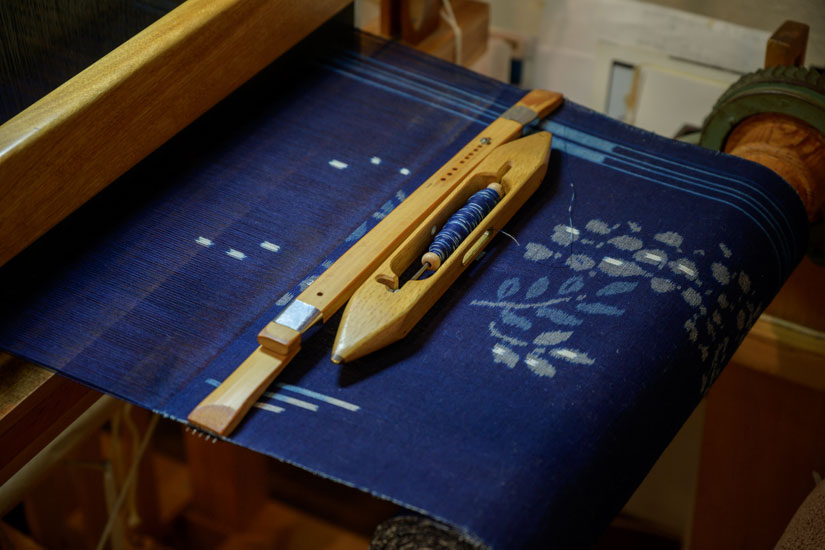
In the Iyo region, including Matsuyama, cotton was once cultivated. Within this culture where cotton was woven into daily life, “Iyo Gasuri” developed.
Kasuri is a woven fabric characterized by a blurred, faint appearance along the outlines of its woven patterns. This is achieved by partially tying off warp or weft threads to create areas that resist dye absorption, then applying indigo dye. The resulting contrast between white and indigo creates the unique, beautiful texture characteristic of kasuri.Iyo Kasuri is counted among the “Three Great Kasuri of Japan,” alongside Kurume Kasuri (Fukuoka Prefecture) and Bingo Kasuri (Hiroshima Prefecture). However, it is noted for its composition centered around the “Yokokasuri” pattern, where the kasuri threads are used primarily on the weft threads.
”When setting up 17 meters of thread per bolt, the weft threads alone can require tying over 1,000 points,” explains Mr. Murakami. Consequently, while tying the warp threads takes about a month, tying the weft threads takes two to three months, making it an extremely labor-intensive process.Horizontal kasuri allows for delicate, regular pattern expression because the design unfolds continuously in the horizontal direction. However, this requires advanced skill and considerable time. This characteristic is closely linked to Iyo kasuri’s simple, approachable design aesthetic, creating its appeal as a practical, everyday fabric.
Shaping Curiosity, Meticulously Woven
Murakami-san’s early Iyo-kasuri designs often featured floral motifs. However, as she continued creating, she began incorporating elements that moved her in daily life. As she says, “I finish each piece while gazing at it repeatedly,” her works vividly reflect her curiosity. In recent years, motifs related to Earth and space—such as the fault lines at Dogo Park and the asteroid probe Hayabusa2—have emerged as new themes.
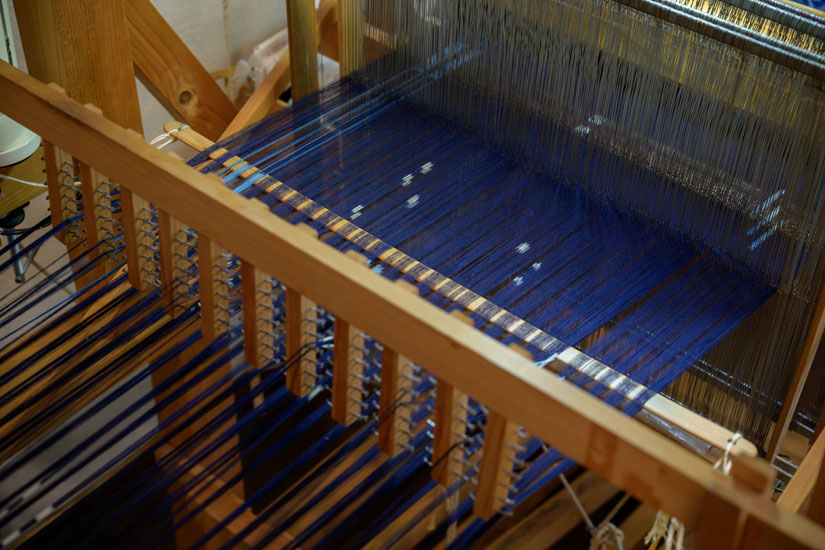
Once the design is complete, the process moves to meticulously calculating and designing the position and amount of thread ties to ensure the pattern is woven precisely. “I strive to avoid any misalignment during finishing. While some say misalignment is part of the charm of kasuri, I find it sad when something I calculated doesn’t turn out exactly as planned. I suppose that’s just my personality,” Mr. Murakami says with a smile.
The workshop is at home, where daily life breathes with handcraft
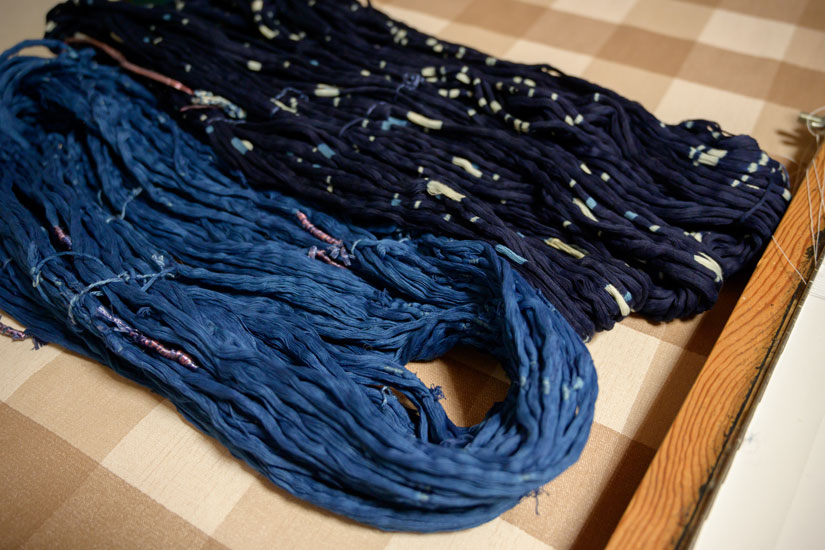
Murakami operates without a dedicated workshop, handling every step of the process alone at home. Weaving accounts for only about 20-30% of the total work; most time is spent on dyeing and preparing the threads. She conceives designs in her bedroom and dyes fabrics using fermented indigo in her garage.Maintaining the indigo in optimal condition is crucial, requiring constant monitoring of humidity, temperature, and the pH level of the dye bath to indicate its acidity or alkalinity. The dyeing process is repeated about 40 times, taking roughly a month to complete. Afterward, she takes time to unravel the yarn and shape it.
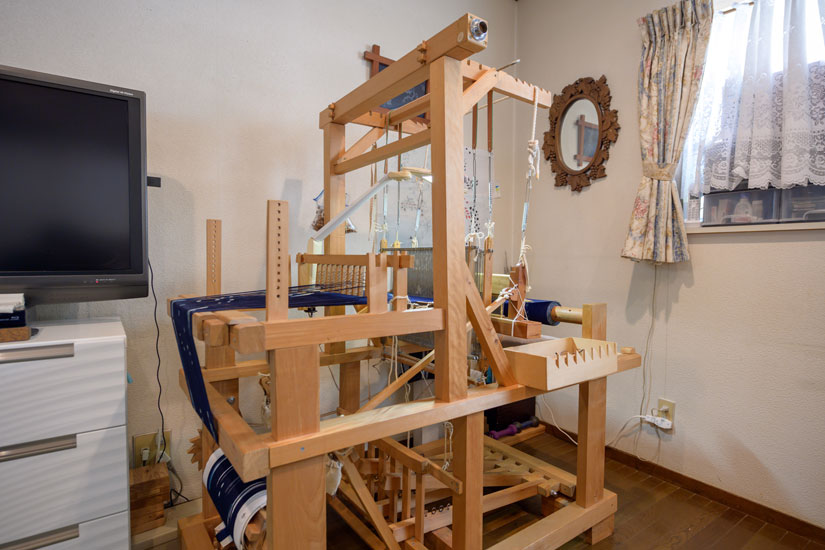
Then, weaving progresses on the loom placed in the living room. Surprisingly, this loom was handmade by the couple themselves. After closely observing a loom at the Iyo Kasuri Hall, Ms. Murakami drew the design plans, and her husband built it to fit her height.
Challenging Traditional Craft Exhibitions and Passing on Iyo Kasuri
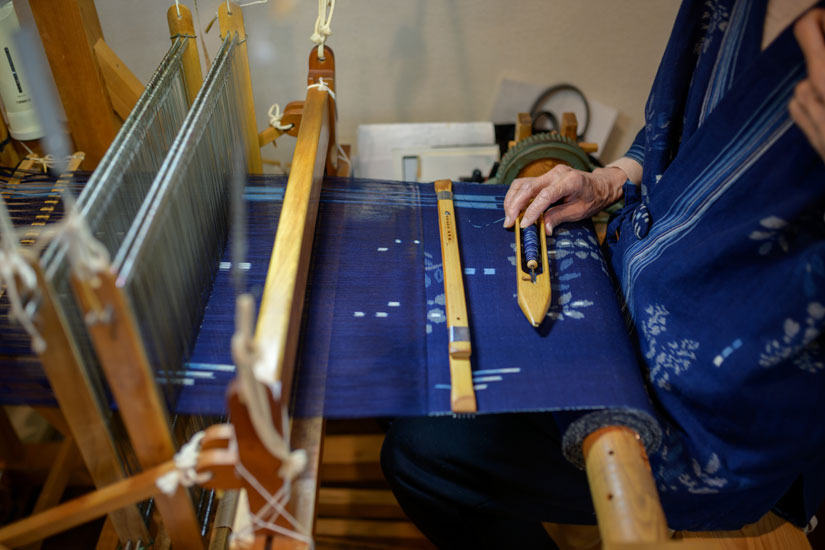
Working on multiple processes simultaneously, Ms. Murakami completes only 2 to 3 Iyo Kasuri pieces per year. She says her heart races with excitement when a piece woven over such a long time is finally finished.
In 2011, her Iyo Tsumugi woven kimono “Time of Fragrant Winds” won the Sanyo Shimbun Award at the 45th Japan Traditional Crafts Dyeing and Weaving Exhibition. Since then, she has actively exhibited her completed works at dyeing exhibitions and the Japan Traditional Crafts Exhibition. Challenging the Japan Traditional Crafts Exhibition, which tours nationwide, is a valuable opportunity to spread awareness of Iyo Kasuri. Continuing to take on these challenges is what connects to its preservation.
In 2021, she was certified as a full member of the Japan Craft Association. In 2025, Iyo Kasuri was designated as an Intangible Cultural Property of Ehime Prefecture, and Ms. Murakami was recognized as a holder of this technique. She will continue to engage in her craft while promoting Iyo Kasuri as a cultural asset.
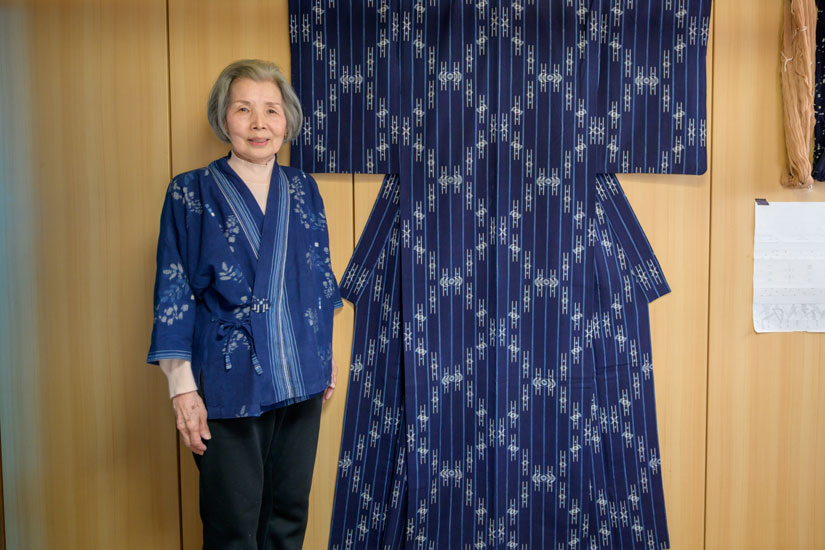
“Housewives work on it between kitchen chores and cleaning,” Mr. Murakami says calmly. “Alone, bit by bit, enjoying it. It’s a blessing to have something to pour myself into at this age.”
Starting in her 50s, she arrived at Iyo Kasuri while seeking “something she could truly enjoy.” For Ms. Murakami, the process of engaging with thread in daily life and gradually completing her work is life itself. “How many fine pieces I can leave behind is also a challenge,” she says. Her words reveal a steadfast spirit of inquiry and a clear determination to carry the inherited skills of traditional craftsmanship forward into the future.
