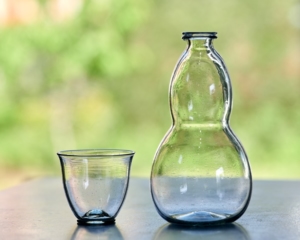

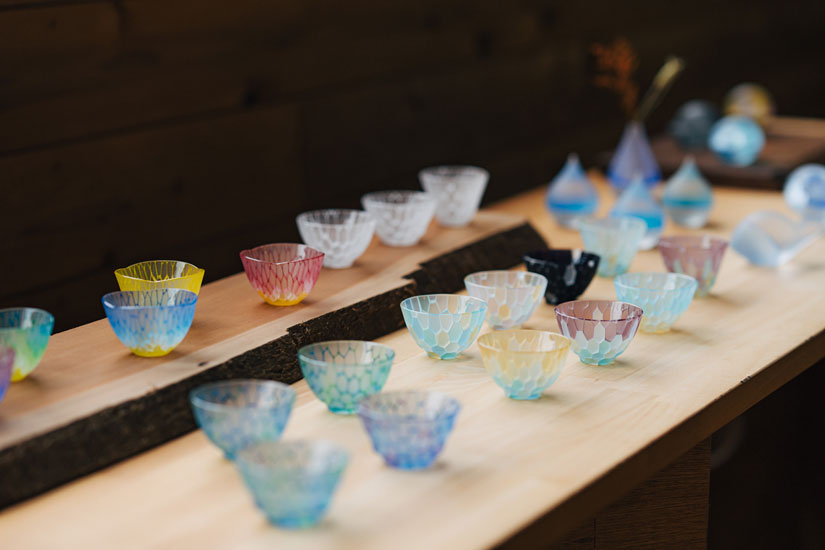
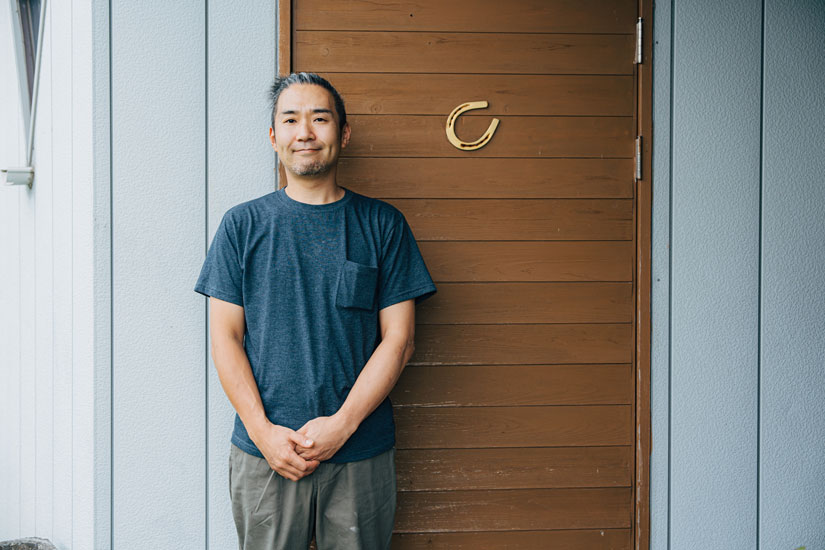
The Aokigahara Forest, formed when lava flows from Mount Fuji’s eruption about 1,200 years ago cooled and solidified, overgrown with trees.At the workshop “Maro” in Fujikawaguchiko Town, Yamanashi Prefecture, nestled at the foot of Mount Fuji amidst expansive primeval forests, delicate glass works crafted through meticulous carving are displayed. The patterned and richly colored glass brings a soft light that blends into the lives of those who hold it.
Each piece is meticulously crafted over time.
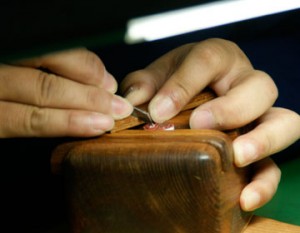
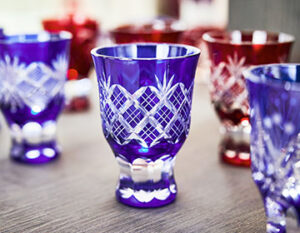
The works of glass artist Ichichō Matsuo showcase delicate details and textures created using a technique called “cold work.”Cold work is a technique applied to chilled glass without heat, involving polishing, decoration, and carving. Edo Kiriko, where patterns are applied by cutting the glass, is one such example. The glass surface is finished with a matte, frosted texture by removing its shine through “sandblasting,” a technique that blasts sand-like abrasives onto the surface.Expressions vary by piece: some blend seamlessly to highlight the smooth, gritty feel of frosted glass, while others feature carved marks like sculptures. While coldwork is primarily a finishing technique, Matsuo’s distinctive “extra touch” is also evident in the processes leading up to this stage.
The expressive potential of glass’s unique properties
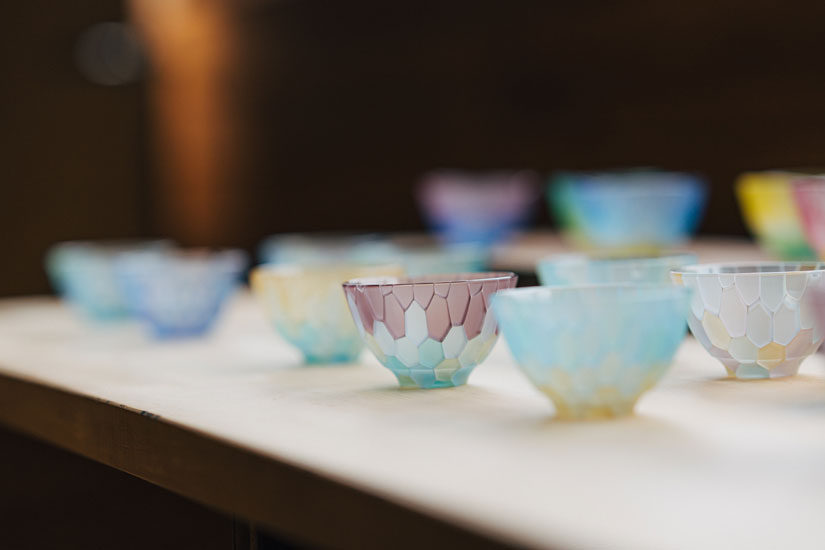
Matsuo’s works vary widely, including “guinomi” (sake cups), “shuhai” (sake bowls), and “futamono” (lidded containers). In these pieces, colored lines or floral-like patterns are created by inserting heated, rod-shaped colored glass into transparent glass and fusing them together. The colored glass rods can be straight or spiral-shaped, and when fused with the transparent glass, they create patterns that seem to float within it.
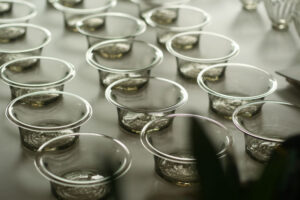
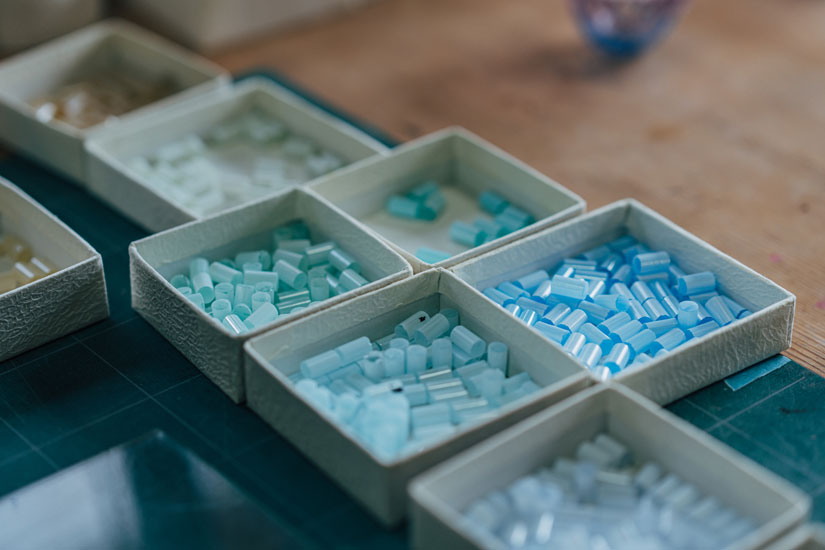
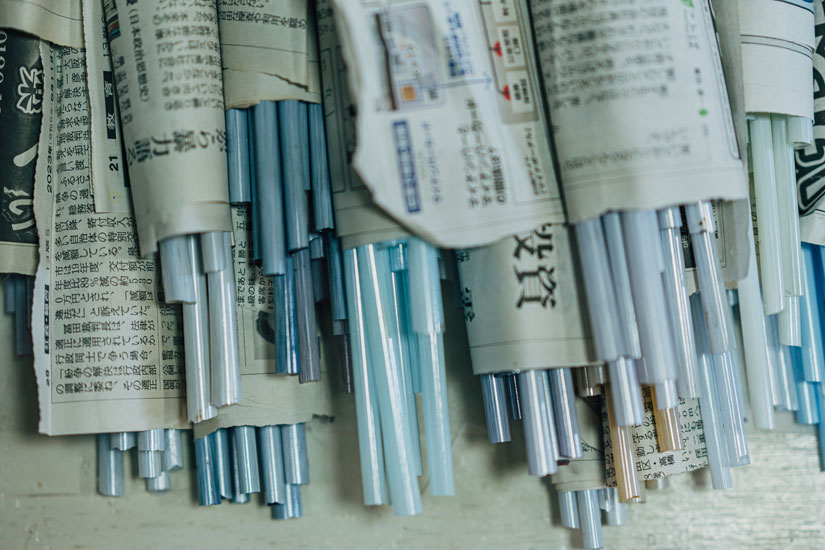
In contrast, for the “Honeycomb Pattern” series, white glass powder is applied to the colored rods during preparation to create a distinct boundary and sharp pattern against the clear glass. The term “honeycomb” refers to the hexagonal structure formed by the glass rods pushing against each other as they fuse, resulting in beautifully aligned hexagons.To create perfect hexagons, Matsuo meticulously selects materials by measuring rod thickness beforehand. He then arranges cross-sectioned rod pieces in a regular pattern, melting and solidifying them into a sheet in an electric furnace. Matsuo handles nearly every step himself, from component creation to final finishing.His meticulously crafted pieces, characterized by their texture, color, and transparency, have garnered a loyal following. His work was featured in the 2023 Tokyo glass exhibition “Containers of Light,” drawing large crowds daily.
Discovering the Feel of Glass
Matsuo first became interested in glass craft 31 years ago. Encouraged by his parents, he left his hometown of Fujikawaguchiko Town in Yamanashi Prefecture to attend a private middle-high school in Saitama Prefecture. It was there, in the school’s glass craft club, that he encountered glasswork for the first time, setting him on his current path.When he first touched glass, Matsuo recalls, “I found each change fascinating—how it melted, stretched, and curved.” He melted glass using a burner in the science lab and explored pattern-making techniques by studying books. Immersed in these fulfilling activities with his clubmates, his world was suddenly shattered when his father passed away unexpectedly during his second year of high school.
He realized he would have to make his own way from then on. He agonized over his future and what path to take after graduation. “I loved glass, and I was happy when people enjoyed the things I made,” he says, explaining his decision to pursue glass craftsmanship. Aiming to enter an art university, he spent the year after high school graduation studying drawing at a preparatory school.
Lacquer: What I Learned in College
Even while studying drawing, his passion for glass only grew. He reflected, “I was so absorbed in glass that I hadn’t paid attention to other materials.” To gain a deeper understanding of different materials first and broaden his perspective on glass craft, he deliberately applied to Kanazawa College of Art and Crafts in Ishikawa Prefecture, which didn’t have a dedicated glass department. There, Matsuo majored in the Lacquer Course within the Crafts Department.
“I sensed a similarity to glass in the ‘luster’ produced by lacquer.” Ishikawa Prefecture, home to traditional crafts like Wajima lacquerware and Yamanaka lacquerware, provided an ideal environment for studying lacquer. He visited local artisans actively working in the field and became increasingly captivated by the material’s charm.
Through studying lacquer art, he came to see lacquer as “an ‘outer material’ that decorates the surface of a work,” while glass, with its translucent nature, is “an ‘inner material’ where the view inside also becomes part of the expression.” This led him to wonder, “Couldn’t I expand expressive possibilities by utilizing glass’s color, form, and transparency, while also exploring texture and decoration?” This question became the thread leading to his current artistic style.Matsuo also notes, “I was never good at detailed work.” However, his experience with lacquer art—which demands meticulous, delicate handwork—proved invaluable for his later glass craft, especially since most glass processes rely on machinery. “By sincerely engaging with lacquer, I acquired skills without even realizing it,” he reflects on that time.
Techniques Learned in the “Glass Town”
After graduating university, he enrolled at the Toyama Glass Art Institute. For the first two years, he studied the three pillars of glass techniques in the Sculpture Department: “hot work” (techniques like glassblowing that involve melting and shaping with heat), “kiln work” (casting techniques using electric furnaces), and the aforementioned “cold work.”During the subsequent two years, while re-examining his direction as a glass artist, he felt “the sensation of glass changing form as I carved it with my hands was akin to sculpture.” His father, who worked as a woodcarver, significantly influenced this perspective.Having grown up surrounded by wood as a material, he consciously adopted cold work glass processing—where unique patterns emerge through carving, much like how patterns appear on carved wood surfaces—as his signature style.
With the goal of becoming a full-time glass artisan, he held his first solo exhibition, “Glass Treasures,” in 2006 while still a student.After graduating, he continued creating glass works while working part-time in Toyama. From 2010, he served as a teaching assistant in the Glass Course of the Craft and Fine Arts Department at Kobe Design University. During this time, he honed his skills while seeking specific advice from artist acquaintances on critiquing his work and monetization methods. In 2014, he established his studio “Maro” in his hometown of Yamanashi.
The Joy of “Shaping”
Matsuo’s works combine multiple glass craft techniques. He begins by creating parts through hot work, then uses kiln work to form the base shapes for vessels and other pieces, finally finishing the work through cold work. Generally, in techniques like glassblowing, the accidental beauty created by the artisan’s breath is valued, so few artists, like Matsuo, actively seek to intervene and refine the work.”As I continued making glass, I came to realize that ‘taking the time to ultimately complete the work in my own hands’ is the style I should value.”
While the accidental qualities of hot-work and kiln-work pieces hold their own appeal, the real fascination of carving lies in “being able to transform the shape with my own hands while expanding my vision.” Carving changes the expression, giving birth to unexpected new forms of expression. Gazing at his carefully crafted pieces, Matsuo smiles innocently, saying, “I enjoy the time spent carving.”
“I want people to store their precious things inside” – the wish embedded in his lidded vessels
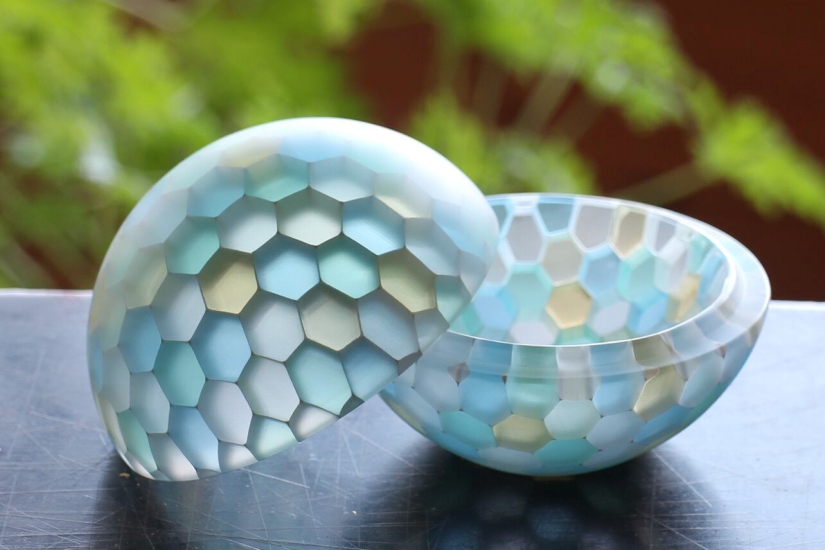
Matsuo’s signature series is the “Lidded Vessels,” where soft light pools within the glass and color seeps through its transparency. This series, packed with the unique charm of glass, is named “Tamabako” (literally “jewel box”), using the word “tama” (jewel) to signify something beautiful and precious. Placed near a window or in sunlight, a gentle, soft light emerges from within.
“I feel there’s a connection between light gathering inside the glass and storing something within the lidded container. People often ask what they should put inside. I tell them, ‘Please place whatever small, precious things you hold dear,’ like an anniversary ring or an acorn a child brought home.”
She recalls a customer who once purchased one as a container for keeping ashes close by. This reminded her of her student days when creating such pieces was a theme—to make something that would make someone want to place their late father’s ashes inside. She felt a connection. “What’s ‘precious’ varies for each person, but I’d be happy if, when they glance at the lidded container I made, it helps them recall some cherished feeling.”
Finding my own voice, bit by bit
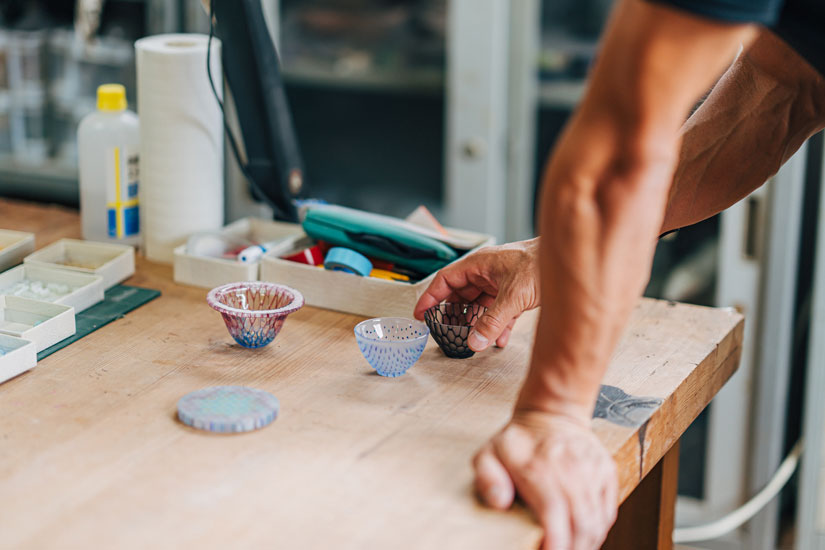
After returning to Yamanashi and establishing her studio, Matsuo describes her days as “a constant cycle of trial and error” in an environment where she had no teacher. Gradually, she refined her own style of work—pieces that blend practical usability as vessels with the beauty of craft—while incorporating feedback from those around her.
“Being alone made me realize things I’d unconsciously absorbed in my privileged environment and how I’d been trapped by preconceived notions. There were failures, but as I rethought my style, I steadily discovered what I truly wanted to do.”
There were times when poor health hindered her progress, but her resolve remained unchanged: “I want to create what I believe is good without compromise.” To adjust her pace, she reduced the frequency of her solo exhibitions, which she had held multiple times a year. In 2022, she launched a new online shop. While maintaining her own well-being and producing satisfying work, she is also exploring ways to monetize her craft using the power of the internet.Matsuo’s journey continues, driven by the goal of “sustaining this as something I love, as work, for the long term.”
I want people to discover the charm of glass
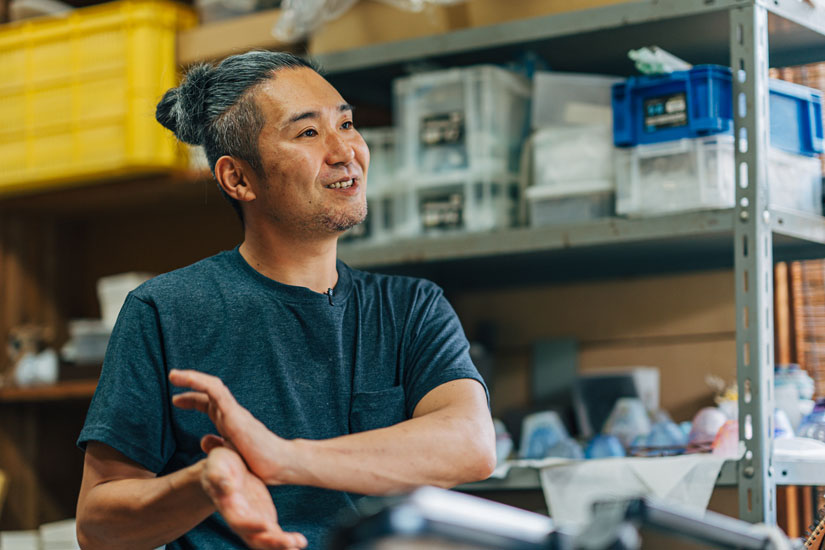
As a glass artist, Matsuo shares, “I want many people to discover the charm of glass through the pieces I create.” Speaking calmly about the “extra effort” that comes from years of accumulated experience, she says, “I know it seems wasteful, but the steady work and that extra effort are what make it ‘me.'” Holding a polished lidded vessel, her smile as she said, “I’d be happy if my creations could become part of someone else’s life going forward,” was truly memorable.