
Shizuoka City, located in central Shizuoka Prefecture, is blessed with a commercial sphere along the Tōkaidō route connecting Japan’s major cities: Tokyo, Nagoya, and Osaka. While this city is famously known as a mecca for plastic models and scale models, home to Tamiya Co., Ltd., one of the world’s leading comprehensive model manufacturers, its other facet as a longstanding “hub of traditional crafts” is surprisingly less known.
Suruga lacquerware, Suruga maki-e, and Suruga woodturning are designated as prefectural folk crafts, while Suruga bamboo filigree, Suruga hina ornaments, and Suruga hina dolls are designated as national traditional crafts.The development of such diverse crafts in this region stems from the presence of Lord Tokugawa Ieyasu and a specialized division of labor network cultivated over many years. Standing on this foundation of tradition, a workshop has proposed a new type of hina doll, “Kioku Hitoe,” designed to fit the modern family structure, attracting attention nationwide. This is “Ningyo Kobo Sakyo,” a doll workshop with over 100 years of history since its founding.
From “Play” to “Display”: The Roots of Hina Dolls
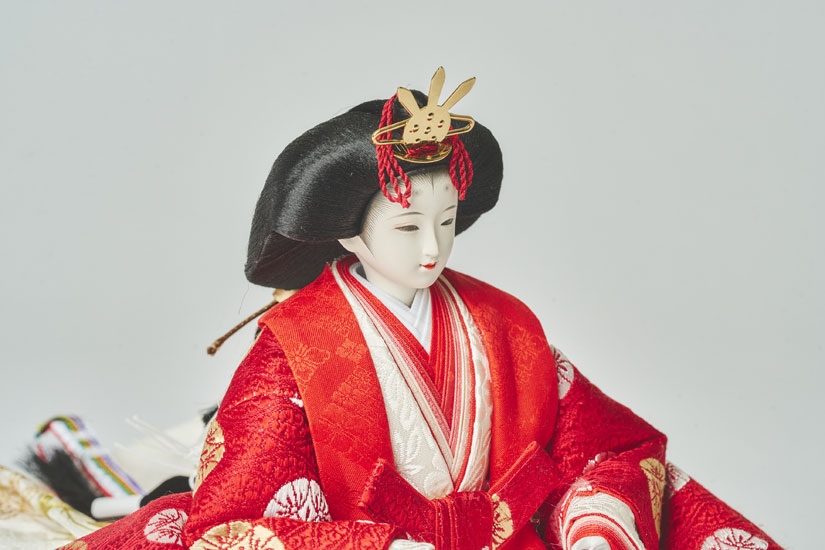
While there are various theories about the origins of hina dolls, one traces back to the Heian period and the “Hina-asobi” (doll play) enjoyed by young girls in the imperial court. “Hina” means “small and lovely,” and for the children of nobility at the time, it was an everyday play similar to what we now call “pretend play.”
A dramatic shift occurred in this “everyday play” during the early Edo period. When the Edo shogunate designated March 3rd as “Joushi no Sekku” (the formal name for Hina Matsuri), an event wishing for girls’ healthy growth and happiness, it sparked a leap in doll-making techniques. The kimonos and facial features evolved into lavish and splendid forms, leading to the hina dolls we know today.
While Kyoto is often associated as the production center for these elegant dolls, Iwatsuki Ward in Saitama City, Saitama Prefecture, actually holds Japan’s top spot for doll shipment value. Shizuoka City in Shizuoka Prefecture boasts the top position as the production center for hina accessories.
Craft Culture Rooted in Sunpu, the City Beloved by the Ruler
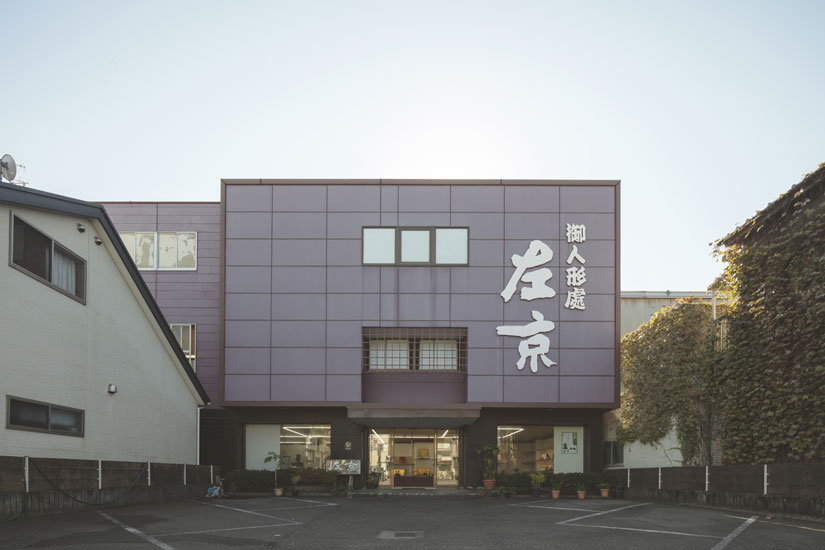
Sakyo has its workshop in Shizuoka City. The contributions of Lord Tokugawa Ieyasu to the city’s craft history are immeasurable.
In the early Edo period, when Lord Ieyasu retired to Sunpu Castle (present-day Aoi Ward, Shizuoka City), he summoned skilled artisans from across the nation—master carpenters, joiners, lacquerers, and metalworkers. These artisans settled in the castle town, and their techniques were passed down through generations, forming the foundation of Shizuoka’s crafts today.
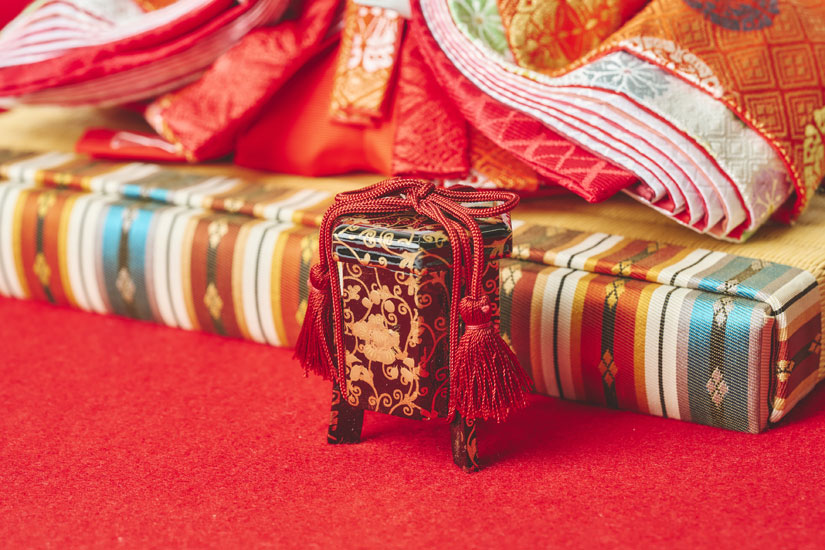
Among these, the “Suruga Hina-gu” items—such as folding screens, chests (wooden boxes for storing bridal trousseaus), and sanpo (square stands for offering items)—were overwhelmingly significant. Made using the same processes as genuine furniture and furnishings, they dominated the domestic market, accounting for about 90% of production at their peak.
Furthermore, Shizuoka Prefecture held about 70% of the national market share for producing the torso (torso handles) of hina dolls, which became the foundation for the development of “Suruga Hina Dolls” as a craft.This differs from the origins of Suruga Hina-gu. Its roots are said to lie in the “Tsuchitenjin” clay figurines depicting Sugawara no Michizane, used during seasonal festivals in Shizuoka Prefecture’s Shida District (now parts of Shimada City, Fujieda City, and Yaizu City), where Tenjin worship flourished since the Edo period. These figurines were dressed in costumes. A key feature was the costumes being divided into upper and lower parts.Unlike Kyoto-made hina dolls with one-piece costumes, this design enabled the division of labor in costume production, leading to mass production and increased output.
Since 1994 (Heisei 6), when “Suruga Hina Accessories” and “Suruga Hina Dolls” were designated as National Traditional Crafts, their status as a brand has been established. However, prior to this, the production was primarily characterized as OEM, supplying individual parts to wholesalers nationwide. Consequently, despite its significant production share, the region’s recognition as a production center was relatively low.
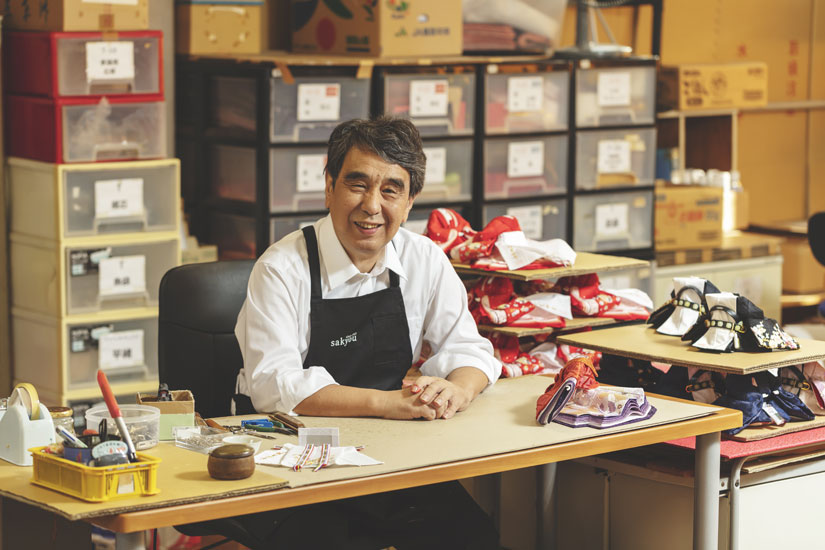
“Shizuoka had many artisans specializing in each component,” explains Kazuhito Mochizuki, the company’s third-generation chairman. “People who made the wooden bases, applied lacquer, painted maki-e designs, crafted metal fittings. Wholesalers would go around collecting these parts and assembling them into finished dolls.”
Sakyo’s roots also lie within this artisan ecosystem; its founder was a metal fittings craftsman for furniture and mikoshi portable shrines.
“Hina doll accessories include nearly 40 types of items like chests and trunks, all requiring intricate metal fittings. However, since fittings are just parts, the work could disappear depending on the wholesaler. I thought if I became the wholesaler coordinating the entire set of hina accessories, the business would stabilize. That was the start of Sakyo.”
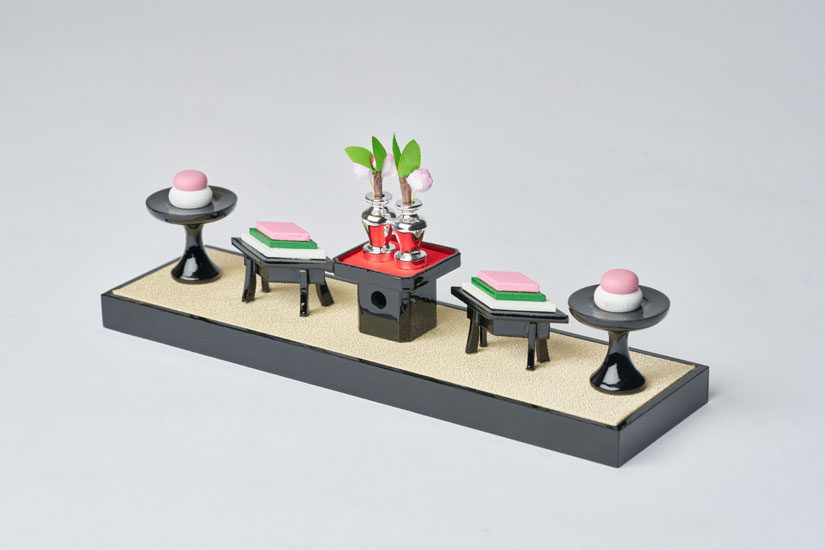
Thus, the first generation built his fortune as a wholesaler coordinating hina doll accessories with artisans in Shizuoka City. Yet, he always knew the main attraction of the hina display was the dolls themselves, and he eventually wanted to handle those too.
To that end, he first sent his son to apprentice under craftsmen in Iwatsuki City, Saitama Prefecture (now Iwatsuki Ward, Saitama City), a major production center for dolls.
That son was the father of the second-generation president, Kazuto. While learning hina doll making at his apprenticeship, the second-generation president began thinking, just as the first had intended, “Why not handle hina dolls themselves, not just the accessories?”
This was because, when the second-generation president joined the family business, the torso parts of hina dolls were typically sourced from Shizuoka Prefecture, where Tenjin dolls (festival dolls depicting Sugawara no Michizane) were thriving.The “head” (kashira), which forms the face of the doll, was typically sourced from various production areas like Iwatsuki, and the dolls were assembled into complete pieces at wholesalers in Tokyo. If they could assemble these components themselves, they could handle both the accessories and the dolls as a complete package.
For the second-generation owner, who had closely observed and learned from the first-generation’s work as a wholesaler, recognizing the demand for this was a natural progression.
However, ideas and inspiration alone don’t make a viable business. This is where the founder’s vision came into play: “Through apprenticeship, we could build relationships with hina doll artisans and with Iwatsuki, the major production center.”
“My father used connections from his apprenticeship to arrange direct purchases of doll heads from Iwatsuki artisans. That was crucial,” says Chairman Kazuto.
Thus, Sakyo became the first wholesaler in Shizuoka City to handle complete sets of hina doll displays.
The second-generation president’s distribution strategy—to bypass Tokyo wholesalers and deliver complete sets directly to Kansai retailers, thereby targeting market share in the Kansai region—proved pivotal. “Our proximity to Kansai (compared to Kanto) is definitely a geographical advantage,” he reasoned. This strategy, aligned with the era’s context, propelled Sakyo’s significant growth.
The Benefits of the Second Baby Boom
The era coincided with the onset of Japan’s high economic growth period. Fueled by the second baby boom, hina dolls flew off the shelves.
It was an era when seven-tier displays were mainstream, and amassing volume was the top priority. By wholesaling complete sets of hina decorations—which were often purchased separately—Sakyo significantly reduced the expenses and burden on retailers.
“Come year-end, wholesalers from the Osaka area would arrive in huge trucks to stock up,” recalls Chairman Kazuto, looking back on those days. “They’d stuff their belly bands with stacks of cash, all scrambling to get first dibs.”
The Era of Variety and Small Quantities: The Third Generation Pursued “The Hina Dolls He Wanted”
Later, when Chairman Kazuto took over the family business as the third generation, the period of high economic growth had settled down, and the lives of the people were about to change significantly.
Around this time, across all industries, the trend shifted from mass production to high-mix, low-volume production to meet consumer needs.
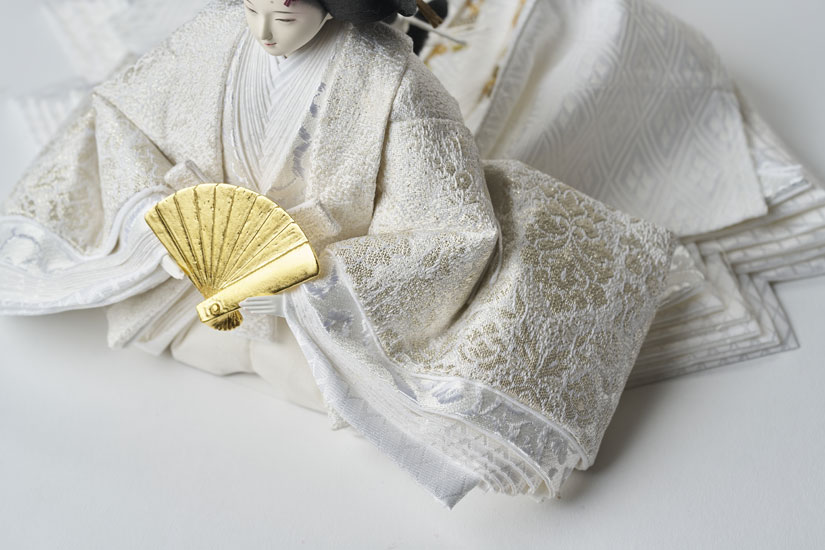
Chairman Kazuto reasoned, “Most buyers are my generation. So I should just make what I want.” He broke with convention by altering traditional color combinations for doll costumes, using materials like Shizuoka’s traditional Enshu cotton corduroy and pure white Nishijin-ori silk. He dedicated himself to developing “the hina dolls I personally desired,” unconstrained by old frameworks.
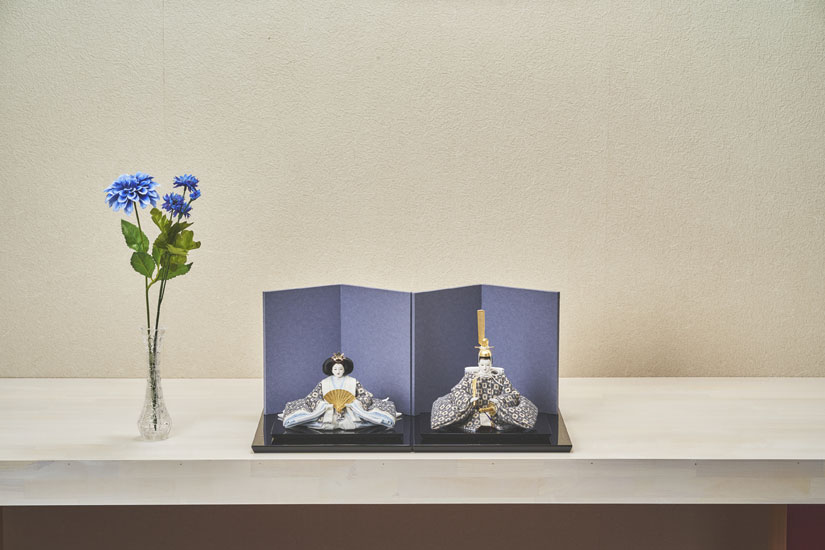
The times also saw the rise of nuclear families. Along with changes in housing conditions, the main product shifted from the lavishly decorated tiered displays (“dan-kazari”) to the simpler “prince and princess displays” (featuring only the male and female dolls). Giving the central male and female dolls distinct personalities proved successful, achieving differentiation.
However, becoming more compact meant fewer dolls and accessories per set, leading to lower unit prices.
Despite achieving differentiation, amid the increasingly pronounced decline in birthrates, there was a sense of crisis that unless more distinct branding was pursued, the business would eventually become unsustainable.
It was the fourth generation, currently serving as President and Representative Director, Takuya, the son, who dispelled the third generation’s sense of crisis.
Passing the Torch to the Next Generation: The Fourth Generation Discovers New Possibilities
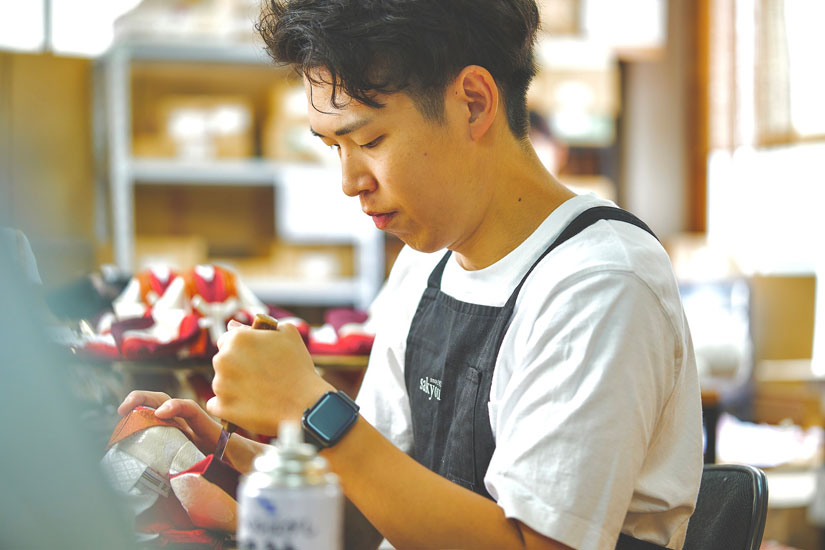
Takaya Mochizuki, the fourth-generation head, took over the family business during his sophomore year of college.
“I originally went to university with no intention of succeeding Sakyo. But when my older brother decided not to take over, the baton was passed to me in a casual way, like ‘Well, then, it’s you.'”
With the workshop and his home separated, Takuya rarely set foot in the workshop and had little understanding of the industry’s situation. Hina dolls were not a familiar presence in his life.
“I entered the field without even knowing traditional industries were in decline. All around me were companies with no successors, saying things like ‘Maybe we should close in five years.’ That’s when I first felt a sense of urgency.”
After graduating from university, he spent two years working in sales at a real estate systems company in Tokyo to gain social experience before returning to Shizuoka. What awaited him, however, was a workplace that was incomparably more analog than his previous job.
That’s when Takaya started using social media to share information. As he was practically a novice when it came to being a craftsman, his drive was to find ways to contribute to the company without spending money. His experience working in Tokyo, where he had also been involved in digital work, proved valuable.
At the time, using Instagram for business was still rare, and he gained 10,000 followers in just four months. By consistently sharing the company’s unique approach through easy-to-understand visuals, inquiries from media outlets also began to increase.
Giving shape to cherished memories: The birth of “Kikuhitoe”
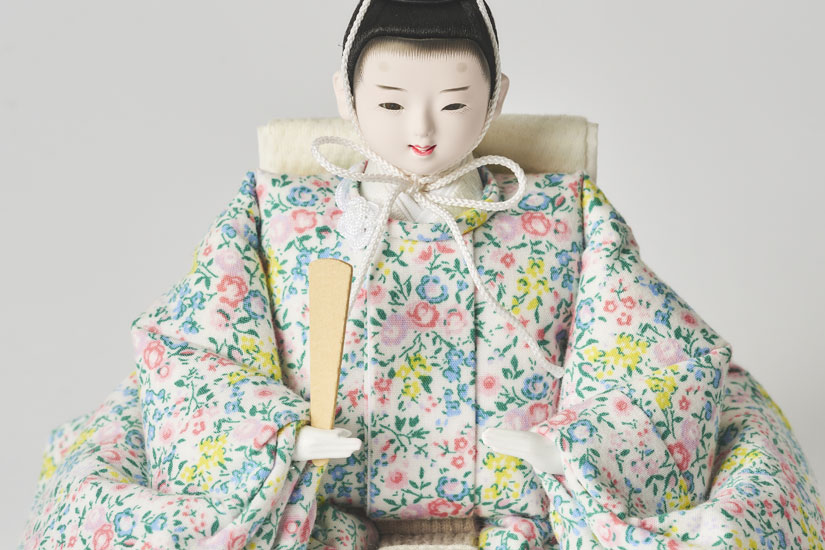
As a unique business vision for the fourth generation began to take shape, a new turning point arrived. It came from a proposal by the Creative Director at Hakuhodo’s group company, SIGNING: “Many people have sentimental attachments to children’s clothes and don’t want to throw them away, but they can’t display them either. Could we combine this problem with the concept of hina dolls?”
He himself was a father of a three-year-old, making this a challenge rooted in personal experience. Thus, after about a year and a half from the initial concept, “Kiyoku Hitoe” was born in 2024.
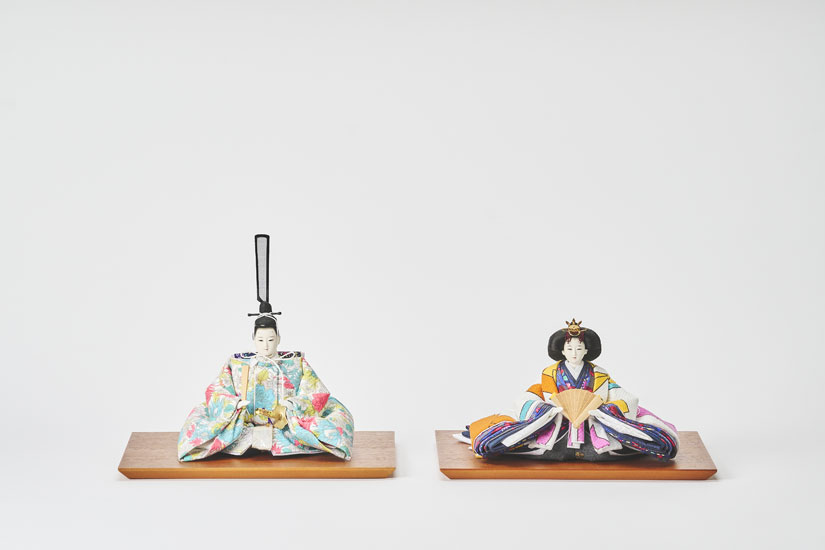
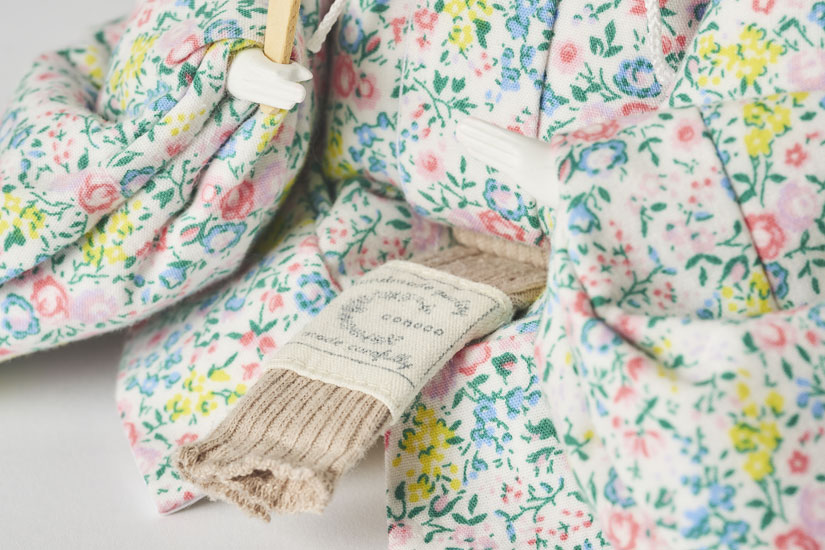
Its defining feature is transforming cherished children’s clothing into costumes for hina dolls. T-shirts, dresses, undershirts—any fabric can be used for the dolls after being reinforced with backing.
Memorable clothes are reborn as hina dolls. The stories woven into each and every one of these dolls are the very essence of “Kioku Hitoe’s” value.
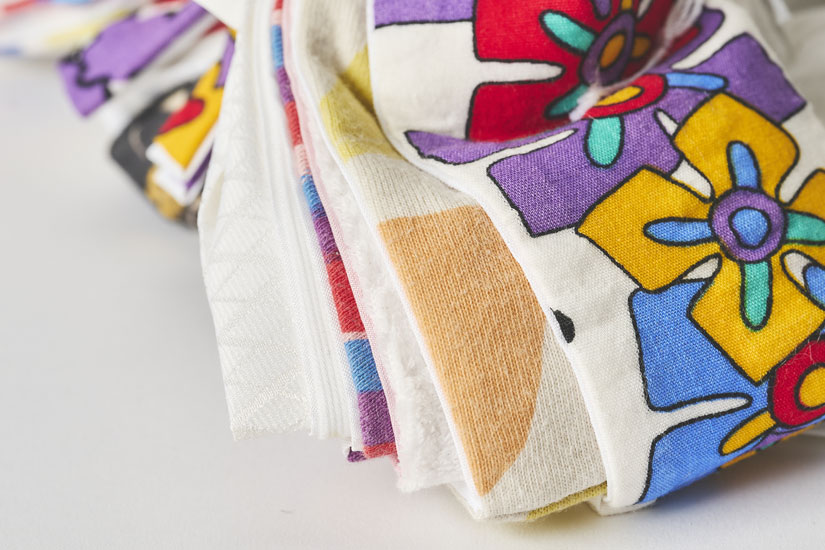
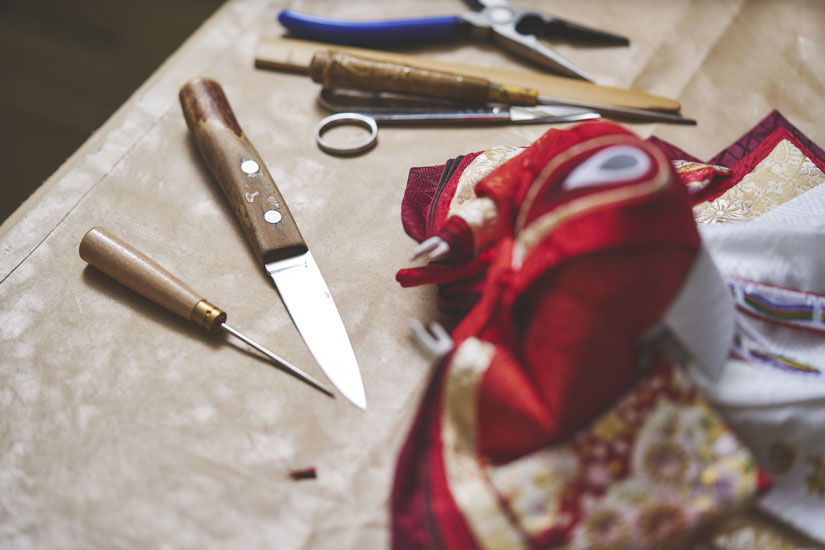
For the doll’s costume—composed of multiple layers like the outer robe (omote-ginu), underlayers, single layer (hitoe), karagoromo, and collar—we decide together with the customer which fabrics to use and where to place each pattern.
“(We) cut into items dear to the customer’s heart, reshape them, and present them anew. Since we’re entrusted with precious memories, we always proceed with the utmost care and consideration, approaching each individual’s memories with genuine thoughtfulness.”
Prices start at around ¥150,000 for a set of male and female dolls. While not inexpensive compared to market rates, it is a fair price for a one-of-a-kind custom piece. Considering the added value, it likely holds even greater worth for the customer.
Recently, they introduced a new initiative: a plan where customers can create their own “Kiyoku Hitoe” (a single-layer memory piece).
This experiential plan goes beyond online or mail-order interactions. Customers bring cherished clothing or fabric directly to the workshop and collaborate with the company’s artisans to complete the dolls on-site.
Typically, creating a Kiyoku Hitoe takes 4 to 6 months from start to delivery. However, with this plan, the entire process—from consultation to completion—takes only about half a day.
To significantly shorten the schedule, artisans who normally handle multiple tasks simultaneously prioritize the experience plan, working as a team of 4-5 people exclusively for that day. Additionally, intricate parts and sewing that are usually outsourced are handled entirely by the artisans within the workshop.
All of this stems from a desire to avoid wasting the precious time of participants who make the effort to visit the workshop in person, and to provide an immersive, moving experience.
To halt regular production and concentrate significant artisan resources on this plan, pricing is higher than standard single-layer kimonos. However, it allows real-time consultation with skilled artisans on intricate pattern placement and color balance, enabling meticulous attention to detail within a short timeframe—truly the pinnacle of custom-made products.
The experience of personally adding touches to a hina doll that weaves memories further heightens its special feeling.
Between tradition and innovation. A father pushing his son forward.
However, new challenges like “Kiyoku Hitoe” naturally attract criticism.
The Mochizuki family remains unfazed by the stinging remarks from fellow artisans.
“People who wouldn’t buy traditional hina dolls might buy ‘Kiyoku Hitoe’ because it’s different. Even if it strays a little from convention, if it sparks renewed interest in hina displays, isn’t that a good thing?”
Creating new demand is what opens the future for traditional industries. Kazuto is convinced of this regarding Takuya’s challenge. That’s why, as a parent and as a mentor, he decided to support him no matter what criticism came.
Expanding to the next generation. From celebration to everyday art.
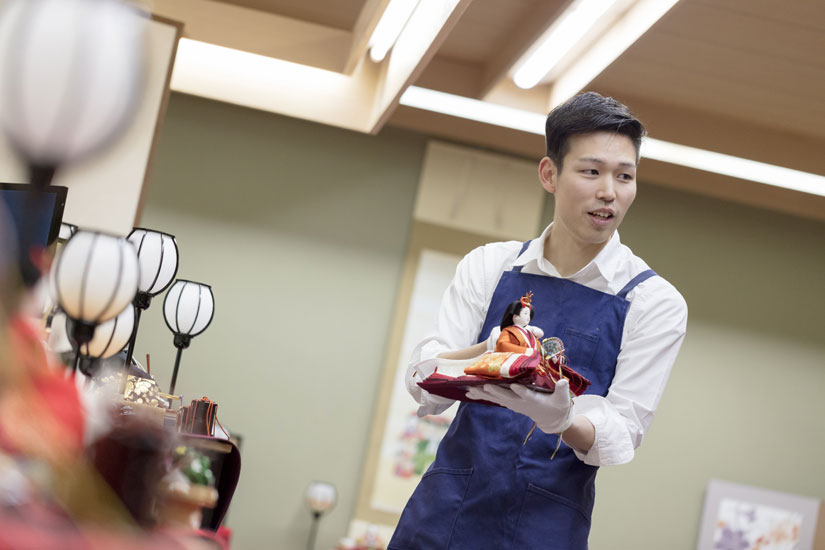
Having successfully launched “Kiyoku Hitoe,” Takaya’s next goal is to establish demand for “Hina Dolls” as “art.”
To do this, he must overcome Japan’s deep-rooted animism—the belief that all things possess souls or spirits. This unique spirituality persisted precisely because monotheistic religions never took root in Japan.
“Japanese people can’t just throw away dolls. Even when letting them go, it’s not a simple toss in the trash—they’re ritually burned at shrines or temples as a form of mourning.”
However, Takuya had heard from his predecessor that “during the Edo period, there were many stalls selling hina dolls around the hanamachi entertainment districts. People would buy a doll as a gift before going to meet their favorite performer.”
While surprised to learn there was demand beyond seasonal festivals, he also saw potential for hina dolls, considering the current boom in figures and their soaring global trading prices.
That’s precisely why Takuya wanted to elevate their cultural value beyond just being ceremonial items.
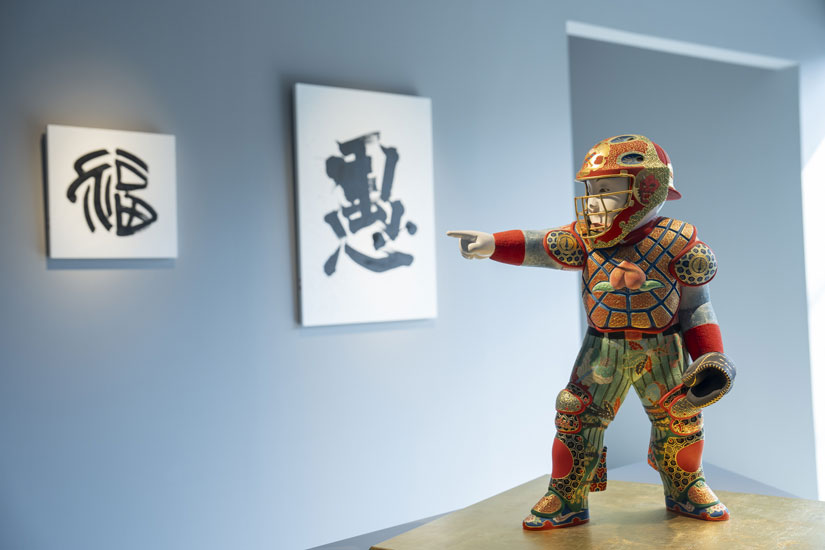
His benchmark is Hiroshi Nakamura, the fourth-generation master dollmaker at Nakamura Ningyo, a long-established Hakata doll shop in Fukuoka City, Fukuoka Prefecture. Nakamura is currently attracting global attention for his unique approach to expressing Hakata dolls through themes like sports and monsters.
“I think Mr. Nakamura’s work exemplifies this perfectly. I want to dispel the image that ‘dolls = scary’ and make them something you can display as art or interior decor. Ideally, I’d like to elevate them to the level of collectible art, like BE@RBRICK or LLADRO.”
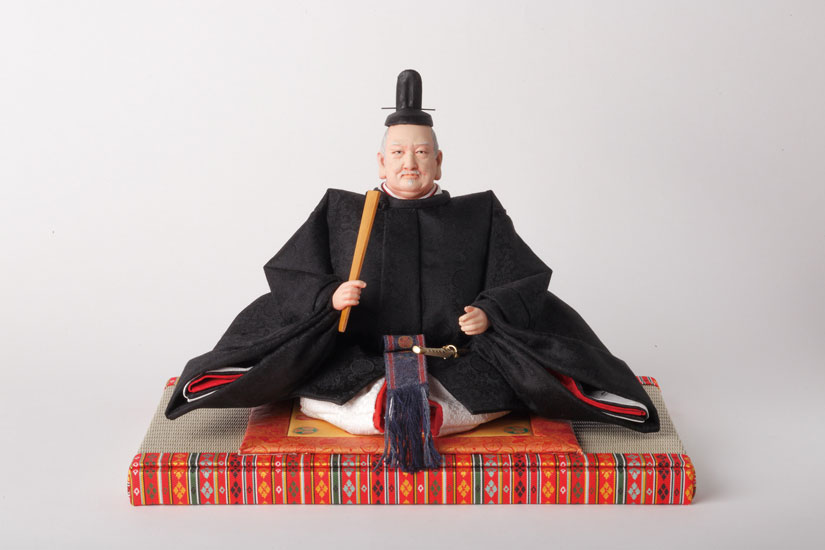
He has already begun challenges toward this goal.
For the 400th anniversary of Lord Ieyasu’s death, he commissioned Osaka University of Arts, an authority in figure production, to recreate Lord Ieyasu’s face. This led to the completion of a hina doll depicting Lord Ieyasu. He also envisions using AI-synthesized faces of parents, instead of commercially available heads, to create 3D-printed dolls representing future children.
In this way, Sakyo preserves the tradition and essence of hina dolls while flexibly incorporating the trends of the times and technological advances. In the artisan town nurtured by Tokugawa Ieyasu, they have pursued innovation suited to each era for over 100 years. From parts to wholesalers, from wholesalers to manufacturing and distribution, and now to personalization.
“Hina dolls have yet to break free from their role as tools for staging Japan’s traditional celebrations. While enhancing their inherent value is important, their appeal will grow even more by presenting them as art to the world and creating pieces that earn ‘likes’ from people overseas.” Takaya’s words carried a strong determination to forge new value.